Search results for: “jet”

  • Featured Video Play Icon

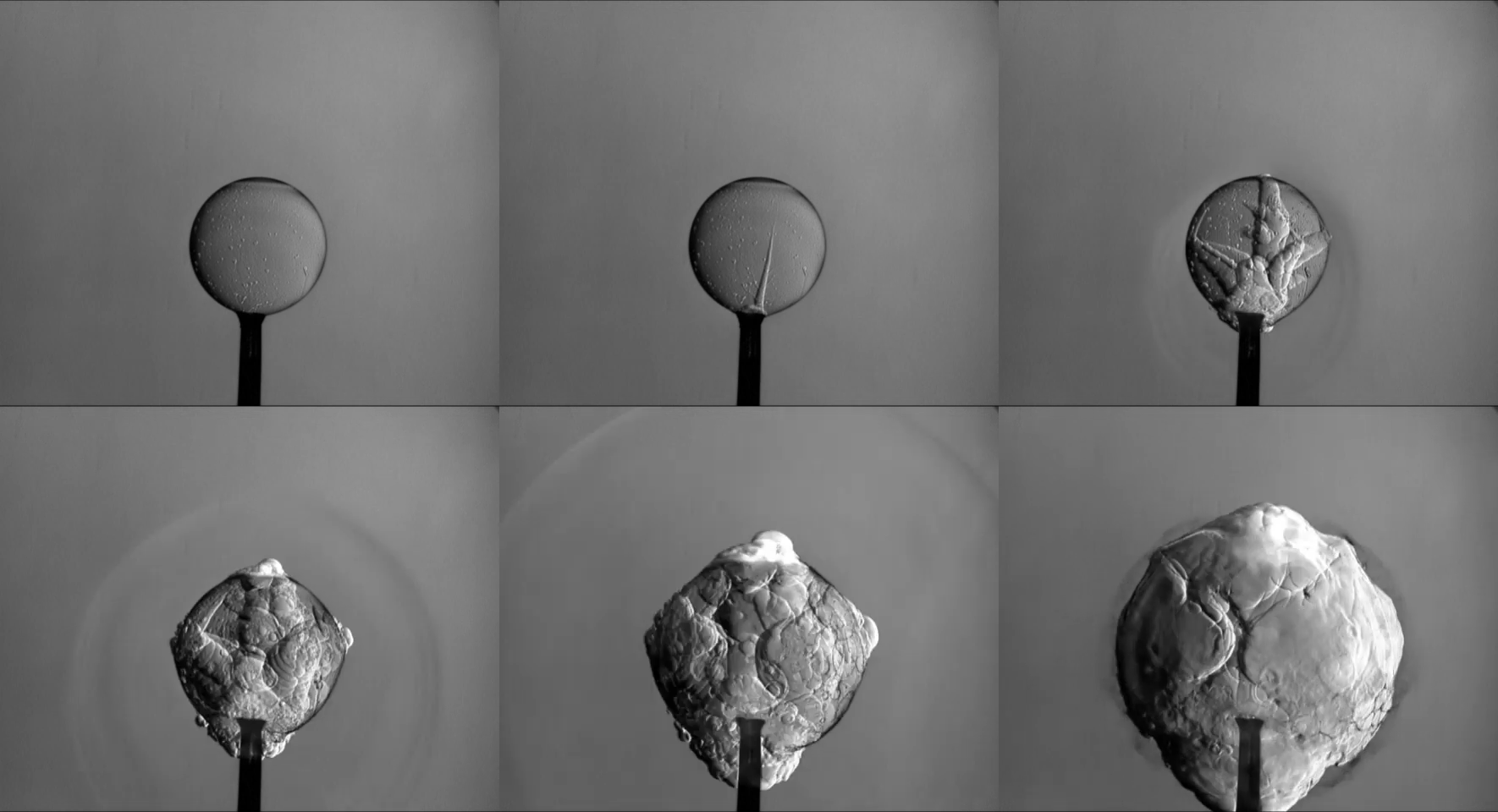
    Hollow Drops

    When a partially-air-filled drop hits a surface, it splashes and rebounds in a complex fashion. This video breaks down the physics of the process. Upon impact, a lamella spreads, eventually becoming wavy and unstable along its rim. At the same time, a counterjet forms, growing until it pierces the remaining bubble of the drop. The jet continues to stretch upward due to its momentum, pinching off and forming wobbly satellite drops that finally fall back to the surface. (Image and video credit: D. Naidu and S. Dash)

  • Featured Video Play Icon

    Draining a Bottle

    Turn a bottle upside-down to empty it, and you’ll hear a loud glug-glug-glug as the liquid in the bottle empties and air rushes in. In this video, researchers aim a high-speed camera at the very first bubble that forms during the process. Once the bubble reaches the wider area of the bottle, it tends to pinch off in the bottle’s neck. That creates a narrow jet that pierces the bubble and flies all the way to the other side, leaving a column of liquid inside the rising bubble. Increasing the fluid’s viscosity has remarkably little effect, at least until the liquid is extremely viscous. (Image and video credit: H. Mayer et al.)

  • Airflow in the Opera

    Airflow in the Opera

    Like so many other performers, the singers and musicians of New York’s Metropolitan Opera House were left without a way to safely perform when the SARS-CoV-2 pandemic began in early 2020. In search of safe ways to perform and rehearse, the Met turned to researchers at nearby Princeton University, who worked directly with the performers to explore aerosol production and airflow in the context of professional opera.

    Through visualization and other experiments, the team found that the highly-controlled breathing of opera singers actually posed a lower risk for spreading pathogens than typical speaking and breathing. Most of a singer’s voiced sounds are sustained vowels, which produce a slow, buoyant jet that remains close to a singer. The exception are consonants, which created rapid, forward-projected jets.

    In the orchestra, the researchers found that placing a mask over the bell of wind instruments like the trombone reduced the speed and spread of air. One of the highest risk instruments they found was the oboe. Playing the oboe requires a long, slow release of air, but between musical phrases, oboists rapidly exhale any remaining air from their lungs and take a fresh breath. That rapid exhale creates a fast, forceful jet of air that necessitates placing the oboist further from others. (Image credit: top – P. Chiabrando, others – P. Bourrianne et al.; research credit: P. Bourrianne et al.; via APS Physics; submitted by Kam-Yung Soh)
  • Never Break the Chain

    Never Break the Chain

    Pour water out of a bottle, and you’ll see a jet with a shape that resembles chain links. Sometimes known as a “liquid chain,” this phenomenon occurs when water pours through a non-circular hole. It’s quite a complex behavior, as shown in this recent study of the nonlinear effect. Even so, the authors found that the amplitude and wavelength of the chain’s sections are tied directly to the shape of the opening. Current models of the effect don’t account for the viscosity of the liquid, though, so future experiments will have to explore how fluids other than water behave. (Image and research credit: D. Jordan et al.; via APS Physics; submitted by Kam-Yung Soh)

    A comparison of oscillating jet shapes and metal chains.
    A comparison of an oscillating jet’s shape and metal chains. Each view is rotated 45 degrees from the one before.
  • Testing Full-Size Engines

    Testing Full-Size Engines

    Engineers can often use small-scale models to test the physics of their creations, but sometimes there’s no substitute for going large. In this photo, we see a full-size commercial engine used on an airplane, mounted at the Instituto Nacional de Tecnica Aeroespacial (INTA) in Madrid.

    Behind the engine, in red, is an optical rig used for a brand-new measurement technique that allows engineers to directly measure the carbon dioxide emissions of the engine as it runs. The optical frame is 7 meters in diameter and uses 126 beams of near-infrared laser light to probe the engine’s exhaust without interrupting the flow. It’s the first chemically specific imaging of a full-scale gas turbine like those found on commercial aircraft. Given the high carbon emissions associated with air travel, the technique will be important for engineers building greener aircraft engines. (Image and research credit: A. Upadhyay et al.; via The Engineer; submitted by Simon H.)

  • “Keeping Our Sheet Together”

    “Keeping Our Sheet Together”

    When two liquid jets collide, they form a falling liquid sheet. Here researchers explore how that sheet breaks up when the liquids involved contain polymers. The intact areas of the sheet show as dark red or almost black. The edges of the sheet appear in brighter red and yellow, outlining the holes that form and grow during breakup. The type of breakup observed depends on the concentration of polymer in the liquid. (Image credit: C. Galvin et al.)

  • Featured Video Play Icon

    Pistol Shrimp Snaps

    Gram for gram, few animals can match the power of a pistol shrimp’s snap. When its claw closes, the shrimp ejects a jet of water so fast that the water pressure drops below the vapor pressure, causing a cavitation bubble. Like other cavitation bubbles, this one is short-lived, growing and collapsing (and sending out shock waves!) in less than a millisecond. That’s enough to knock any predator or prey for a loop. (Image and video credit: Ant Lab)

  • Featured Video Play Icon

    Dolphins Playing With Bubble Rings

    Blow a jet of air underwater and you can make a bubble ring. It takes some practice for humans, or you can use a device. In this video, a team introduced wild dolphins to a bubble-ring-making machine and observed how the dolphins reacted. After some initial wariness, the animals played with them for hours, creating games and having fun. Note that there are some dolphins who create their own bubble rings to play with, so it’s hard to say that these particular dolphins have never seen a bubble ring before. But even if they have seen the bubbles, they wouldn’t have seen a machine making them. (Image and video credit: BBC Earth)

  • Eroding Grains

    Eroding Grains

    When a spacecraft comes in for a landing (or a tag similar to what OSIRIS-REx did), there’s a turbulent jet that points straight into a bed of particles. How those particles react — how they erode and the crater that forms — depends on many factors, including the cohesion between particles. In these experiments, researchers investigated such a jet (in air) and its impact on particles with differing amounts of cohesion.

    When there is little cohesion between particles, erosion takes place a single particle at a time (Image 1). Once there’s some cohesion, the jet’s velocity has to be higher to trigger erosion (Image 2). Once erosion does begin, it includes both singular and clumped particles. In highly cohesive beds, velocities must be even higher to create erosion, which takes place with large clusters of particles flying off together (Image 3). (Image and research credit: R. Sharma et al.)

  • Sonic Booms and Urban Canyons

    Sonic Booms and Urban Canyons

    In the days of the Concorde — thus far the world’s only supersonic passenger jet — noise complaints from residents kept the aircraft from faster-than-sound travel except over the open ocean. With many pursuing a new generation of civil supersonic aircraft, researchers are looking at how those sonic booms could interact with those of us on the ground.

    In this study, researchers simulated the shock waves from aircraft interacting with single and multiple buildings on the ground. They found that the presence of a building increases the perceived sound level of the boom by about 7 dB at the most. But the most interesting results are what happens between multiple buildings.

    If the street between buildings is wide enough, they each act independently, as if they were single buildings. But for narrower streets, the acoustics waves reflect and diffract between the buildings, creating a resonance that makes the acoustic echoes last longer. The effect is especially pronounced for a sonic boom traveling across a series of buildings, which mimics the layout of a dense city full of urban canyons. (Image credit: Concorde – M. Rochette, simulation – D. Dragna et al.; research credit: D. Dragna et al.)

    Acoustic waves reflect and propagate through 2D urban canyons with widths of 10 meters (top), 20 meters (middle), and 30 meters (bottom).
    Acoustic waves reflect and propagate through 2D urban canyons with widths of 10 meters (top), 20 meters (middle), and 30 meters (bottom).