Search results for: “jet”

  • Featured Video Play Icon

    Mud Pots

    Mud pots, or mud volcanoes, form when volcanic gases escape underlying magma and rise through water and earth to form bubbling mud pits. I had the chance to watch some at Yellowstone National Park a few years ago and they are bizarrely fascinating. In this Physics Girl video, Dianna recounts her adventures in trying to locate some mud pots in southern California and explains the geology that enables them there. And if you haven’t seen it yet, check out her related video on the only known moving mud puddle! (Image and video credit: Physics Girl)

  • Featured Video Play Icon

    When Squids Fly

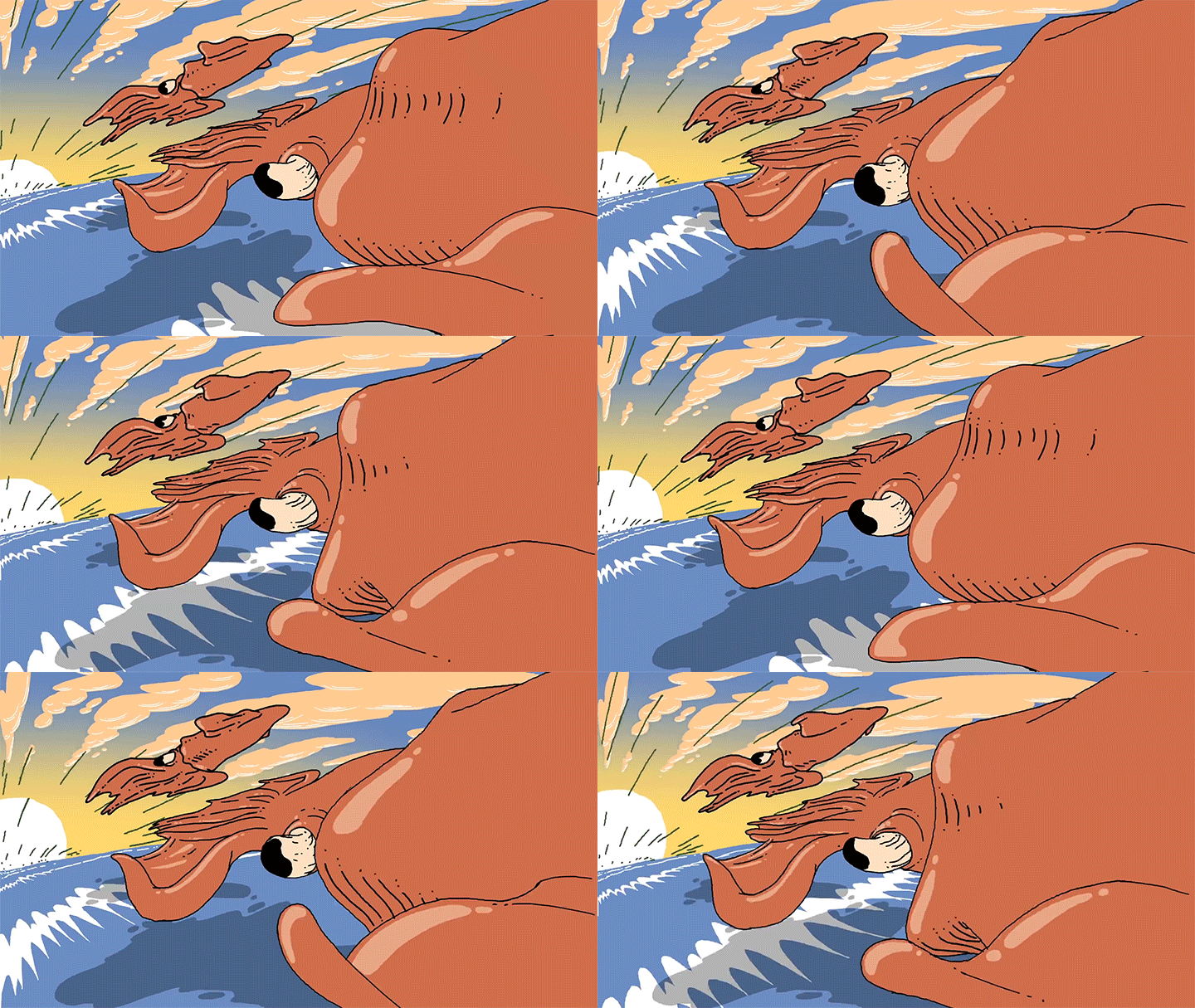
    Some species of squid fly at speeds comparable to a motorboat for distances of 50 meters. The cephalopods get into the air the same way they swim underwater: by expelling a jet of water through the center of their body. Once aloft, the squids spread their tentacles to form a semi-rigid wing-like surface for lift. They can also use fins on their mantle as a canard for additional lift or control of their altitude. Researchers suspect the squids use flight as an escape mechanism to put distance between themselves and predators, but it could also be a low-energy migration strategy since a single pulse carries a squid farther in air than in water. (Video and image credit: TED-Ed)

  • Featured Video Play Icon

    Challenges of Commercial Supersonic Flight

    Years ago as I sat on a plane taxiing at Heathrow, I caught a glimpse of a Concorde out on the tarmac. My classmates couldn’t understand why I was so excited to see that funny looking plane, but even as a high schooler, I was fascinated by the prospect of flying faster than sound.

    Unfortunately, there are a lot of challenges to overcome in making supersonic flight widely available — fuel efficiency, cost effectiveness, and sonic boom control, to name a few. This video delves into some of the major issues and touches on some of the recent work at NASA and other organizations studying the problem. Perhaps as new technologies develop and mature we’ll once again see faster-than-sound air travel outside of rocket launches and military jets. (Video and image credit: TED-Ed)

  • Bubbles Rising

    Bubbles Rising

    Here we see high-speed video of air bubbles rising through sesame oil. The flow rate of air is just right for one bubble to catch up to and merge with the previous bubble. As it the trailing bubble pinches off from the valve, it shoots a small jet through itself and into the prior bubble. For information on how to recreate this and related experiments, check out this article. (Image credit: C. Kalelkar and S. Paul, source; see also C. Kalelkar)

  • Featured Video Play Icon

    Fluid Chains

    In this video, Steve Mould tackles a question many of us have likely wondered: just why does falling water make this chain-like shape? When pouring from a slit-like orifice, water jets take on this undulating pattern. While I have no issue with Steve’s explanation of surface tension oscillations driving the shape, I’ll quibble a little bit with the idea that this hasn’t been studied. Personally, I’d connect it to the fishbone instability, which classically occurs when two jets collide. At low flow rates, though, the colliding jets form a pattern very much like this one. And if you look just past the initial conditions at the container opening, all of these flows have thicker jet-like rims colliding. I think the flows in these videos are just a slightly messier version of the low-flow-rate fishbone. What do you think? (Video and image credit: S. Mould)

  • Featured Video Play Icon

    Viscoplastic Drop Impact

    There are many materials that don’t behave exactly as a fluid or a solid, instead displaying characteristics of both. In this video, we see drops of hair gel falling into water. The gel is viscoplastic – showing some of the viscous behavior of a fluid and some of the plastic behavior (the inability to change back to its initial shape) of a solid.

    On impact, the gel deforms due to the forces on it, but the final shape does not depend solely on the amount of force; instead, it’s the rate at which the forces are applied that determines the final shape. By tuning the impact speed and the gel stiffness, it’s possible to make many final capsule shapes, something that could be useful in applications like drug manufacturing. (Image and video credit: M. Jalaal et al.)

  • Oil in Water

    Oil in Water

    In the decade since the Deepwater Horizons oil spill, scientists have been working hard to understand the intricacies of how liquid and gaseous hydrocarbons behave underwater. The high pressures, low temperatures, and varying density of the surrounding ocean water all complicate the situation.

    Released hydrocarbons form a plume made up of oil drops and gas bubbles of many sizes. Large drops and bubbles rise relatively quickly due to their buoyancy, so they remain confined to a relatively small area around the leak. Smaller drops are slower to rise and can instead get picked up by ocean currents, allowing them to spread. The smallest micro-droplets of oil hardly rise at all; instead they remained trapped in the water column, where currents can move them tens to hundreds of kilometers from their point of release. (Image and research credit: M. Boufadel et al.; via AGU Eos; submitted by Kam-Yung Soh)

  • Featured Video Play Icon

    Recreating Acoustics

    The cultural heritage of a site is made up of more than its appearance; its soundscape is vital, as well. Acousticians and historians work together to preserve and recreate the auditory landscape of important sites through acoustical measurements and digital reconstructions based on architecture and building materials. Thanks to projects like these, researchers can achieve feats like recreating a concert within the Notre Dame Cathedral as it was before the 2019 fire. To learn more about the technologies behind these feats, check out this Physics Today article. (Image and video credit: Ghost Orchestra; for more, see Physics Today)

  • Featured Video Play Icon

    Coalescing Drops

    This year’s Nikon Small World in Motion competition was won by fluid dynamics! The first place video shows droplets on a superhydrophobic surface coalescing. The droplets are a mixture of water and ethanol. Their initial merger creates a ripple of waves that’s followed by a ghostly vortex ring that jets into the interior. Previous research on coalescence during impact shows jets driven by surface tension but the jet here doesn’t appear to be confined to the surface. (Image and video credit: K. Rabbi and X. Yan; via Nature; submitted by Kam-Yung Soh)

    Droplets on a superhydrophobic surface coalescing.

  • Chaos in the Lagoon Nebula

    Chaos in the Lagoon Nebula

    Even on the scale of light-years, fluid dynamics plays a role in our universe. This photograph shows the Lagoon Nebula, where stars, gas, and dust are battling for supremacy. Jets from young stars push the dust left from supernova remnants into a chaotic patterns, and the high-energy particles streaming from the youthful stars illuminate interstellar gases, creating the nebula’s distinctive glow. This section of the nebula is about 50 light-years across, so every picture we capture is only the tiniest snapshot of the true scale of its turbulence. (Image credit: Z. Wu; via APOD)