Search results for: “droplet”

  • Featured Video Play Icon

    Freezing Drops

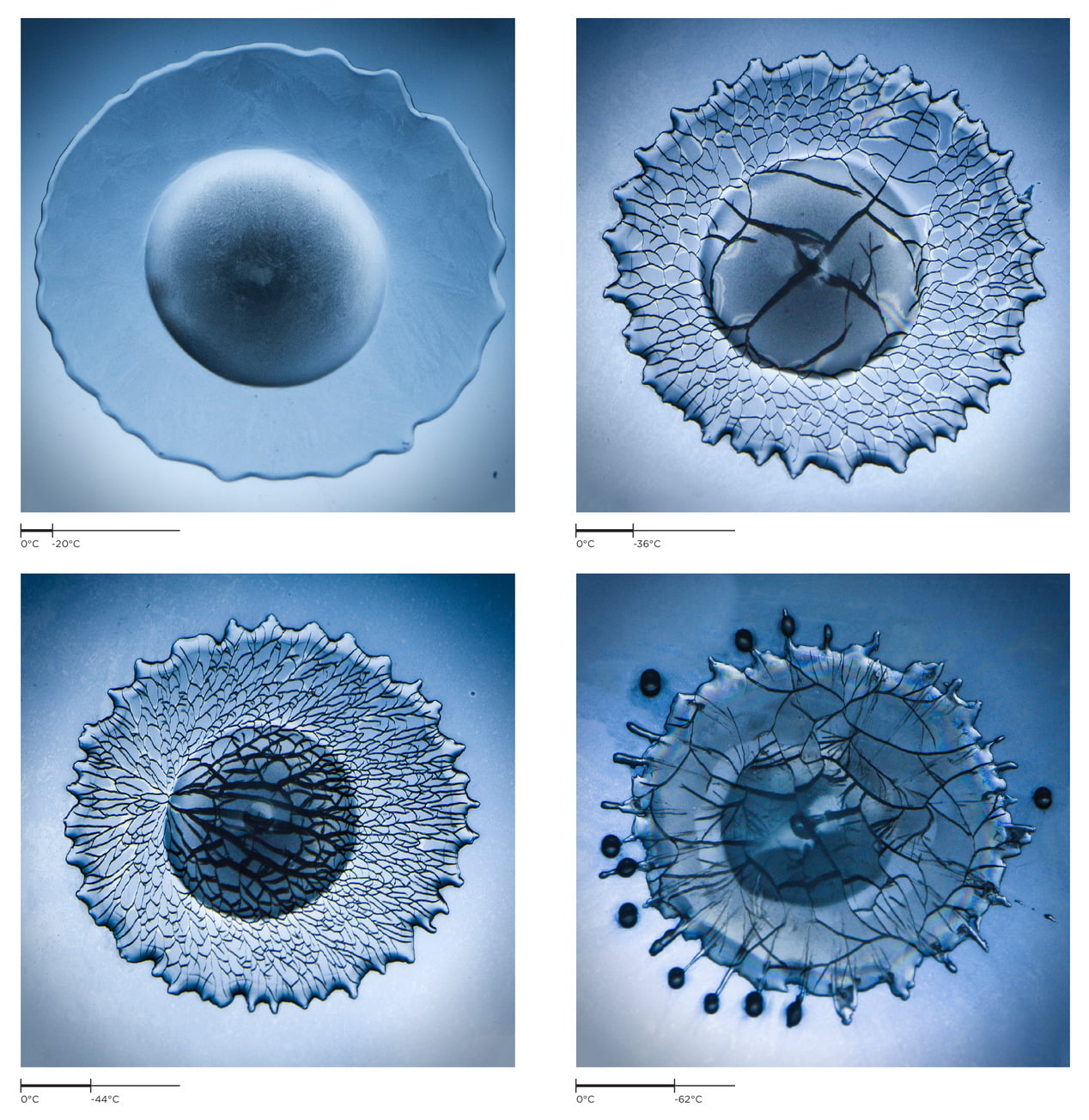
    A water droplet deposited on a cold surface freezes from the bottom up. As anyone who has made ice cubes knows, water expands when it freezes. But watch the outline of the drop carefully. The drop isn’t expanding radially outward while it freezes. Instead the remaining liquid part of the drop forms what’s known as a spherical cap, a shape like the sliced-off top of a sphere. Surface tension creates that spherical shape, but the water still has to expand when it freezes. The result? The last bit of the drop freezes into a point! This means that surface tension maintains the drop’s spherical shape, for the most part, and all the expansion the water does takes place vertically. (Video credit: D. Lohse et al.)

  • Featured Video Play Icon

    Liquid Fragmentation

    From spilling coffee to driving through puddles, our daily lives are full of examples of liquids fragmenting into drops. A recently published study describes how this break-up occurs and predicts what the distribution of droplet sizes will be for a given fluid. Viscoelasticity is the property that governs this droplet size distribution. Viscoelasticity describes two aspects of a fluid–its viscosity, which acts like internal friction, resisting motion–and its elasticity, the fluid’s ability to return to its original shape after stretching. Most fluids have a little bit of each of these properties, which makes them somewhat sticky, both in the sense of not-flowing-easily and in the sense of sticking-to-itself. These same properties cause viscoelastic fluids to wind up with a broader droplet size distribution, ultimately creating both more small droplets and more large droplets than a Newtonian liquid like water. (Video credit: MIT News; research credit: B. Keshavarz et al.; submitted by mrvmt)

  • Oil in Alcohol

    Oil in Alcohol

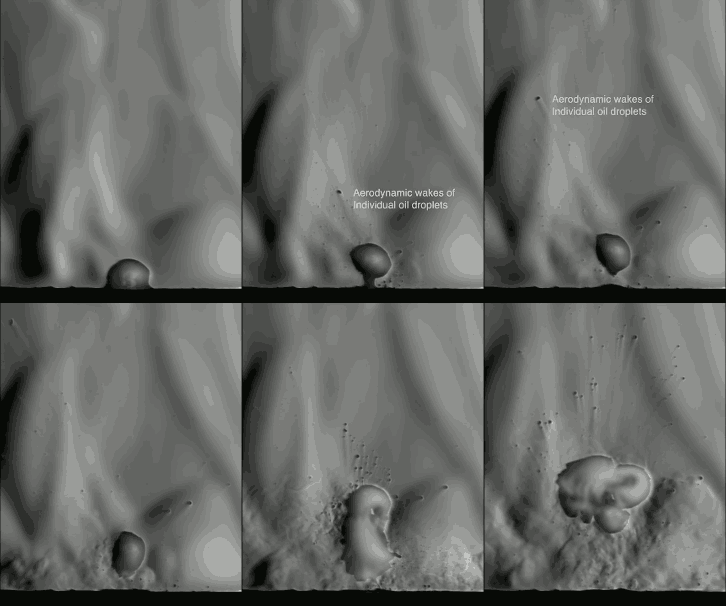
    A drop of oil impacts and falls through a pool of isopropyl alcohol. Momentum, viscosity, and diffusion combine to deform the drop into a shape that is initially like an upside-down wine glass (top image). Because the oil is both denser than the alcohol and soluble in it, the drop sinks and dissolves as it falls. The drop expands rapidly outward, thinning and formed a concave shape around its denser, sinking core (bottom image). Ultimately, the droplet will deform and fragment as it dissolves into the alcohol. (Image credit: R. La Foy et al.)

  • A Particle-Filled Splash

    A Particle-Filled Splash

    A drop of water that impacts a flat post will form a liquid sheet that eventually breaks apart into droplets when surface tension can no longer hold the water together against the power of momentum flinging the water outward. But what happens if that initial drop of water is filled with particles? Initially, the particle-laden drop’s impact is similar to the water’s – it strikes the post and expands radially in a sheet that is uniformly filled with particles. But then the particles begin to cluster due to capillary attraction, which causes particles at a fluid interface to clump up. You’ve seen the same effect in a bowl of Cheerios, when the floating O’s start to group up in little rafts. The clumping creates holes in the sheet which rapidly expand until the liquid breaks apart into many particle-filled droplets. To see more great high-speed footage and comparisons, check out the full video.  (Image credit and submission: A. Sauret et al., source)

  • Surfing on Vapor

    Surfing on Vapor

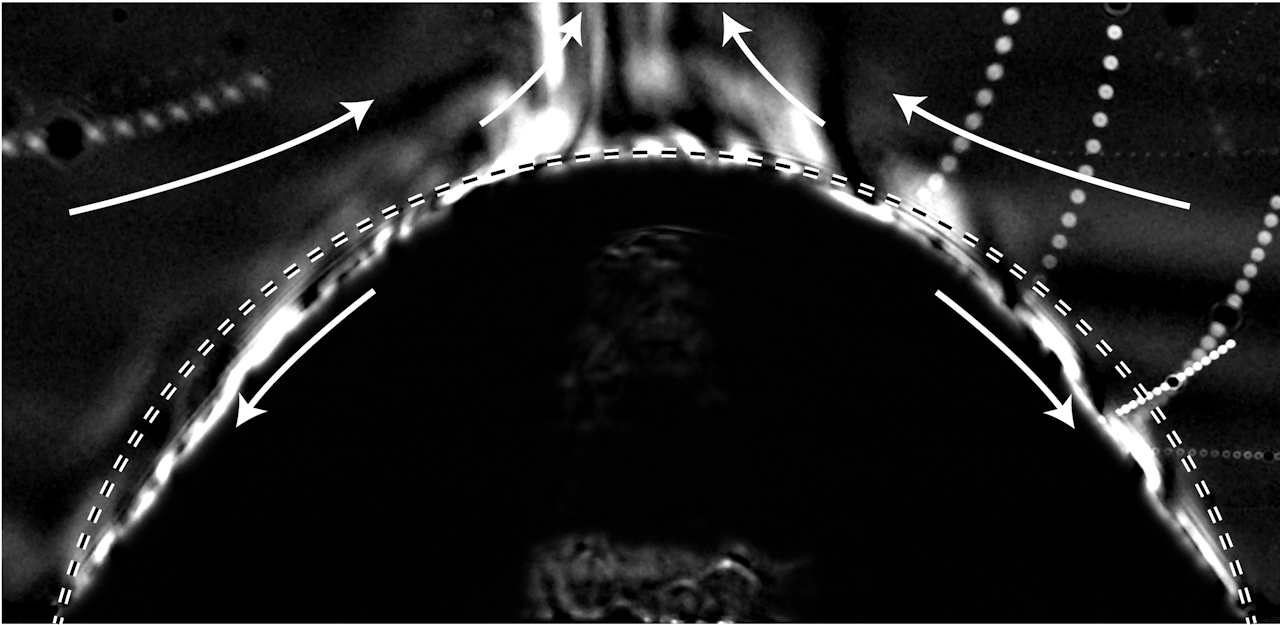
    Place a drop of liquid on a surface much, much hotter than the liquid’s boiling point, and the portion of the drop that impacts will vaporize immediately. This leaves the droplet hovering on a thin layer of vapor. With a fluid like water, the vapor state is a much more efficient insulator than the liquid state. Thus, the vapor layer actually protects the liquid droplet, enabling it to boil off at a much slower rate than if the drop were touching the heated surface. This is known as the Leidenfrost effect, and it can be used to create self-propelled droplets.  (Image credit: R. Thévenin and D. Soto)

  • Featured Video Play Icon

    Colors in Macro

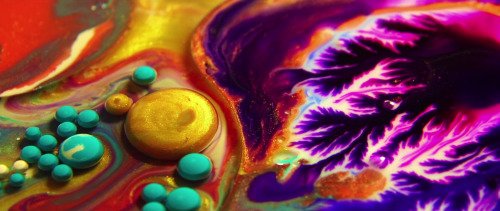
    Milk, acrylic paints, soap, and oil – all relatively common fluids, but together they form beautiful mixtures worth leaning in to enjoy. Variations in surface tension between the liquids cause much of the motion we see. Soap, in particular, has a low surface tension, which causes nearby colors to get pulled away by areas with higher surface tension, behavior also known as the Marangoni effect. Adding oil creates some immiscibility and lets you appreciate both the coalescence and fragmentation of the fluids. And finally, there’s one of my favorite sequences, where bubbles start popping in slow motion. As the bubble film ruptures, fluid pulls away, breaking into ligaments and then a spray of droplets as the bubble disintegrates. (Video credit: Macro Room; via Gizmodo)

  • Featured Video Play Icon

    Avoiding Coalescence

    If you watch closely as you go about your day, you may notice drops of water sometimes bounce off a pool of water instead of coalescing. Fluid dynamicists have been fascinated by this behavior since the 1800s, but it was Couder et al. who explained that these droplets can bounce indefinitely as long as the thin air layer separating the drop and pool is refreshed by vibrating the pool. In this video, Destin teams up with astronaut Don Pettit to film the phenomenon in beautiful high-speed. My favorite part of the video starts around 8:18, where Destin shows Don’s experiments with this effect in microgravity. It turns out that the cello produces just the right frequencies to create a cascade of bouncing water droplets, much like a Tibetan singing bowl turned back on itself! (Video credit: Smarter Every Day; submitted by Destin and effyeahjoebiden)

  • Dripping, Frozen

    Dripping, Frozen

    The simple drip of a faucet is more complicated when frozen in time. Any elongated strand of water tends to break up into droplets due to surface tension and the Plateau-Rayleigh instability. Whenever the radius of the water column shrinks, surface tension tends to drive water away from the narrow region and toward a wider point. This exaggerates the profile, making narrow regions skinnier and wider regions fatter. Eventually, the neck connecting the droplets becomes so thin that it pinches off completely, leaving a string of falling droplets.  (Image credit: N. Sharp)

  • Frost Spreading

    Frost Spreading

    Frost typically forms when supercooled droplets of water scattered across a surface freeze together. The freezing spreads via tiny ice bridges that link droplets together into a frozen network. The animation above shows this process in action. Freezing starts in a droplet off-screen on the right and quickly spreads. Watch carefully, and you can see the ice bridges growing toward the unfrozen droplets. This is because the ice bridges are fed by water vapor evaporating from the droplets. If one can spread the droplets far enough from one another, it’s possible for a droplet to evaporate completely before the ice bridge reaches it, thereby disrupting the spread of frost.  (Video credit: J. Boreyko et al.; research paper)

  • Floating on a Granular Raft

    Floating on a Granular Raft

    A thin layer of hydrophobic particles dispersed at an oil-water interface is strong enough to prevent a water droplet from coalescing. The researchers refer to this set-up as their granular raft. As the red-dyed water droplet gets larger (top row), it deforms the raft more and more, but the grains continue to keep the drop separate from the fluid beneath (middle row). When water is removed from the droplet, wrinkles form on the raft as the drop’s volume shrinks. This is because the contact line – where the droplet, grains, and air meet – is pinned. The grains already touching the drop are held there by adhesion. But since the drop is shrinking, the area on the raft has to shrink, too – thus wrinkles! (Photo credits: E. Jambon-Puillet and S. Protiere, original)