Search results for: “droplet”

  • Reader Question: Shower Curtains

    Reader Question: Shower Curtains

    Reader thansy asks:

    Why do the bottoms of shower curtains drift in toward the water coming from the shower head?

    We all know that moment. You’re minding your own business, scrubbing away, and all of a sudden, the shower curtain billows up and grabs you. Scientists have debated the cause of this behavior for years. Some argued that the curtain billowed due to hot air rising from the shower. Others claimed the fast-moving spray caused lift that pulled the curtain up. But fifteen years ago, one scientist tackled the problem computationally. He performed a numerical simulation of a shower head spraying into a bath and found that this spray of droplets creates a weak horizontal vortex in the shower.

    This shower vortex has a low-pressure core at the middle, which is thought to provide the suction that causes the shower curtain to billow. The scientist, David Schmidt, was awarded the 2001 Ig Nobel Prize for his work. (Image credits: N. Paix, D. Schmidt; research credit: D. Schmidt)

  • Drawing Up Dew

    Drawing Up Dew

    Desert plants have evolved to efficiently collect and capture whatever water they can. Each leaf of the moss Syntrichia caninervis ends in a hairlike fiber called an awn (seen in white in the top image). Tiny as they are, awns are vital to the moss’s water collection, correlating to more than 20% of their dew collection. Extremely tiny grooves on the surface of the awn provide nucleation sites where dew condensed from fog collects. Once a droplet forms on the awn, it grows larger as more fog condenses (middle image). When the droplet grows large enough, the conical shape of the awn will cause surface tension to draw the droplets along the awn and toward the leaf (bottom image).

    (Credits: Syntrichia caninervis moss image – M. Lüth; videos and research – Z. Pan et al., Supplementary Videos 3 and 4; h/t to T. Truscott)

  • When Lasers Strike

    When Lasers Strike

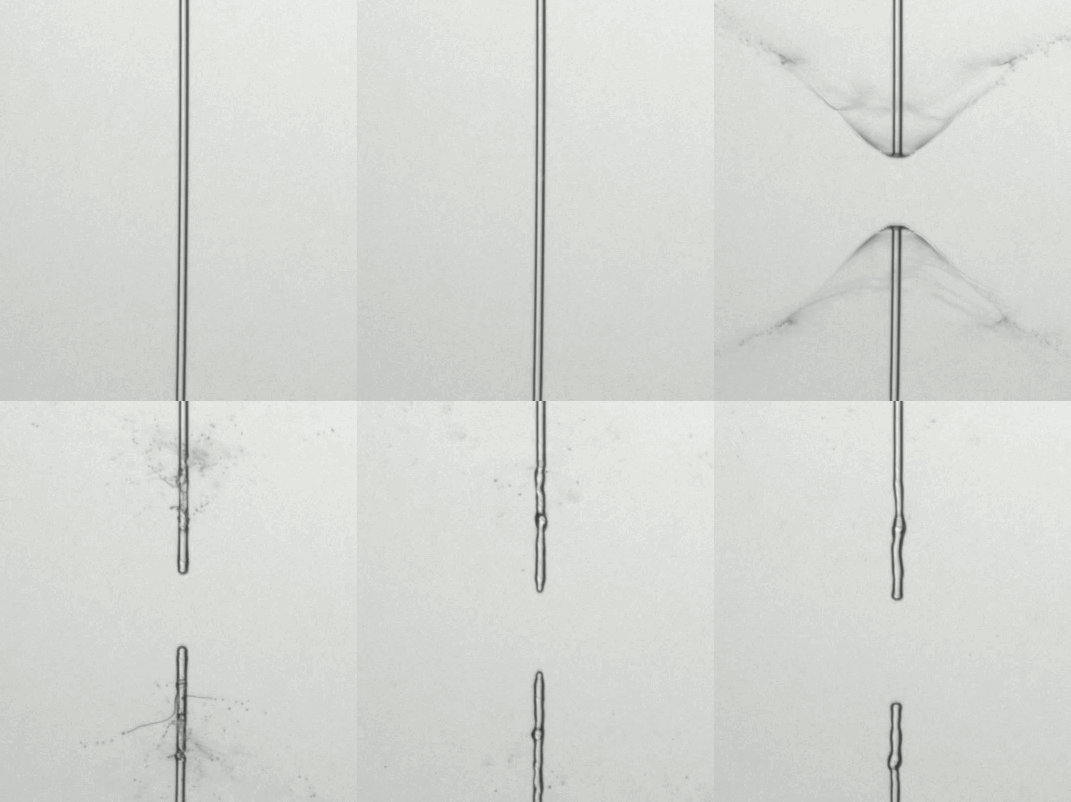
    Lasers are a great way to deliver a lot of energy very quickly. In this animation, you see a jet of water get struck by a pulse from a powerful X-ray laser. The energy from that laser pulse gets absorbed by the water in a matter of picoseconds – that’s trillionths of a second. All that energy in so little time makes the water vaporize explosively. It’s this vapor explosion that breaks the jet in two. As the vapor expands outward, it forces water from the jet into a thin film that forms a cone. The conical film bends back on itself until it strikes the jet and coalesces. For more, check out this video of a similar experiment that looked at laser impacts on droplets. (Image credit: C. Stan et al., from Supplementary Movie 5; via Gizmodo)

  • Whiskey Stains

    Whiskey Stains

    Photographer Ernie Button discovered that whiskey left behind intriguing patterns after it evaporated. Unlike coffee rings, the whiskey leaves behind a more uniform residue. Curious, he contacted researchers at Princeton, who were eventually able to explain why whiskey and coffee dry so differently. They observed three major effects in drying whiskey mixtures. Firstly, the alcohol in whiskey evaporates faster than other components, creating differences in concentration and, therefore, surface tension along the droplet. These variations in surface tension create Marangoni flow, which tends to mix the droplet. Coffee, being non-alcoholic, does not do this.

    Whiskey also contains surfactants, low surface tension chemicals, which help pull particulates away from the edge of the droplet so they aren’t trapped there like in coffee. And finally, they found that the polymers in whiskey helped glue particles to the glass so that they were less likely to be carried by the flow. Taken together, these three ingredients – alcohol, surfactants, and polymers – all help make the whiskey stain more uniform. For more, watch the video below, see Button’s website, or check out the research paper. (Image credit: E. Button; research credit: H. Kim et al.; video credit: C&EN; submitted by @tommyjwilson)


  • Striking Oobleck

    Striking Oobleck

    Mixing cornstarch and water creates a fluid called oobleck that has some pretty bizarre properties. Oobleck is a shear-thickening, non-Newtonian fluid, which means its viscosity increases when you try to deform it with a shearing, or sliding, force. But as the Backyard Scientist demonstrates above, striking oobleck with a solid object produces some spectacular and very non-fluid-like results. The golf ball’s impact blows the oobleck into pieces that look more like solid chunks than liquid droplets. This solid-like behavior occurs because the impact jams the suspended cornstarch particles together, creating a solidification front that travels ahead of the golf ball. Imagine how a snow plow pushes a denser region of snow ahead of it as it drives; the cornstarch behaves similarly but only in a region near the impact. Once that impact force dissipates, the particles unjam and the mixture responds fluidly again. (Image credit: The Backyard Scientist, source; research credit: S. Waitukaitis and H. Jaeger, pdf)

  • Emulsion Impact

    Emulsion Impact

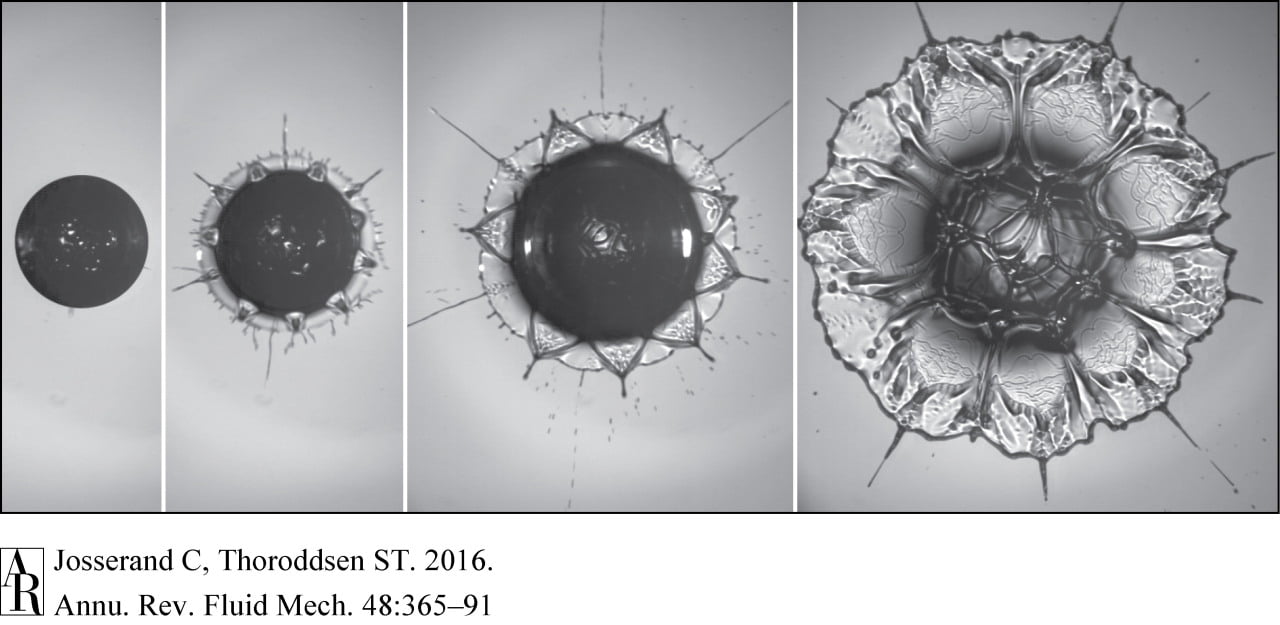
    Emulsions – mixtures of two immiscible fluids – are quite common; the oil and vinegar combination used in many salad dressings is one. The image sequence above shows the first 800 microseconds of the impact of a similarly emulsified droplet. The outer drop, seen on the left, consists of a water/glycerin mixture, and inside the drop are 20 smaller perfluorohexane droplets. These smaller droplets are denser and tend to settle toward the bottom of the outer drop. When the compound droplet hits a solid surface, it spreads in a spectacular starburst pattern that depends on the number and location of interior droplets. You can see a similar impact in motion here. (Image credit: J. Zhang and E. Li; source: C. Josserand and S. Thoroddsen)

  • Bubbles and Films Merging

    Bubbles and Films Merging

    As we’ve seen before, a water droplet can merge gradually with a pool through a coalescence cascade. It turns out that the coalescence of a soap bubble with a soap film can follow a similar process! Initially, the bubble and film are separated by a thin layer of air. Once that air drains away and the bubble contacts the fluid, it starts to coalesce. But the bubble pinches off before its entire volume merges, leaving behind a daughter bubble with about half the radius of the previous bubble. This process repeats until the bubble is small enough that it merges completely. To see more great high-speed footage of this bubble merger, check out the full video below.  (Image/video credit: D. Harris et al.)

  • Pinning a Drop

    Pinning a Drop

    The shape of a droplet sitting on a surface depends, in part, on its surface tension properties but also on the nanoscale roughness of the surface. Small variations in the height and shape of the surface will change the area a drop contacts as well as the contact angle the edge of the drop makes with the surface. If the contact line between the drop and surface stays the same as a droplet evaporates into the surrounding gas or dissolves into the surrounding liquid, then we say the drop is pinned. A pinned drop’s contact angle will decrease as the drop’s volume decreases. This strains the ability of the nanoscale roughness to keep the drop’s edge pinned. As individual points of contact fail, the drop’s edge may jump inward to a new contact point. This set of discrete jumps between pinned states is called a stick-jump or stick-slip mode. (Image credit: E. Dietrich et al., source; see also: E. Dietrich et al. 2015)

  • Blowing Through a Straw

    Blowing Through a Straw

    As kids, most of us got in trouble at some point for blowing through a straw into our nearly-empty drinks. What you see here is a consequence of such misbehavior, though in this case the fluid is silicone oil and the straw is a metal needle (not shown) through which helium is continuously injected beneath the liquid surface. Depending on the angle of the straw, different behaviors are observed, as seen in this video. The photo above shows an intermediate regime, in which tiny jets form at the surface and eject a stream of drops. Each drop sails in a little parabolic arc and briefly bounces on the surface, like the drops on the right, before coalescing into the pool. (Image credit: J. Bird and H. Stone; video)

  • Fluids Round-up

    Fluids Round-up

    Last week was supposed to have a fluids round-up, but we were having too much fun walking on water instead. So here it is now!

    – NASA has asked Congress for funding for new X-plane programs to explore solutions for greener airliners and quieter sonic booms to enable next-generation air travel. Popular Science, Gizmodo, and Ars Technica take a closer look at the proposed projects. I won’t lie – as an aerospace engineer I am hugely in favor of this. The first ‘A’ in NASA has been neglected for quite a while and projects like these are needed if we want to advance the state-of-the-art in aeronautics.

    – The New York Times’ ScienceTake video series took a look back at their most popular videos, and 3 of the top 5 videos are fluid dynamics-related. Because we are just that awesome. (via Rebecca M)

    – I made a guest appearance on last week’s Improbable Research podcast, where we talked about bizarre experiments trying to unravel swimming.

    – Physics Girl shows us 5 weird ways to blow out a candle. There’s some neat and potentially non-intuitive fluid dynamics involved!

    – SciShow offers an explanation of why we sneeze. Spoiler alert: it’s more than just to get rid of irritants.

    – Fluid dynamics made the short list for NPR’s Golden Mole awards with the discovery of dancing droplets. Here’s Skunkbear’s take on it.

    – Ernst Mach, of Mach number fame, was also a bit of an artist and philosopher. (via @JenLucPiquant)

    – It’s not quite fluid dynamics, but this Slow Mo Guys video of spinning burning steel wool might be their most beautiful video yet. Check it out!

    (Image credit: NASA)