Archer fish hunt by shooting jets of water at their prey to knock them into the water where the fish can eat them. Previous research showed that the archer fish’s projectile jet is pulsed such that the water released at a later time has a greater velocity. This makes the jet bunch up so that a ball of liquid hits the prey with greater force than the jet would otherwise. A recently released paper shows that the archer fish actively adjust their liquid jets in order to strike targets at different distances while maintaining this bunching effect. To control the jets, the fish adjust both how long they jet and what speed they impart to the fluid by changing how they open and close their mouths. (VIdeo credit: Nature; research credit: P. Gerullis and S. Schuster; via phys.org; submitted by @jchawner)
Search results for: “art”

“Smoke”

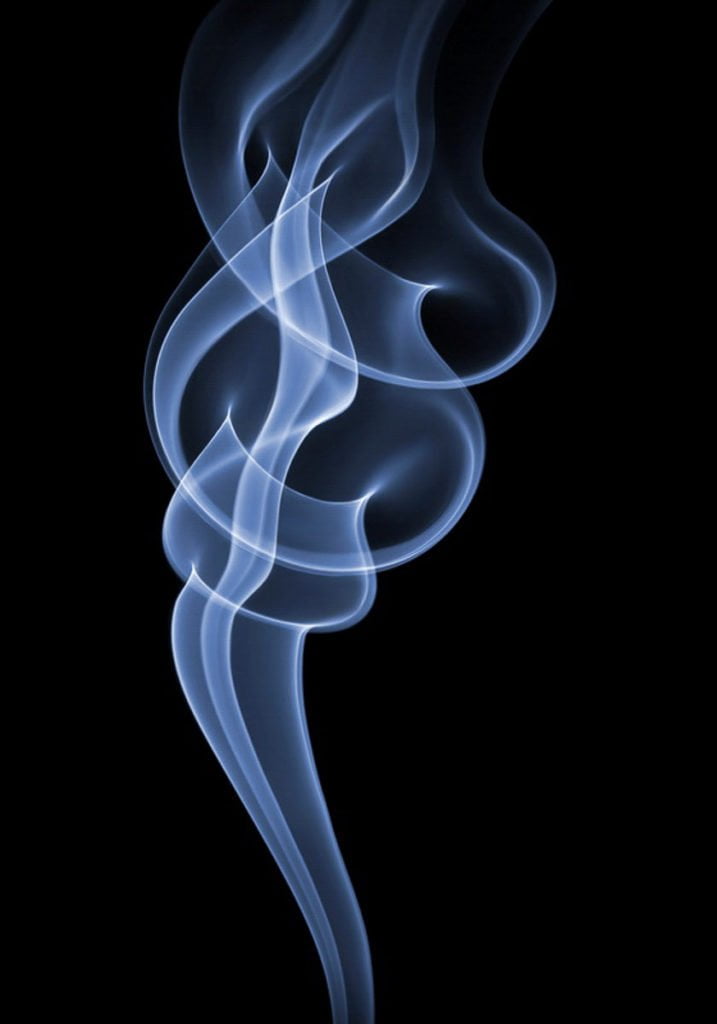


Ethereal forms shift and swirl in photographer Thomas Herbich’s series “Smoke”. The cigarette smoke in the images is a buoyant plume. As it rises, the smoke is sheared and shaped by its passage through the ambient air. What begins as a laminar plume is quickly disturbed, rolling up into vortices shaped like the scroll on the end of a violin. The vortices are a precursor to the turbulence that follows, mixing the smoke and ambient air so effectively that the smoke diffuses into invisibility. To see the full series, see Herbich’s website. (Image credits: T. Herbich; via Colossal; submitted by @jchawner, @__pj, and Larry B)
P.S. – FYFD now has a page listing all entries by topic, which should make it easier for everyone to find specific topics of interest. Check it out!

Soap Film Physics
Soap films consist predominantly of water, yet their thin, virtually two-dimensional nature is impossible for water alone to achieve. The small amount of added soap acts as a surfactant, lowering the surface tension of the fluid and preventing it from bursting into droplets. When forming a film, the soap molecules align themselves along the outer surfaces of the film, with their hydrophilic heads among the water molecules and their hydrophobic tails oriented outward. For the most part, the water molecules stay sandwiched between the surfactant layers, forming a film only about as thick as the wavelength of visible light. In fact, the psychedelic colors of a soap film are directly related to the film’s thickness with the black regions being the thinnest. The video above shows a horizontal soap film at the microscopic scale and some of the dynamics exist therein. (Video credit: J. Hart)

Death Valley’s Roaming Rocks


The mystery of the roaming rocks of Death Valley’s Racetrack Playa may be at an end. Since their discovery in the 1940s, researchers have speculated about what conditions on the playa could cause 15+ kg rocks to slide tens or hundreds of meters across the dry lakebed. But the rare nature of the movement and the remoteness of the location had prevented direct observation of the phenomenon until last December when a research team caught the rocks in motion (see the timelapse animation above or the source video). Winter rain and snow had created a shallow ice-encrusted pond across the playa by the time the researchers arrived to check their previously installed equipment. Late one sunny morning, the melting ice, only millimeters thick, cracked into plates tens of meters wide and began to move under the light breeze (~4-5 m/s). Despite its windowpane-like thickness, the ice pushed GPS-instrumented rocks up to hundreds of meters at speeds of 2-5 m/min. It took just the right mix of conditions–sun, wind, snow, and water–but the two ice-shoving instances the team observed go a long way toward explaining the sailing rocks. (Image credits: R. Norris et al.; J. Norris, source video; NASA Goddard; via Discover and SciAm)
Water-Based Tractor Beam
 Researchers in Australia have demonstrated a “tractor beam” capable of manipulating floating objects from a distance using surface waves on water. And, unlike some research, you can try to replicate this result right in the comfort of your own bathtub! When a wave generator oscillates up and down, it creates surface waves that move objects and particles on the water’s surface. When the wave amplitudes are small, the outgoing wave fronts tend to be planar, as in part (a) of the figure above. These planar waves push surface flow away from the wave generator in a central outward jet, and new fluid is entrained from the sides to replace it. This creates the kind of flowfield shown in the streaklines of part (b).
Increasing the amplitude of the surface waves drastically changes the surface flow’s behavior. Larger wave amplitudes are more susceptible to instabilities due to the nonlinear nature of the surface waves. This means that the planar wave fronts seen in part (a) break down into a three-dimensional wavefield, like the one shown in part (c). Near the wave-maker, the surface waves now behave chaotically. This pulsating motion ejects surface flow parallel to the wave-maker, which in turn draws fluid and any floating object toward the wave-maker. The corresponding surface flowfield is shown in part (d). The researchers are refining the process, but they hope the physics will one day be useful in applications oil spill clean-up. (Video credit: Australia National University; image and research credit: H. Punzmann et al. 1, 2; via phys.org; submitted by Tracy M)

Stopping the Slosh
Sloshing is a problem with which anyone who has carried an overly full cup is familiar. Because of their freedom to flow and conform to any shape, fluids can shift their shape and center of mass drastically when transported. The issue can be especially pronounced in a partially-filled tank. The sloshing of water in a tank on a pick-up truck, for example, can be enough to rock the entire vehicle. One way to deal with sloshing is actively-controlled vibration damping – in other words, making small movements in response to the sloshing to keep the amplitude small. This is exactly the kind of compensation we do when carrying a mug of coffee without spilling. (Image credit: Bosch Rexroth; source)

Bead-Infused Droplet
A Leidenfrost droplet impregnated with hydrophilic beads hovers on a thin film of its own vapor. The Leidenfrost effect occurs when a liquid touches a solid surface much, much hotter than its boiling point. Instead of boiling entirely away, part of the liquid vaporizes and the remaining liquid survives for extended periods while the vapor layer insulates it from the hot surface. Hydrophilic beads inserted into Leidenfrost water droplets initially sink and are completely enveloped by the liquid. But, as the drop evaporates, the beads self-organize, forming a monolayer that coats the surface of the drop. The outer surface of the beads drys out, trapping the beads and causing the evaporation rate to slow because less liquid is exposed. (Photo credit: L. Maquet et al.; research paper – pdf)
Hydrophobicity and Viscous Flow
Hydrophobic surfaces are great for creating some wild behaviors with water droplets, but they make neat effects with other liquids, too. The viscous honey in the first segment of this Chemical Bouillon video is a great example. Because the honey doesn’t adhere to the hydrophobic surface, the viscoelastic fluid does not maintain the form it had when drizzled on the surface. Instead, the honey contracts, with surface tension driving Plateau-Rayleigh-like instabilities that break the contracting ligaments apart to form nearly spherical droplets of honey on the surface. (Video credit: Chemical Bouillon)

Sharkskin Fluid Dynamics


Sharks have evolved some incredible fluid dynamical abilities. Instead of scales, their skin is covered in microscopic structures called denticles. To give you a sense of size, each denticle in the black and white image above is about 100 microns across. Denticles are asymmetric and overlap one another, creating a preferential flow direction along the shark. When water tries to move opposite the preferred direction, the denticles will bristle, like in the animation above. The bristled denticles form an obstacle for the reversed flow without any effort on the shark’s part. Since local flow reversal is an early sign of separation, researchers theorize that this bristling tendency prevents flow along the shark’s skin from separating. Keeping flow attached, especially along the shark’s tail, is vital not only to the shark’s agility but to keeping its drag low. Researchers have even begun 3D printing artificial shark skin to try and harness the animal’s hydrodynamic prowess. For much more shark-themed science, be sure to check out this week’s “Several Consecutive Calendar Days Dedicated to Predatory Cartilaginous Fishes” video series by SciShow, It’s Okay to be Smart, The Brain Scoop, Smarter Every Day, and Minute Physics. (Image credits: J. Oeffner and G. Lauder; A. Lang et al.; original video; jidanchaomian)
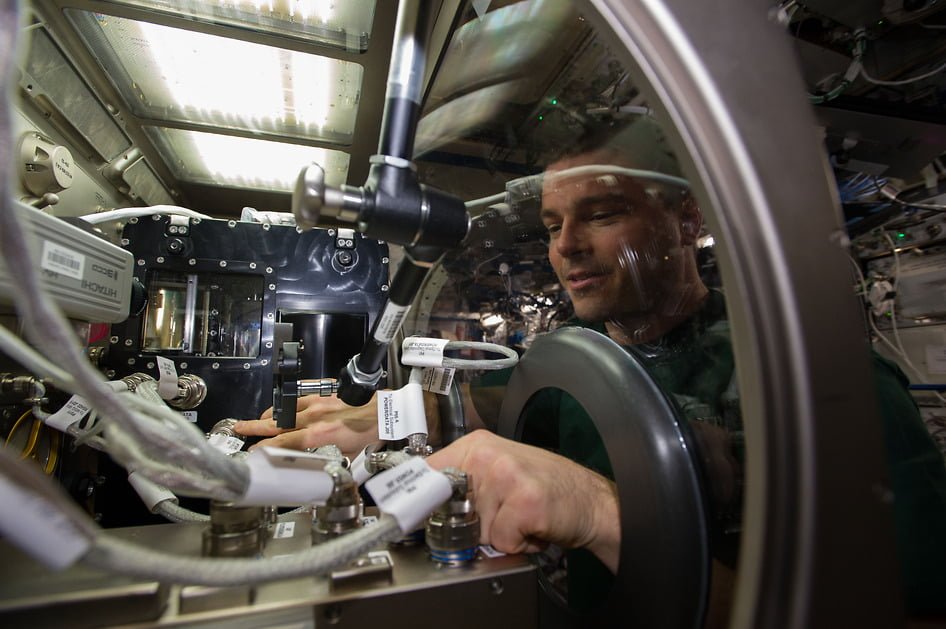
The Capillary Channel Flow Experiment
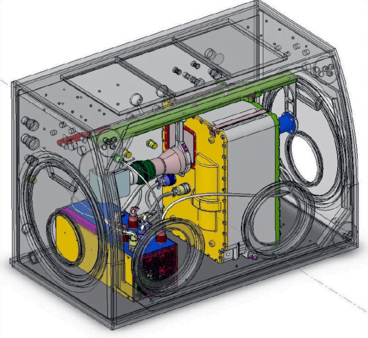

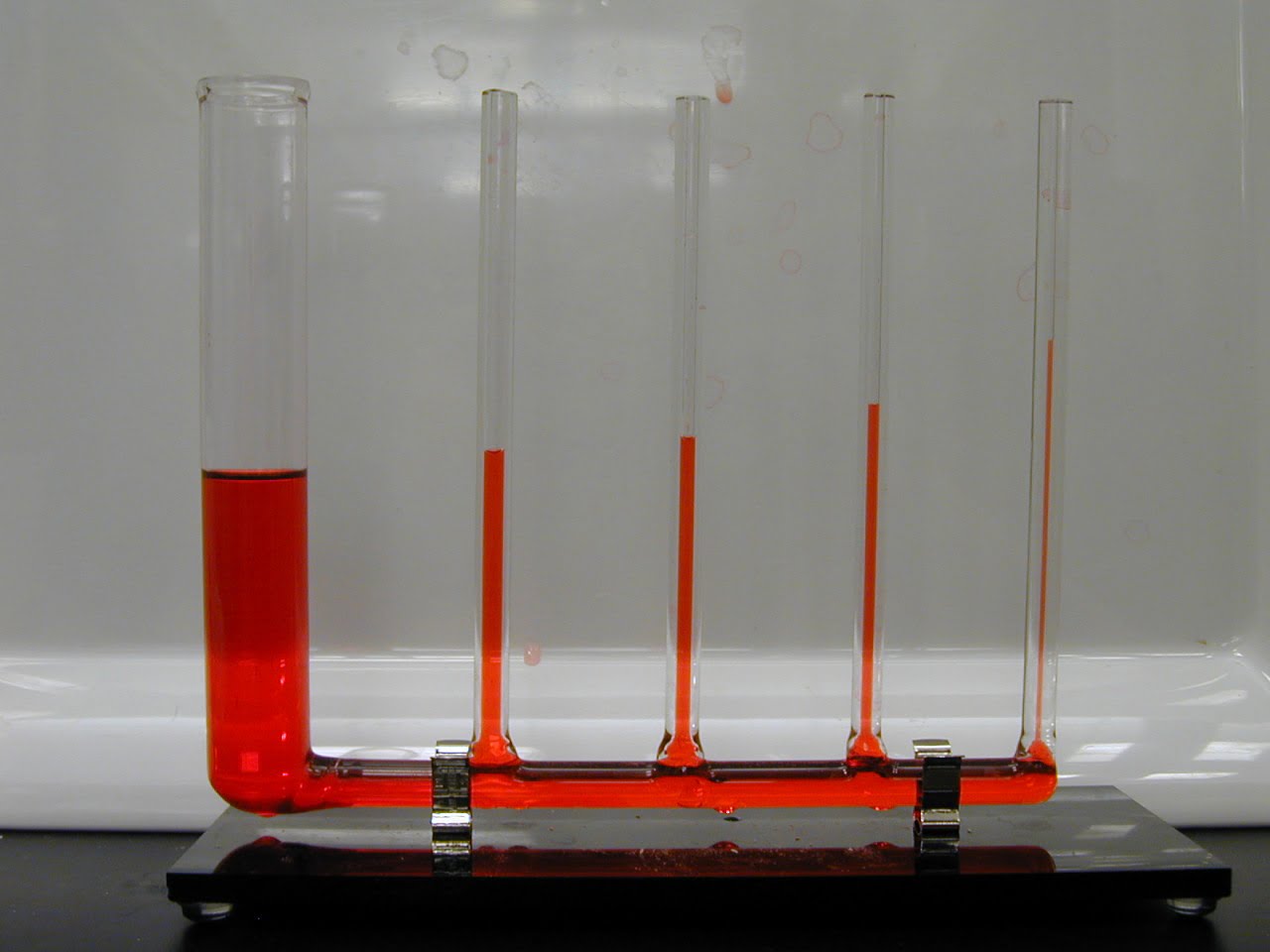
Moving fluids around in microgravity can be a challenge. On Earth we experience buoyancy and other gravitational effects that dominate how fluids move. In space, on the other hand, the only options are to move fluids mechanically with pumps or fans or to use capillary action. Even on earth, adhesive forces between a liquid and its solid container can draw fluids in narrow tubes upward against the force of gravity. In microgravity, this capillary flow can be even more effective. But the best way to study and understand this flow regime is to do so in space. The Capillary Channel Flow experiment and similar studies have allowed astronauts on the space station and researchers back on Earth to explore the effects of capillary action on microgravity fluid transport. The results will be used to improve propulsion systems, heat exchangers, and life support systems used in space. (Photo credits: NASA, M. Dreyer et al., and A. Agrawala; submitted by jshoer)
