“The Flow II” film by Bose Collins and colleagues features a ferrofluid, a magnetically-sensitive liquid made up of a carrier fluid like oil and many tiny, ferrous nanoparticles. Although ferrofluids are known for many strange behaviors, their most distinctive one is the spiky appearance they take on when exposed to a constant magnetic field. This peak-and-valley structure is known as the normal-field instability. It’s the result of the fluid attempting to follow the magnetic field lines upward. Gravity and surface tension oppose this magnetic force, allowing the fluid to be drawn upward only so far until all three forces balance. (Video credit: B. Collins et al.)
Search results for: “art”

Giant Bubbles
In their latest video, Gavin and Dan of The Slow Mo Guys demonstrate what giant bubbles look like in high-speed video from birth to death. Surface tension, which arises from the imbalance of intermolecular forces across the soapy-water/air interface, is the driving force for bubbles. As they move the wand, cylindrical sheets of bubble film form. These bubble tubes undulate in part because of the motion of air around them. In a cylindrical form, surface tension cannot really counteract these undulations. Instead it drives the film toward break-up into multiple spherical bubbles. You can see examples of that early in the video. The second half of the video shows the deaths of these large bubble tubes when they don’t manage to pinch off into bubbles. The soap film tears away from the wand and the destructive front propagates down the tube, tearing the film into fluid ligaments and tiny droplets (most of which are not visible in the video). Instead it looks almost as if a giant eraser is removing the outer bubble tube, which is a pretty awesome effect. (Video credit: The Slow Mo Guys)

Waterspouts
Waterspouts are commonly thought of as tornadoes over water, but this is only partially true. Some waterspouts do begin as tornadoes, but waterspouts are more commonly non-tornadic or fair-weather in origin. These non-tornadic waterspouts form when cold, dry air moves over warm water. As the warm, moist air rises, entrainment and conservation of angular momentum cause the air nearby to begin rotating. The spout does not actually suck water up from the surface. Instead, the humid rising air cools and the water vapor condenses, forming the cloud wall of the spout. Waterspouts are typically very short-lived and last 5 to 10 minutes before the inflowing air cools and the vortex weakens and dissipates. (Photo credit: U.S. Navy/K. Wasson)
Blood Flow Simulations
Though we may not often consider it, our bodies are full of fluid dynamics. Blood flow is a prime example, and, in this video, researchers describe their simulations of flow through the left side of the heart. Beginning with 3D medical imaging of a patient’s heart, they construct a computational domain – a meshed virtual heart that imitates the shape and movements of the real heart. Then, after solving the governing equations with an additional model for turbulence, the researchers can observe flow inside a beating heart. Each cycle consists of two phases. In the first, oxygenated blood fills the ventricle from the atrium. This injection of fresh blood generates a vortex ring. Near the end of this phase, the blood mixes strongly and appears to be mildly turbulent. In the second phase, the ventricle contracts, ejecting the blood out into the body and drawing freshly oxygenated blood into the atrium. (Video credit: C. Chnafa et al.)
Fireworks Taking Off
Aerial fireworks are essentially semi-controlled exploding rockets. Here Discovery Channel shares high-speed video of fireworks taking off. The turbulent billowing exhaust on the ground is reminiscent of other rocket launches. The tube-launched firework clip is a great example of an underexpanded nozzle. The pressure of the gases in the tube is higher than the ambient air, so when the gases escape, the exhaust fans out to equalize the pressure. And, finally, the explosion that propels the colorful chemicals outward forms jets that can affect the final form of the display. To my American readers: Happy 4th of July! And be safe! (Video credit: Discovery Slow-Down)

Reader Question: Rib Vortices
Reader tarastarr1 asks:
For the (awesome) wave gif and explanation, I think the asker was wondering about that little branch-like projection you can see in the top-middle part of the gif right after the camera submerges. Your explanation of the wave is great, but now I’m also wondering: if the wave is so powerful, how can that little jet form?
I think you’re probably right about the original question. I actually didn’t even notice that tiny vortex until after the post went up today! I think the little vortex is probably similar to the rib vortices I referenced at the end of the last post. If there happened to be some small localized rotation in the water initially, the wave’s passage would stretch it out. Stretching a vortex causes it to spin faster, exactly the way that an ice skater pulling her arms in causes her to spin faster – conservation of angular momentum! In that situation, the wave’s passage actually strengthens the vortex rather than destroying it.
Specialized’s Win Tunnel
Awhile back, I mentioned that bike manufacturer Specialized had built their own wind tunnel to test cycling equipment. In this video, they provide a walk-through of their facility. Although there are features unique to this tunnel and its intended purpose, much of what Chris and Mark describe is standard for any subsonic wind tunnel. The story begins upstream in the inlet and contraction, where air is pulled into the tunnel. Honeycomb flow straighteners direct the incoming air, followed by a series of mesh screens. These screens break up any turbulent eddies, which helps smooth and laminarize the flow. The test section is where measurements occur, whether on cyclists or other models. This part of the tunnel is usually equipped with many sensors and specialized equipment, like the balance shown. These allow researchers to measure quantities like force, velocity, pressure, and/or temperature. Then the wind tunnel widens gradually in a diffuser, which slows down the air and helps prevent disturbances from propagating upstream. Finally, the fans at the back provide the source of low-pressure that drives the air flow. (Video credit: Specialized Bicycles; submitted by J. Salazar)
Steam Hammer
The steam hammer phenomenon–and the closely related water hammer one–is a violent behavior that occurs in two-phase flows. Nick Moore has a fantastic step-by-step explanation of the physics, accompanied by high-speed footage, in the video above. Pressure and temperature are driving forces in the effect, beginning with the high-temperature steam that first draws the water up into the bottle. As the steam condenses into the cooler water, the steam’s pressure drops, drawing in more water. Eventually it drops low enough that the incoming water drops below the vapor pressure. This triggers some very sudden thermodynamic changes. The drop in pressure vaporizes incoming water, but the subsequent cloud cools rapidly, which causes it to condense but also drops the pressure further. Water pours in violently, cavitating near the mouth of the bottle because the acceleration there drops the local pressure below the vapor pressure again. The end result is a flow that’s part-water, part-vapor and full of rapid changes in pressure and phase. As you might imagine, the forces generated can destroy whatever container the fluids are in. Be sure to check out Nick’s bonus high-speed footage to appreciate every stage of the phenomenon. (Video credit and submission: N. Moore)

“Clourant”
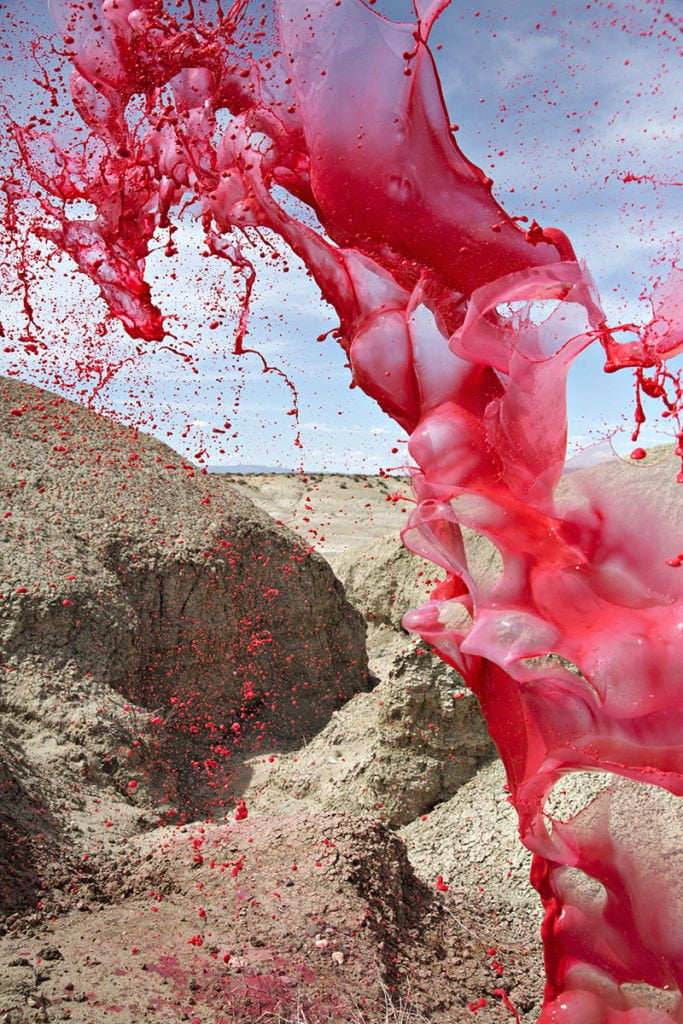
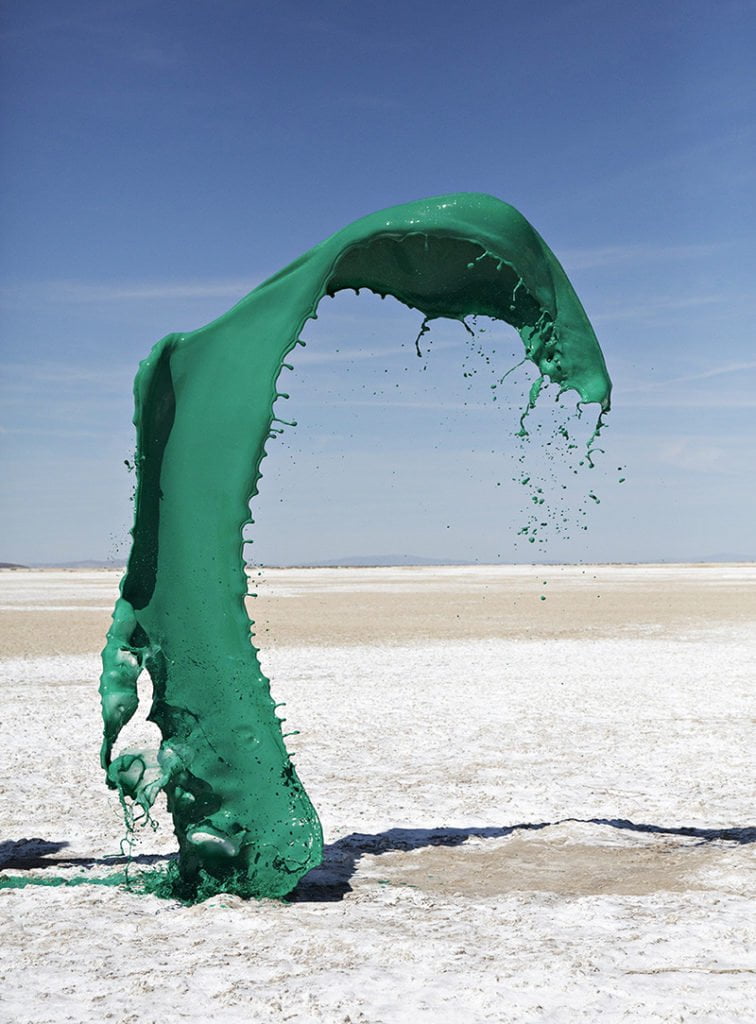

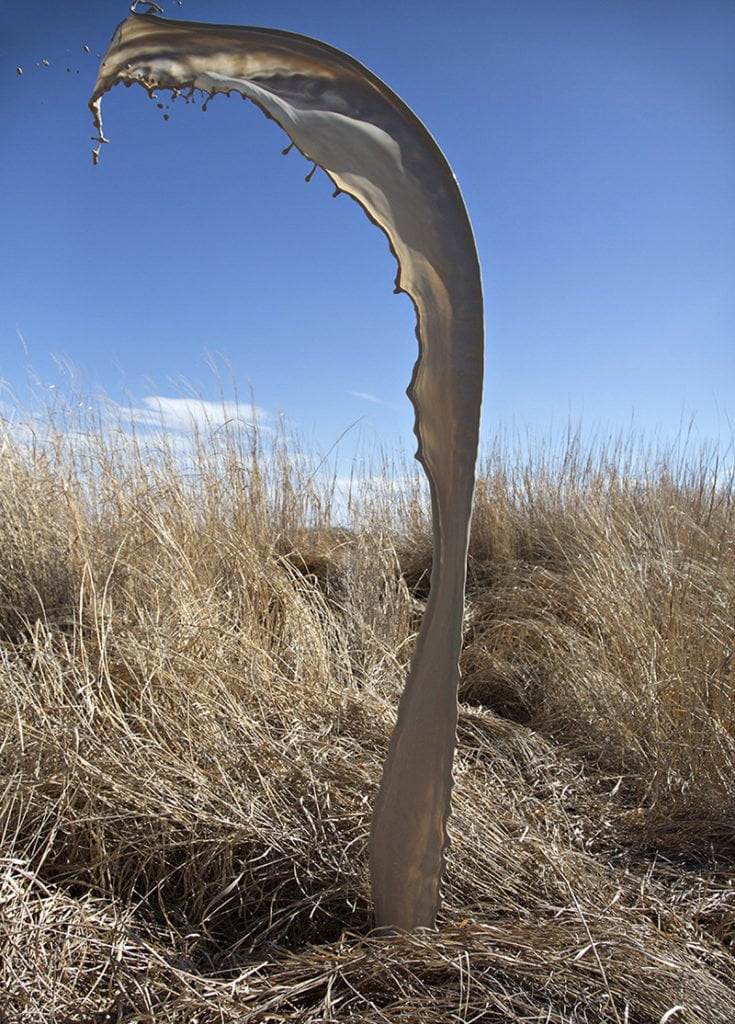
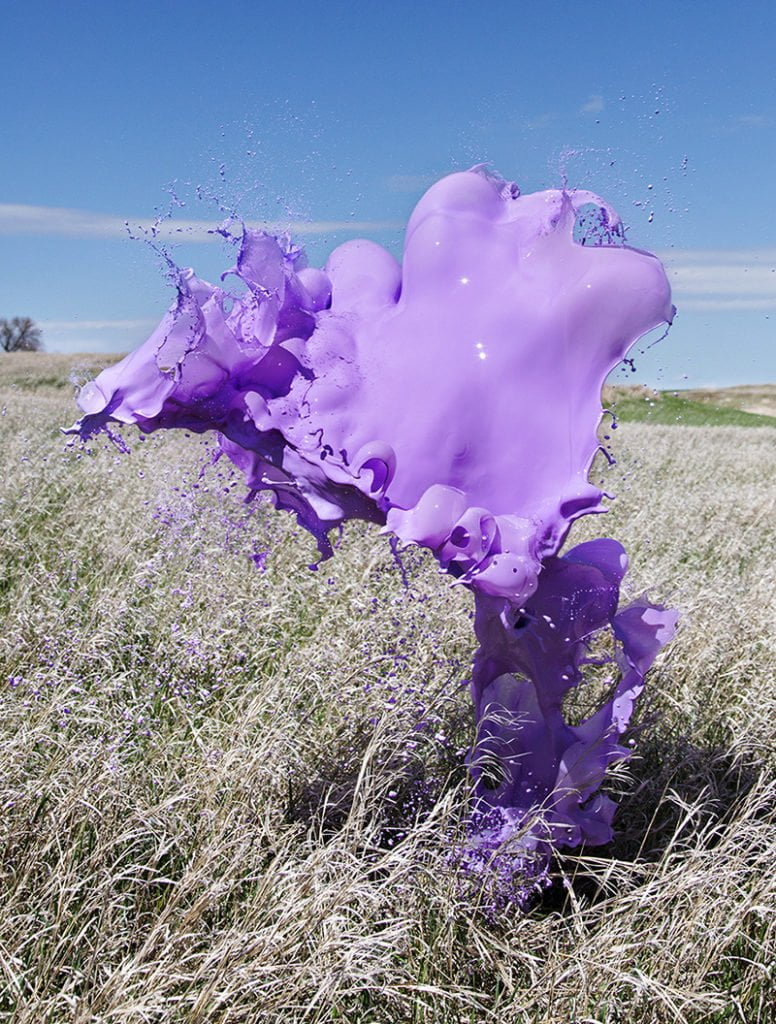


Photographers Cassandra Warner and Jeremy Floto produced the “Clourant” series of high-speed photographs of colorful liquid splashes. The artists took special care to disguise the origin of splashes, making them appear like frozen sculptures. The photos are beautiful examples of making fluid effects and instabilities. Many of them feature thin liquid sheets with thicker rims just developing ligaments. In other spots, surface tension has been wholly overcome by momentum’s effects and what was once ligaments has exploded into a spray of droplets. (Photo credit: C. Warner and J. Floto; submitted by jshoer; via Colossal)

The Magnus Effect in Football
Like many sports, the gameplay in football can be strongly affected by the ball’s spin. Corner kicks and free kicks can curve in non-intuitive ways, making the job of the goalie much harder. These seemingly impossible changes in trajectory are due to airflow around the spinning ball and what’s known as the Magnus effect. In the animation above, flow is moving from right to left around a football. As the ball starts spinning, the symmetry of the flow around the ball is broken. On top, the ball is spinning toward the incoming flow, and the green dye pulls away from the surface. This is flow separation and creates a high-pressure, low-velocity area along the top of the ball. In contrast, the bottom edge of the ball pulls dye along with it, keeping flow attached to the ball for longer and creating low pressure. Just as a wing has lift due to the pressure difference on either side of the wing, the pressure imbalance on the football creates a force acting from high-to-low pressure. In this case, that is a downward force relative to the ball’s rightward motion. In a freely moving football, this force would curve its trajectory to the side. (GIF credit: SkunkBear/NPR; original video: NASA Ames; via skunkbear)

