Last week we saw what happens when a solid projectile hits a water droplet; today’s video shows the impact of a laser pulse on a droplet. Several things happen here, but at very different speeds. When the laser impacts, it vaporizes part of the droplet within nanoseconds. A shock wave spreads from the point of impact and a cloud of mist sprays out. This also generates pressure on the impact face of the droplet, but it takes milliseconds–millions of nanoseconds–for the droplet to start moving and deforming. The subsequent explosion of the drop depends both on the laser energy and focus, which determine the size of the impulse imparted to the droplet. The motivation for the work is extreme ultraviolet lithography–a technique used for manufacturing next-generation semiconductor integrated circuits–which uses lasers to vaporize microscopic droplets during the manufacturing process. (Video credit: A. Klein et al.)
Search results for: “art”
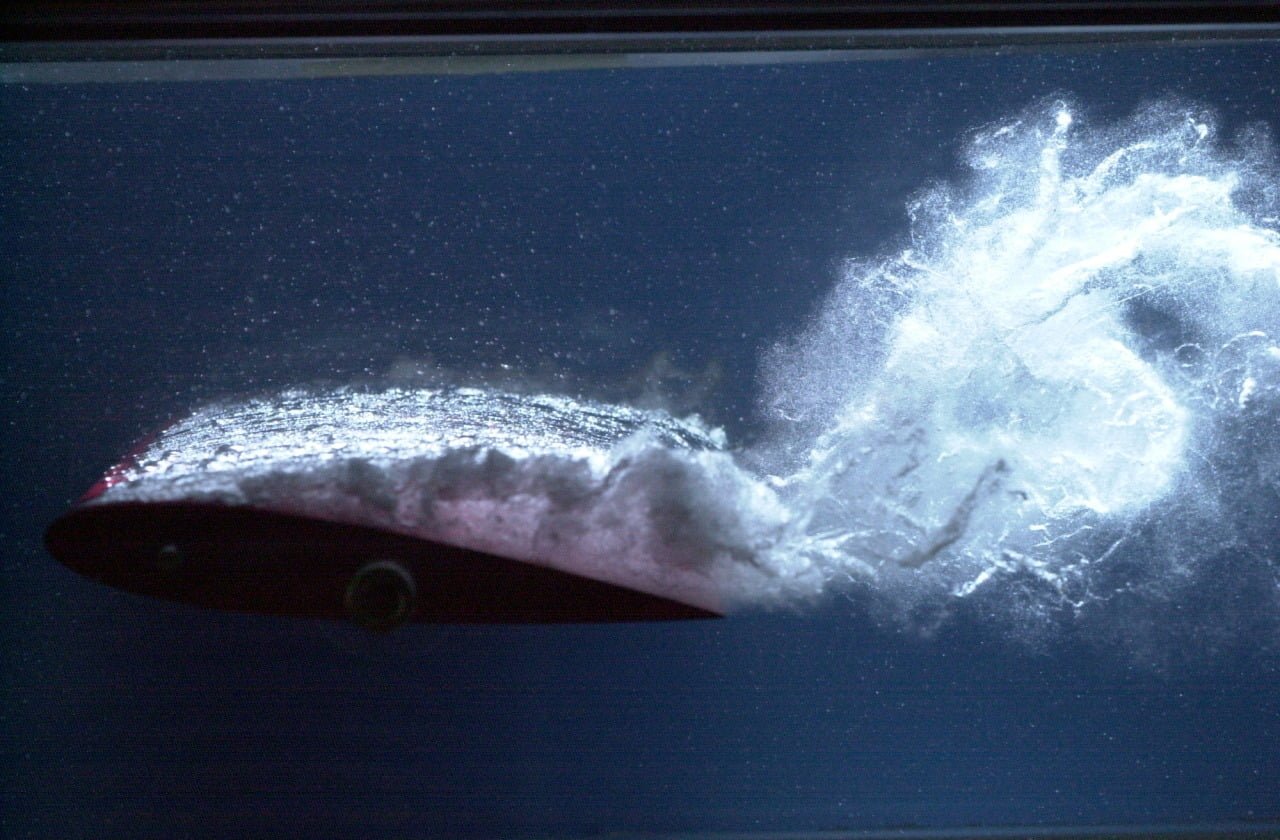
Hydrofoil Cavitation
A cavitation-induced bubbly sheet flows over the upper surface of a hydrofoil in the image above. Cavitation can occur when local pressure in a liquid drops below the vapor pressure, causing a cavity to form. Due to its angle of attack, water flowing over the upper surface of the hydrofoil is accelerated. The high flow velocities and accompanying low pressures over the top of the hydrofoil produce cavitation bubbles which continue to flow over and off the surface. Because cavitation bubbles implode when the pressure again increases, they can cause serious damage to solid surfaces. This is why generating cavitation can damage propellers or shatter a bottle. (Photo credit: R. Arndt et al.)

Shooting Droplets
This animation shows high-speed video of a polystyrene particle striking a falling water droplet. Under the right conditions, the particle rips through the droplet, stretching the water into a bell-shaped lamella extending from a thicker rim. When the particle detaches, surface tension rapidly collapses the lamella into a ring which destabilizes. Thin ligaments and droplets fly off the crown-like ring as momentum overcomes surface tension’s ability to hold the droplet together. Be sure to check out the full video on YouTube or later next month at the APS Division of Fluid Dynamics meeting. (Yes, I will be there!) (Image credit: V. Sechenyh et al., source video)
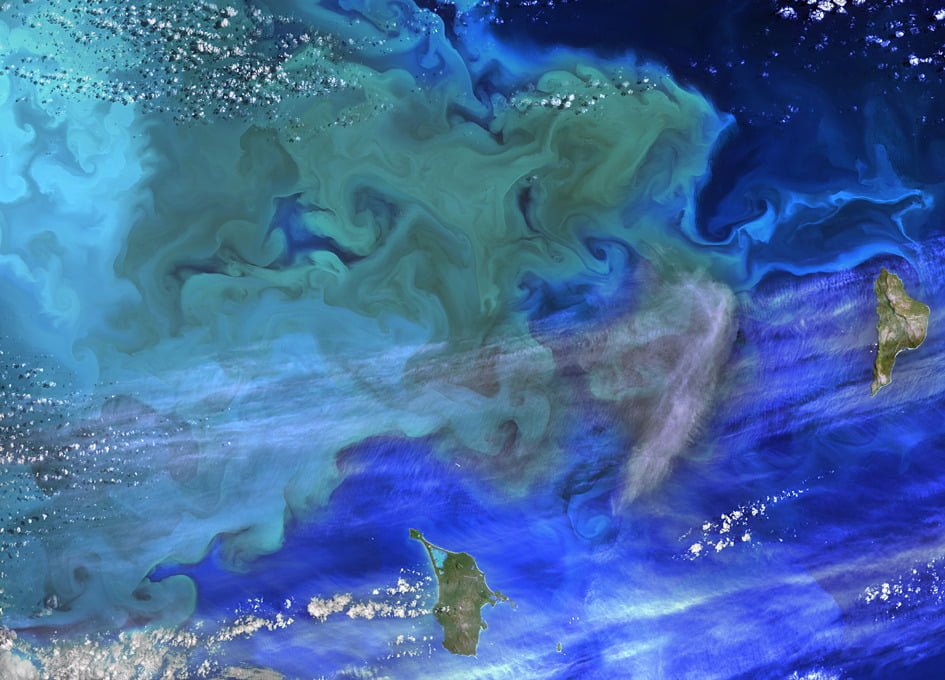
Phytoplankton Bloom
In satellite imagery the blue and green whorls of massive phytoplankton blooms stand out against the ocean backdrop. These microscopic organisms are part of a delicate predator-prey balance and can be very sensitive to nutrient concentrations and other environmental conditions. Their individual size is negligible, but in a bloom phytoplankton are numerous enough that they act as seed particles for the flow. As a result, differing concentrations of phytoplankton reveal the swirling, turbulent mixing of ocean waters. (Image credit: NASA/USGS; via SpaceRef; submitted by jshoer)

Bouncing with Liquids and Grains
Bouncing a ball partially filled with a liquid can create chaotic results when the motion of the ball, fluid, and vibration plate couple. The behavior of a grain-filled ball is a bit different, though. Large grains will tend to bounce with the same frequency as the ball, even across a range of vibration conditions. A ball filled with smaller grains displays a variety of responses depending on the vibration conditions. Among these is a localized wave-like form called an oscillon which oscillates with a period different from but coupled to that of the vibration plate. All these different behaviors inside the bouncing sphere have noticeable effects on its outward motion, too. The chaotic activity of the fluid inside a bouncing ball makes it unstable, and, if not confined, it will bounce itself off the vibration platform. The grain-filled ball, on the other hand, remains bouncing on the platform even after being perturbed. This seems to be a result of the energy dissipation provided by the many inelastic collisions inside the ball as it bounces. (Video credit: F. Pacheco-Vazquez et al.)
Turbine Blade Separation
[original media no longer available]
Maintaining consistent air flow along the contours of an object is key to aerodynamic efficiency. When air flow separates or forms a recirculation zone, the drag increases and efficiency drops. On wind turbine blades, flow often separates on the root end of the blade near its attachment point. This behavior is apparent in the video above at 0:34. The tufts in the foreground on the turning blade flap and flutter with no clear pattern because the air flow has separated from the surface. In the subsequent clip, a line of vortex generators has been attached near the leading edge of the blade. These structures–also commonly seen on airplanes–trail vortices behind them, mixing the flow and generating a turbulent boundary layer which is better able to resist flow separation. The effect on the flow is clear from the tufts, most of which now point in a consistent direction with little to no fluttering, indicating that the air flow has remained attached. (Video credit: Smart Blade Gmbh/Technische Universität Berlin)
(Source: /)
Hovering
Designer Eleanor Lutz used high-speed video of five different flying species to create this graphic illustrating the curves swept out in their wingbeats. The curves are constructed from 15 points per wingbeat and are intended more as art than science, but they’re a fantastic visualization of several important concepts in flapping flight. For example, note the directionality of the curves as a whole. If you imagine a vector perpendicular to the wing curves, you’ll notice that the bat, goose, and dragonfly would all have vectors pointing forward and slightly upward. In contrast, the moth and hummingbird would have vectors pointing almost entirely upward. This is because the moth and hummingbird are hovering, so their wing strokes are oriented so that the force produced balances their weight. The bat, goose, and dragonfly are all engaged in forward flight, so the aerodynamic force they generate is directed to counter their weight and to provide thrust. (Image credit: E. Lutz; via io9)
Bardarbunga Eruption
I thought I was done with volcanoes for this week, but DJI’s aerial footage from Iceland’s Bardarbunga eruption is too fantastic not to share. The eruption is over a month old now and more than 25,000 earthquakes have been registered in Iceland since this eruption began. The lava field covers more than 46 square kilometers, and experts remain unsure how long the eruption will continue. The lava itself is a basalt, which is lower in viscosity than more silica-rich lava. This lower viscosity means that the gases dissolved in the rising magma can escape more easily, like carbon dioxide fizzing out of a soda. If the lava’s viscosity were higher, those dissolved gases would generate a more explosive eruption as they try to escape. (Video credit: DJI; via Wired)
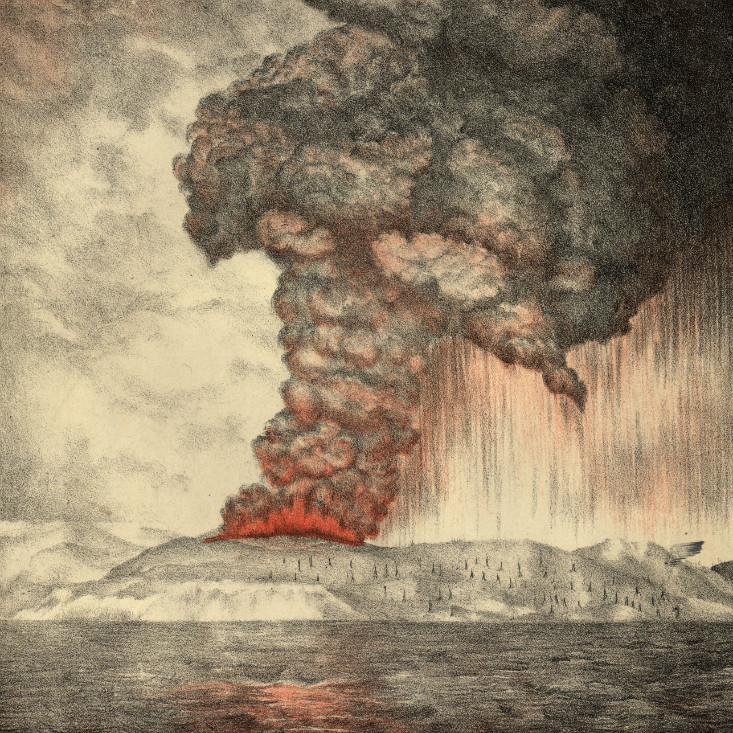
Krakatoa
Volcanoes seem to be a common topic these days. Yesterday Nautilus published a great piece by Aatish Bhatia on the 1883 eruption of Krakatoa, which tore the island apart and unleashed a sound so loud it was heard more than 4800 km away:
The British ship Norham Castle was 40 miles from Krakatoa at the time of the explosion. The ship’s captain wrote in his log, “So violent are the explosions that the ear-drums of over half my crew have been shattered. My last thoughts are with my dear wife. I am convinced that the Day of Judgement has come.“
In general, sounds are caused not by the end of the world but by fluctuations in air pressure. A barometer at the Batavia gasworks (100 miles away from Krakatoa) registered the ensuing spike in pressure at over 2.5 inches of mercury. That converts to over 172 decibels of sound pressure, an unimaginably loud noise. To put that in context, if you were operating a jackhammer you’d be subject to about 100 decibels. The human threshold for pain is near 130 decibels, and if you had the misfortune of standing next to a jet engine, you’d experience a 150 decibel sound. (A 10 decibel increase is perceived by people as sounding roughly twice as loud.) The Krakatoa explosion registered 172 decibels at 100 miles from the source. This is so astonishingly loud, that it’s inching up against the limits of what we mean by “sound.” #
Those are some mindbogglingly enormous numbers. Aatish does a wonderful job of explaining the science behind an explosion whose effects ricocheted through the atmosphere for days afterward. Check out the full article over at Nautilus. (Image credit: Parker & Coward, via Wikipedia)
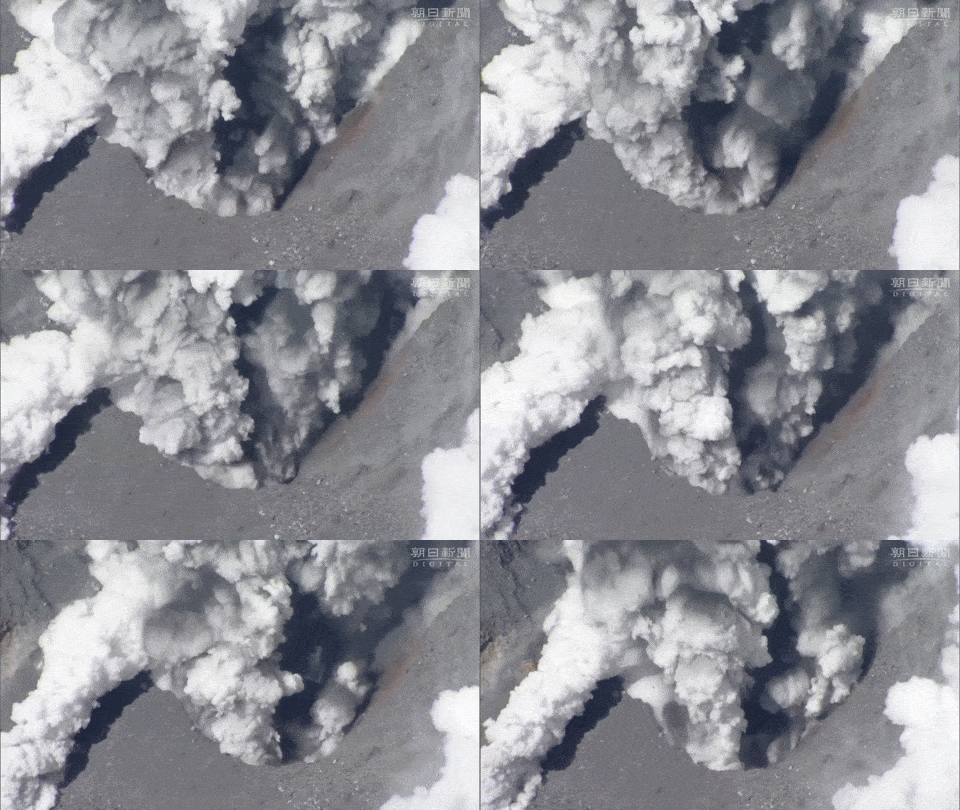
Pyroclastic Flow
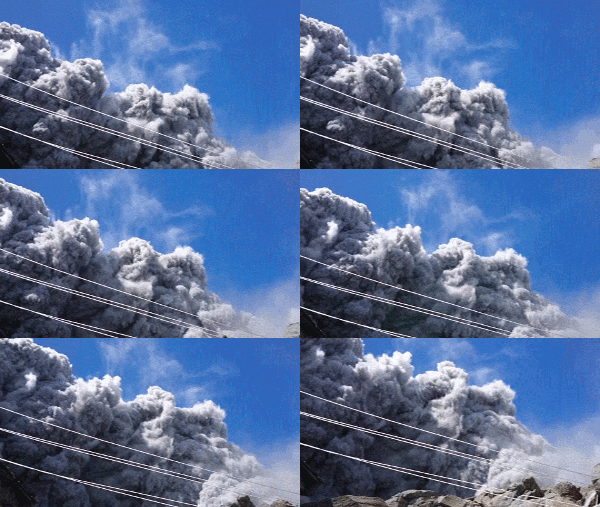
Saturday morning Japan’s Mount Ontake erupted unexpectedly, sending a pyroclastic flow streaming down the mountain. Many, though sadly not all, of the volcano’s hikers and visitors survived the eruption. Pyroclastic flows are fast-moving turbulent and often super-heated clouds filled with ash and poisonous gases. They can reach speeds of 700 kph and temperatures of 1000 degrees C. The usual gases released in a pyroclastic flow are denser than air, causing the cloud to remain near the ground. This is problematic for those trying to escape because the poisonous gases can fill the same low-lying areas in which survivors shelter. Heavy ashfall from the flow can destroy buildings or cause mudslides, and the fine volcanic glass particles in the ash are dangerous to inhale. The sheer power and scale of these geophysical flows is stunning to behold. Those who have witnessed it firsthand and survived are incredibly fortunate. For more on the science and history of Mount Ontake, see this detailed write-up at io9. (Image credits: A. Shimbun, source video; K. Terutoshi, source video; via io9)
