The freediving del Rosario brothers have created a real treat with this underwater film. There are no computer-generated special effects, just some clever tricks with camera angles, perspective, and buoyancy. The end result is slightly surrealistic and captures some of the fluid beauty of the ocean. And don’t miss the excellent bubble ring vortices. (Video credit: The Ocean Brothers; via Gizmodo; submitted by jshoer)
Search results for: “art”

Saturnian Auroras

Earth is not the only planet in our solar system with auroras. As the solar wind–a stream of rarefied plasma from our sun–blows through the solar system, it interacts with the magnetic fields of other planets as well as our own. Saturn’s magnetic field second only to Jupiter’s in strength. This strong magnetosphere deflects many of the solar wind’s energetic particles, but, as on Earth, some of the particles get drawn in along Saturn’s magnetic field lines. These lines converge at the poles, where the high-energy particles interact with the gases in the upper reaches of Saturn’s atmosphere. As a result, Saturn, like Earth, has impressive and colorful light displays around its poles. (Image credit: ESA/Hubble, M. Kornmesser & L. Calçada, source video; via spaceplasma)

City Winds Simulated
Anyone who has spent much time in an urban environment is familiar with the gusty turbulence that can be generated by steady winds interacting with tall buildings. To the atmospheric boundary layer–the first few hundred meters of atmosphere just above the ground–cities, forests, and other terrain changes act like sudden patches of roughness that disturb the flow and generate turbulence. The video above shows a numerical simulation of flow over an urban environment. The incoming flow off the ocean is relatively calm due to the smoothness of the water. But the roughness of an artificial island just off the coast acts like a trip, creating a new and more turbulent boundary layer within the atmospheric boundary layer. It’s this growing internal boundary layer whose turbulence we see visualized in greens and reds. (Video credit: H. Knoop et al.)
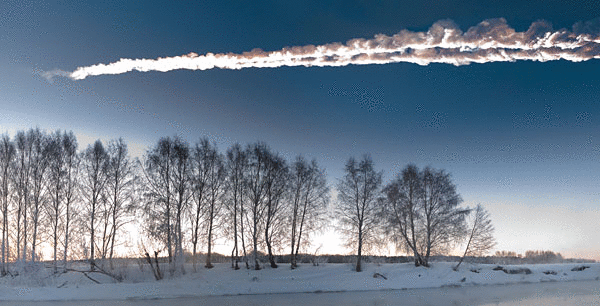
The Chelyabinsk Meteor
In February 2013 a meteor streaked across the Russian sky and burst in midair near Chelyabinsk. A recent Physics Today article summarizes what scientists have pieced together about the meteor, from its origins to its demise. The whole article is well worth reading. Here’s a peek:
The Chelyabinsk asteroid first felt the presence of Earth’s atmosphere when it was thousands of kilometers above the Pacific Ocean. For the next dozen minutes, the 10 000-ton rock fell swiftly, silently, and unseen, passing at a shallow angle through the rarefied exosphere where the molecular mean free path is much greater than the 20-m diameter of the rock. Collisions with molecules did nothing to slow the gravitational acceleration as it descended over China and Kazakhstan. When it crossed over the border into Russia at 3:20:20 UT and was 100 km above the ground, 99.99997% of the atmosphere was still beneath it.
Because the asteroid was moving much faster than air molecules could get out of its way, the molecules began to pile up into a compressed layer of high-temperature plasma pushing a shock wave forward. Atmospheric density increases exponentially with depth, so as the asteroid plunged, the plasma layer thickened and its optical opacity rapidly increased. About one second later, at 95 km above the surface, it became bright enough to be seen from the ground. That was the first warning that something big was about to happen. #
How often are scientific articles that gripping?! Kring and Boslough provide some excellent descriptions of the aerodynamics of the meteor and its airburst. Be sure to check it out. (Photo credit: M. Ahmetvaleev; paper credit: D. Kring and M. Boslough; via io9)
Turning Into 2D
UCLA Spinlab has another great video demonstrating the effects of rotation on a fluid. In a non-rotating fluid, flow over an obstacle is typically three-dimensional, with flow moving over as well as around the object. But in a steadily rotating fluid, as shown in the latter half of the video, the flow only moves around the obstacle, not over it. This non-intuitive behavior is part of the Taylor-Proudman theorem, which shows that flow around an obstacle in a rapidly rotating fluid will be two-dimensional and confined to planes perpendicular to the axis of rotation. (For the mathematically-inclined, Wikipedia does have a short derivation.) This 2D flow creates what are called Taylor columns over the obstacle. The Taylor column is like an imaginary extension of the original obstacle, turning the puck into a tall cylinder, and it’s real enough to flow, which diverts around it as though the column were there. (Video credit: UCLA Spinlab)

Transonic Flow
In the transonic speed regime the overall speed of an airplane is less than Mach 1 but some parts of the flow around the aircraft break the speed of sound. The photo above shows a schlieren photograph of flow over an airfoil at transonic speeds. The nearly vertical lines are shock waves on the upper and lower surfaces of the airfoil. Although the freestream speed in the tunnel is less than Mach 1 upstream of the airfoil, air accelerates over the curved surface of airfoil and locally exceeds the speed of sound. When that supersonic flow cannot be sustained, a shock wave occurs; flow to the right of the shock wave is once again subsonic. It’s also worth noting the bright white turbulent flow along the upper surface of the airfoil after the shock. This is the boundary layer, which can often separate from the wing in transonic flows, causing a marked increase in drag and decrease in lift. Most commercial airliners operate at transonic Mach numbers and their geometry is specifically designed to mitigate some of the challenges of this speed regime. (Image credit: NASA; via D. Baals and W. Corliss)

Volcanic Vortex
This infrared image shows a kilometer-high volcanic vortex swirling over the Bardarbunga eruption. The bright red at the bottom is lava escaping the fissure, whereas the yellow and white regions show rising hot gases. Although the vortex looks similar to a tornado, it is actually more like a dust devil or a so-called fire tornado. All three of these vortices are driven by a heat source near the ground that generates buoyant updrafts of air. As the hot gases rise, cooler air flows in to replace them. Any small vorticity in that ambient air gets amplified as it’s drawn to the center, the same way an ice skater spins faster when she pulls her arms in. With the right conditions, a vortex can form. Unlike a harmless dust devil, though, this vortex is likely filled with sulphur dioxide and volcanic ash and would pose a serious hazard to aviation. (Image credit: Nicarnica Aviation; source video; via io9)
Reconfigurable Liquid Metal
Terminator 2’s T-1000, a liquid metal robot capable of changing its shape at will, just became a little less far-fetched. Researchers at NC State have reported a new method for controlling the form of a liquid gallium alloy. Surface tension governs the shape a liquid assumes when it is not confined by a container, and, although adding surfactants can slightly lower the surface tension, it does not substantially alter the liquid’s shape. Adding soap to water lets one make bubbles, but surface tension keeps the bubbles spherical no matter how much soap you add. Instead, these researchers control the surface tension of the liquid metal using a mild voltage. Applying a voltage creates (or removes) an oxide layer on the liquid metal’s surface, thereby altering the surface tension. By controlling the formation of the oxide layer, the researchers can change the surface tension from approximately 7x that of water to nearly zero. The video above demonstrates some of the liquid shape control this lets them achieve. (VIdeo credit: M. Dickey et al.; research: M. Khan et al.; via PopSci)

Beading Fluids
Adding just a few polymers to a liquid can substantially change its behavior. The presence of polymers turns otherwise Newtonian fluids like water into viscoelastic fluids. When deformed, viscoelastic fluids have a response that is part viscous–like other fluids–and part elastic–like a rubber band that regains its initial shape. The collage above shows what happens to a thinning column of a viscoelastic fluid. Instead of breaking into a stream of droplets, the liquid forms drop connected with a thin filament, like beads on a string. In a Newtonian fluid, surface tension would tend to break off the drops at their narrowest point, but stretching the polymers in the viscoelastic fluid provides just enough normal stress to keep the filament intact. If the effect looks familiar, it may be because you’ve seen it in the mirror. Human saliva is a viscoelastic liquid! (Image credit: A. Wagner et al.)
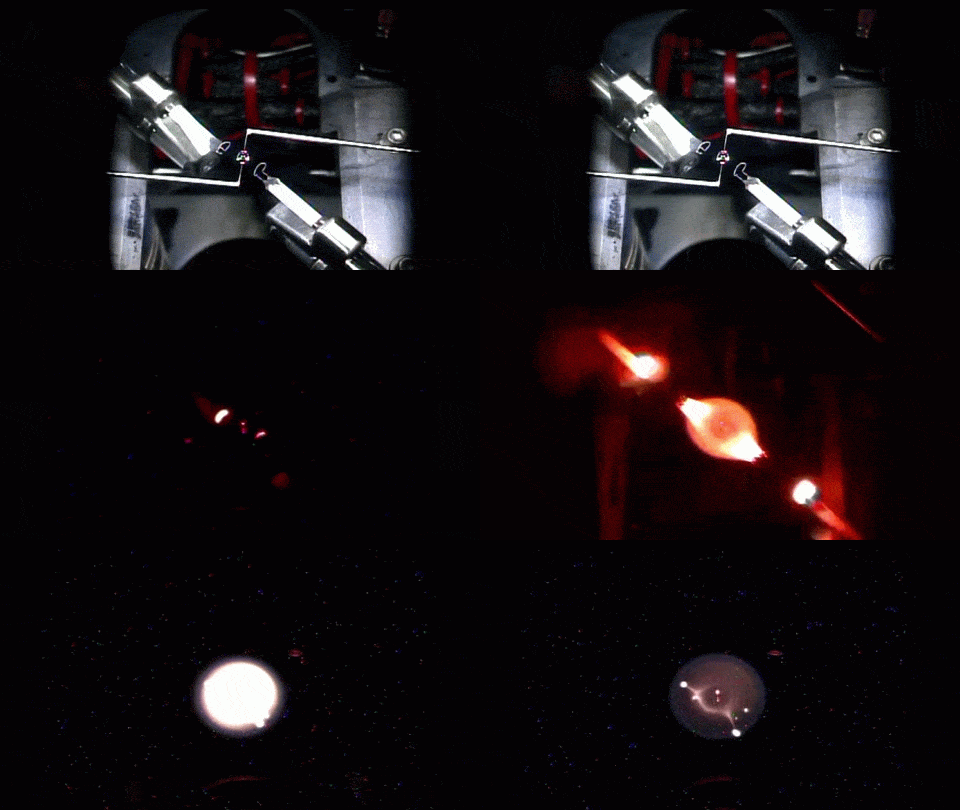
Flames in Space
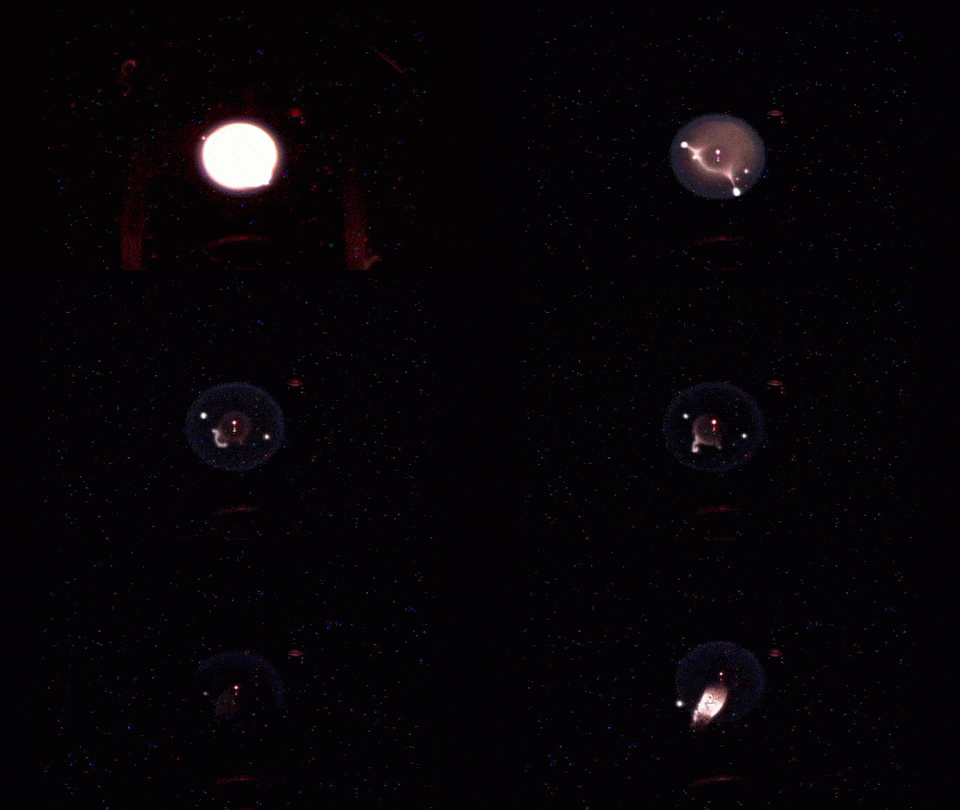

The jellyfish-like light show in the animations above shows the life and death of a flame in microgravity. The work is part of the Flame Extinguishment Experiment 2 (FLEX-2) currently flying aboard the International Space Station. When ignited, the fuel droplet creates a blue spherical shell of flame about 15 mm in diameter. The spherical shape is typical of flames in microgravity; on Earth, flames are shaped like teardrops due to the effects of buoyancy, which exists only in a gravitational field. The bright yellow spots and streaks that appear after ignition are soot, which consists mainly of hot-burning carbon. The uneven distribution of soot is what causes the pulsating bursts seen in the middle animation. When soot products drift back onto the fuel droplet, it causes uneven burning and flame pulses. The final burst of flame in the last animation is the soot igniting and extinguishing the flame. Fires are a major hazard in microgravity, where oxygen supplies are limited and evacuating is not always an option. Scientists hope that experiments like FLEX-2 will shed light on how fires spread and can be fought aboard spacecraft. For more, check out NASA’s ScienceCast on microgravity flames. (Image credits: NASA, source video; submitted by jshoer)