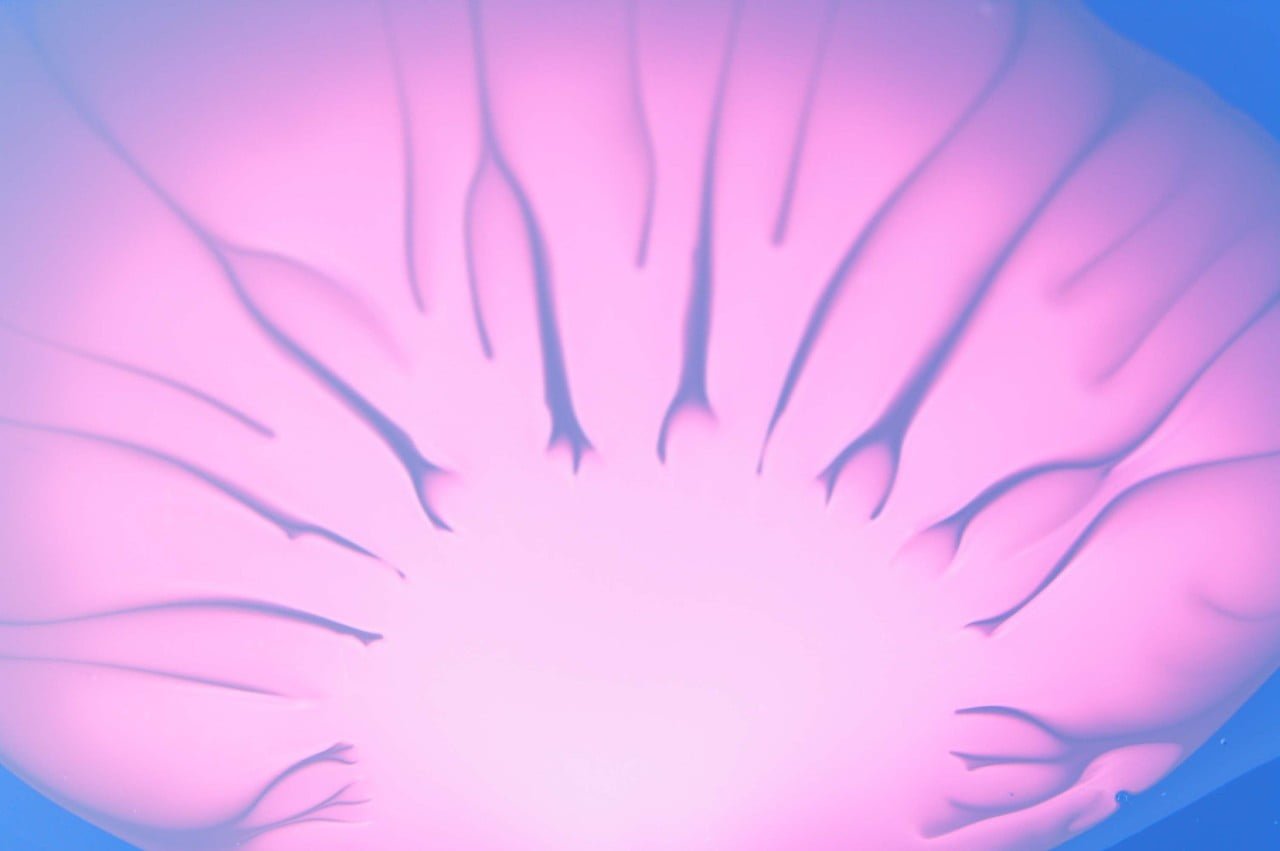
Differences in viscosity or surface tension between two fluids can lead to finger-like instabilities. Here food dye placed on corn syrup forms narrow tendrils driven by the differing surface tensions of the two liquids. Similar dendritic shapes can be generated by injecting a low viscosity fluid into a high viscosity one (Saffmann-Taylor instability) or by pulling apart glass plates sandwiched around a high viscosity fluid. (Photo credit: T. Gaskill et al.)
Search results for: “art”

What’s in a Splash?
A droplet falling onto a solid, dry surface seems like a simple situation, one that would be easy to understand. But splashes can be unpredictable. Velocity, viscosity, and surface tension all play clear roles, but the surrounding air also has an impact – drop the air pressure low enough and a droplet won’t splash. A new paper has tackled the problem, producing a mathematical model in agreement with experimental results. So why do some drops splash and others don’t? When a drop falls, its momentum flattens it into a pancake shape while surface tension struggles to hold it together. The spreading edge, called the lamella, can pull away from the surface. When it does, a pocket of high pressure forms beneath it due to lubrication effects, and the faster airflow over the top of the lamella creates a suction effect. This is analogous to a wing producing lift. Like the momentum that spread the droplet, the lift force pulls the lamella and ejecta sheet further up and outward, overcoming the restoring force of surface tension and tearing the droplet apart. For more on the effect, check out the research paper or this Inside Science article. (Video credit: G. Riboux and J. Gordillo; via Inside Science)

Champagne Bubble Physics
Champagne is well-known for its effervescence, but its tiny bubbles do more than affect your sensation when sipping. Champagne bubbles form when carbon dioxide dissolved in the wine nucleates along imperfections in the glass. Buoyancy causes them to flow upwards, growing as they pull more carbon dioxide from the surrounding champagne. When the bubbles reach the surface, they pop, sending an almost imperceptible fountain of tiny droplets into the air, as seen in the photo above. You can sometimes feel the droplets if you hold a glass near your face. The droplets released from the bursting champagne bubbles spread the aroma of the wine, imparting additional flavor through our olfactory sense. (Photo credit: F. Beaumont et al.)
Healing Bubbles
Soap bubbles are ephemeral creations. The slightest prick will send them tearing apart in the blink of an eye. It may come as a surprise, therefore, that dropping a water droplet through a bubble will not break it. Instead, the bubble will heal itself using the Marangoni effect. In a soap bubble, the soap molecules act as a surfactant, lowering the surface tension of the water and allowing the fragile structure to hold together. When the water drop impacts the bubble, the local surface tension increases because of the relative lack of soap molecules. This increase in surface tension pulls at the rest of the bubble, drawing more soap molecules toward the point of contact. The effect evens out surface tension across the surface and stabilizes the bubble. You can test the effect at home, too. If you wet your finger, you can poke a soap bubble without popping it. (Video credit: G. Mitchell; via io9)

Pyrocumulus Clouds
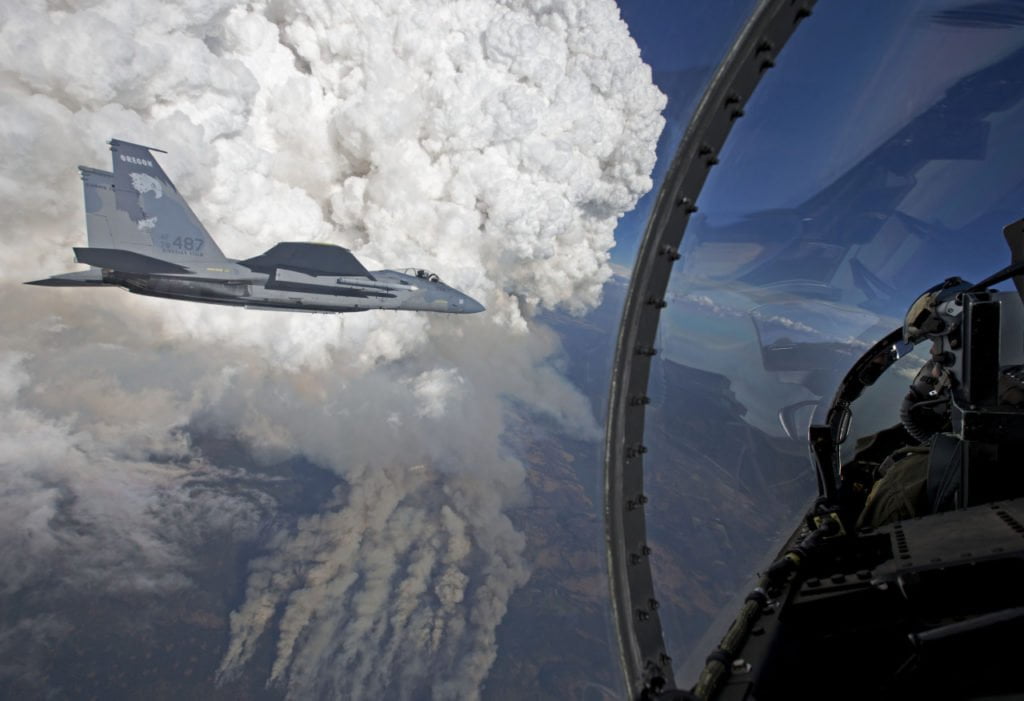
Pyrocumulus clouds tower tall above a wildfire in these photos taken last week from an Oregon National Guard F-15C. Most cumulus clouds form when the sun-warmed surface heats air, causing it to rise and carry moisture upward where it condenses to form clouds. In pyrocumulus clouds, the driving heat is supplied by a forest fire or volcanic eruption. The hot, rising air carries smoke and soot particles upward, where they become nucleation sites for condensation. Pyrocumulus clouds can be especially turbulent, and the gusting winds they produce can exacerbate wildfires. In some cases, the clouds can even develop into a pyrocumulonimbus thunderstorm with rain and lightning. (Photo credit: J. Haseltine; via NASA Earth Observatory)
Reader Question: Winglets
Reader tvargo writes:
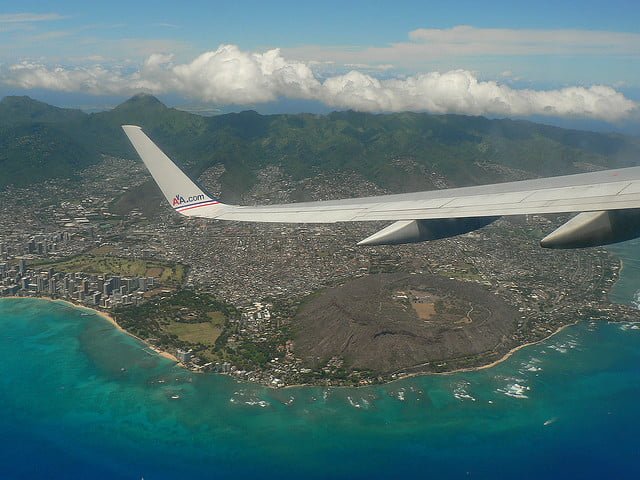
First off… love your blog! I know very little about physics, but love reading about it. Could you potentially explain what the little upturned ends of wings do? looking on wikipedia is see this: “There are several types of wingtip devices, and although they function in different manners, the intended effect is always to reduce the aircraft’s drag by partial recovery of the tip vortex energy.” huh?
Thanks! That’s a great question. Winglets are very common, especially on commercial airliners. To understand what they do, it’s helpful to first think about a winglet-less airplane wing. Each section of the wing produces lift. For a uniform, infinite wing, the lift produced at each spanwise location would be the same. In reality, though, wings are finite and wingtip vortices at their ends distort the flow. The vortices’ upward flow around the ends of the wing reduces the lift produced at the wing’s outermost sections, making the finite wing less efficient (though obviously more practical) than an infinite wing.
Adding a winglet modifies the end conditions, both by redirecting the wingtip vortices away from the underside of the wing and by reducing the strength of the vortex. Both actions cause the winglet-equipped wing to produce more lift near the outboard ends than a wing without winglets.
But why, you might ask, does the Wikipedia explanation talk about reducing drag? Since a finite wing produces less lift than an infinite one, finite wings must be flown at a higher angle of attack to produce equivalent lift. Increasing the angle of attack also increases drag on the wing. (If you’ve ever stuck a tilted hand out a car window at speed, then you’re familiar with this effect.) Because the winglet recovers some of the lift that would otherwise be lost, it allows the wing to be flown at a lower angle of attack, thereby reducing the drag. Thus, overall, adding winglets improves a wing’s efficiency. (Photo credit: C. Castro)

The Real Shape of Raindrops
We often think of raindrops as spherical or tear-shaped, but, in reality, a falling droplet’s shape can be much more complicated. Large drops are likely to break up into smaller droplets before reaching the ground. This process is shown in the collage above. The initially spherical drops on the left are exposed to a continuous horizontal jet of air, similar to the situation they would experience if falling at terminal velocity. The drops first flatten into a pancake, then billow into a shape called a bag. The bags consists of a thin liquid sheet with a thicker rim of fluid around the edge. Like a soap bubble, a bag’s surface sheet ruptures quickly, producing a spray of fine droplets as surface tension pulls the damaged sheet apart. The thicker rim survives slightly longer until the Plateau-Rayleigh instability breaks it into droplets as well. (Image credit: V. Kulkarni and P. Sojka)
4th Birthday: Intro
Next week marks FYFD’s 4th birthday! It’s hard to believe that it’s been so long, or that the blog and I have come so far. I set out with the intention of explaining fluid dynamics to a broad audience because it’s a subject we all experience daily and yet one that few learn formally. (I also, as you may have guessed from the blog’s name, didn’t take things too seriously.) Many things have surprised me these past four years, but one of my favorites is how much I’ve learned. In researching and writing FYFD, I am constantly learning new and fascinating physics. I love it every time something new stuns me with its beauty, its cleverness, or its jaw-dropping, mind-blowing awesomeness. In celebration of that feeling, next week’s posts will revisit some of my favorite subjects, especially those that did and do amaze me. In the meantime, try not to let the ice cream melt. Unless you’re into that. (Video credit: I. Yang; submitted by Stuart B.)
Catching Prey
Over at Smarter Every Day, Destin has a new video, this time about how fish eat, which involves some pretty awesome physics. Instead of accelerating their entire body to close the distance to prey, fish thrust their jaws forward. As they do, they open their mouth, expanding the volume there and lowering the pressure. This causes water to flow into their mouth, pulling the prey with it. But the water has momentum, which would push the fish backward. To prevent this, the fish then opens its gills, allowing the water to rush back out while trapping the prey in its mouth. Be sure to check out Destin’s video so that you can see the process in high-speed. (Video credit: Smarter Every Day)

Hummingbird Hovering
The hummingbird has long been admired for its ability to hover in flight. The key to this behavior is the bird’s capability to produce lift on both its downstroke and its upstroke. The animation above shows a simulation of hovering hummingbird. The kinematics of the bird’s flapping–the figure-8 motion and the twist of the wings through each cycle–are based on high-speed video of actual hummingbirds. These data were then used to construct a digital model of a hummingbird, about which scientists simulated airflow. About 70% of the lift each cycle is generated by the downstroke, much of it coming from the leading-edge vortex that develops on the wing. The remainder of the lift is creating during the upstroke as the bird pulls its wings back. During this part of the cycle, the flexible hummingbird twists its wings to a very high angle of attack, which is necessary to generate and maintain a leading-edge vortex on the upstroke. The full-scale animation is here. (Image credit: J. Song et al.; via Wired; submitted by averagegrdy)
.svg)
.svg)
