Category: Research

  • Splashing on Spheres

    Splashing on Spheres

    The splash of a droplet is a surprisingly complex phenomenon, depending not only on the droplet’s characteristics but also the surrounding air pressure, the roughness and temperature of the impact surface, and the surface’s curvature. In this study, researchers investigated the effects of surface curvature on splashing, finding that it’s harder for a drop to splash on spheres of smaller radius than ones with a larger radius of curvature.

    In Image 1, the falling droplet coats the 2-mm sphere with no sign of splashing. But as the radius gets larger (Images 2 and 3), splashing becomes more and more pronounced. They found that the splash suppression is due to a modification of the lift force on the leading edge of the lamella, the thin liquid layer created as the drop impacts and spread. (Image, research, and submission credit: T. Sykes et al.; also available here)

  • Wild Patterns in Ionic Liquids

    Wild Patterns in Ionic Liquids

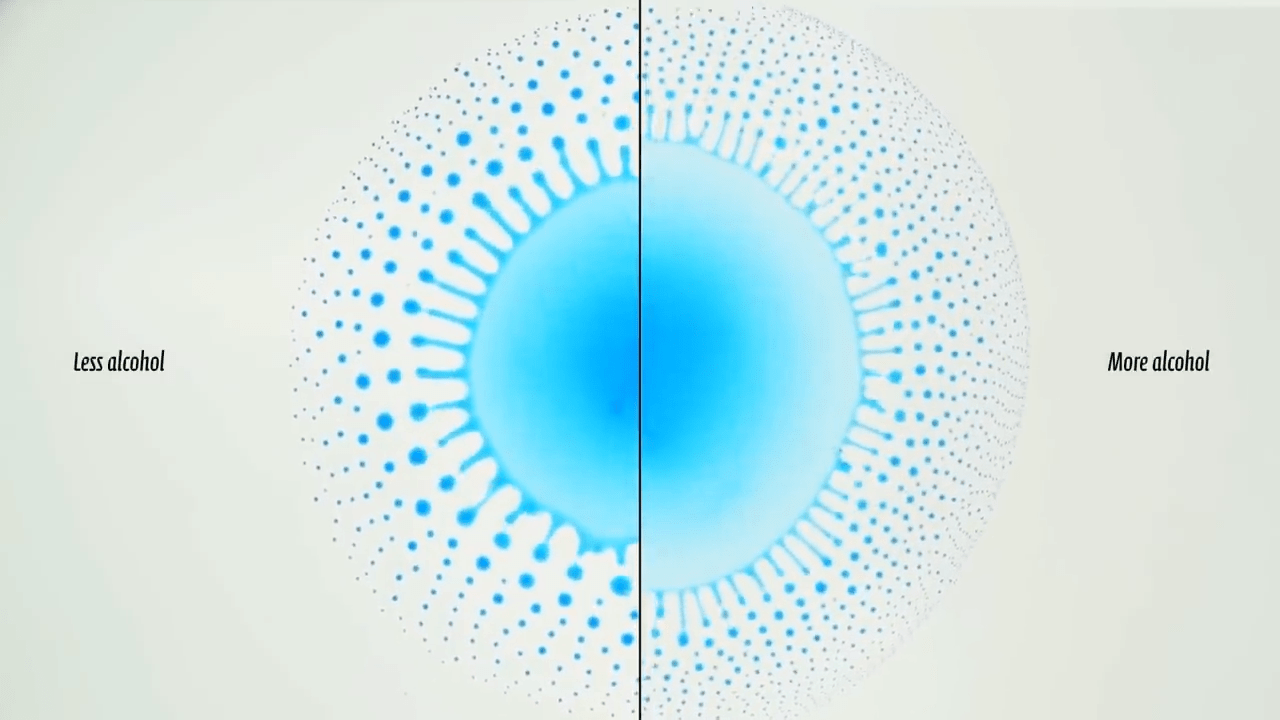
    Ionic liquids are essentially salts in a liquid form. In these images, a mixture of water and ionic liquid separates when heated. This phase separation causes the initial mixture to break into two regions: one low in ionic liquid and one rich in ionic liquid. Because the surface tensions of these two phases are different from one another, complex flow patterns form. (Image and research credit: M. Pascual et al.)

  • The Shapes of Melting Ice

    The Shapes of Melting Ice

    Water is an odd substance because it is densest at 4 degrees Celsius, well above its melting point at 0 degrees Celsius. This density anomaly means that melting ice takes on very different shapes, depending on the temperature of the water surrounding it. At low temperatures (under 4 degrees Celsius), the cold water melting off the ice is denser than the surroundings, so it sinks. The sinking fluid melts lower portions of the ice faster, leading to an inverted pinnacle (Image 1).

    In contrast, at higher temperatures (above 7 degrees Celsius), the meltwater is lighter than the surroundings and therefore rises, creating an upward-pointing pinnacle (Image 3). At intermediate temperatures, some areas of the ice see rising meltwater and some see sinking. This complicated flow pattern sets up vortices that result in a scalloped edge along the ice (Image 2). (Image and research credit: S. Weady et al.; via APS Physics)

  • Culinary Fluid Dynamics

    Culinary Fluid Dynamics

    I’ve long been a fan of exploring fluid dynamics from my own kitchen, and I’m far from the only one. One of the pioneers of interfacial physics developed most of her science in her kitchen! Whether you’re cooking, baking, frying, searing a steak, mixing a cocktail, preparing coffee, or simply dunking a cookie, chances are you’ve got some serious fluid dynamics going on. And now there’s a rather comprehensive review paper covering the intersection of food and fluid physics. It’s freely available on arXiv and written for more than just physicists — it’s even structured like a menu! — so check it out. (Image credit: steam – Z. Lezniewicz, coffee drip – N. Dumlao, whipped cream – T. Gak, cocktails – G. Yerden, crepe chef – C. Urrutia; research credit: A. Mathijssen et al.; submitted by multiple readers)

  • Quantum Instability

    Quantum Instability

    In our everyday lives, two fluids moving past one another often form a wave-like pattern thanks to the Kelvin-Helmholtz instability. We see it in the curl of waves on the ocean, in clouds in the sky, and even in spirals of lava on Mars. Here researchers explore an analogous instability in the quantum world.

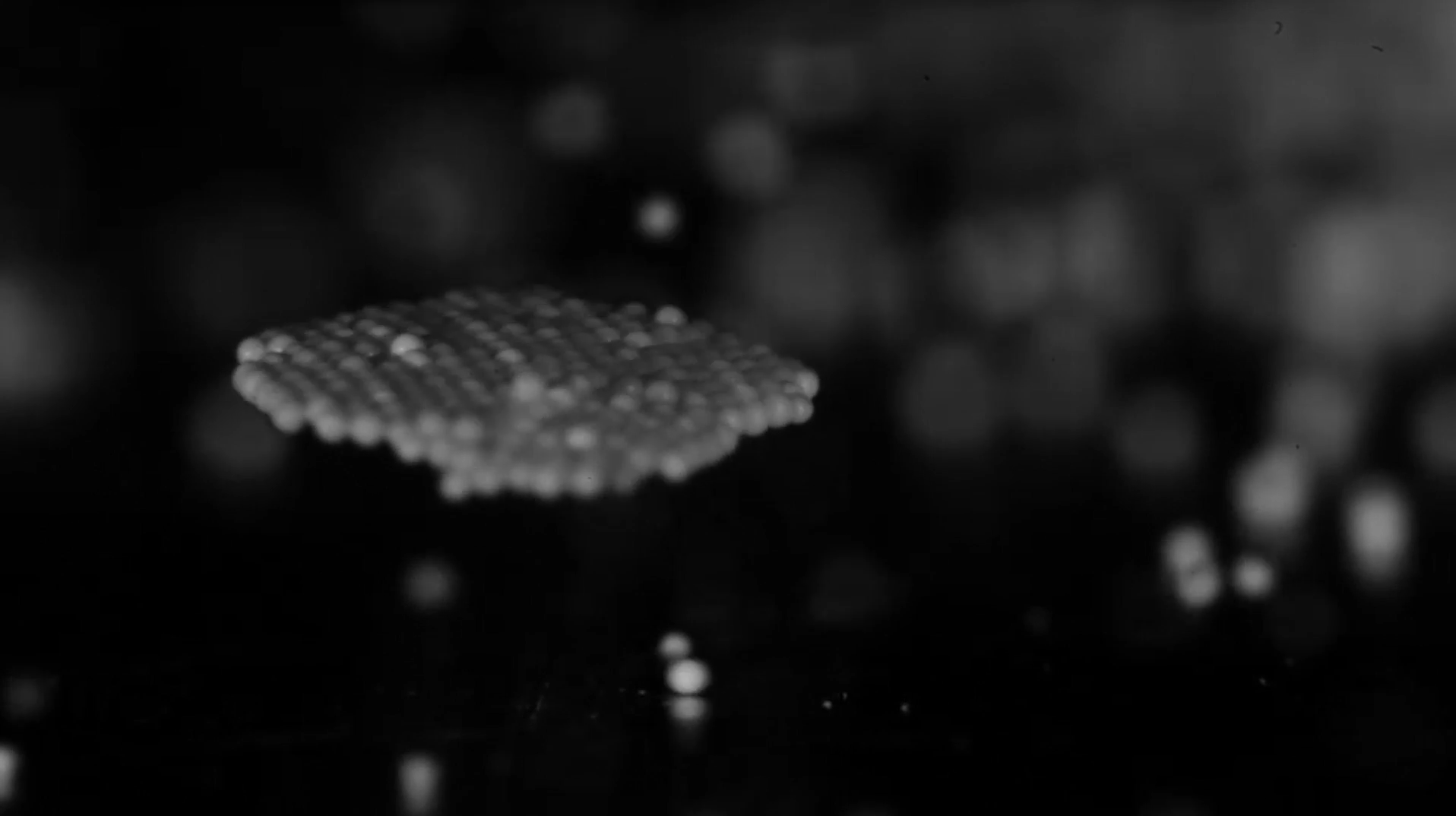
    By spinning a gas of ultracold atoms, the team observed a spontaneous transition from a needle-like configuration to a crystal made up of spirals. It’s a quantum Kelvin-Helmholtz instability! The authors found that wave’s phase is random; it arises purely from quantum interactions between the atoms. (Image, research, and submission credit: B. Mukherjee et al.; see also MIT News)

    The spinning cloud of ultracold atoms breaks up into a series of spirals.
  • Everlasting Bubbles

    Everlasting Bubbles

    Soap bubbles are delicate and ephemeral, always a breath away from collapse due to thinning driven by gravity or evaporation. But that frailty can be countered. Adding microparticles to the bubble’s shell in place of surfactants counters drainage and makes bubbles last for tens of minutes (left). Adding glycerol to the mix takes things a step further (right). The glycerol, which absorbs water from the surrounding air, counteracts the evaporation, allowing bubbles to remain intact — with no discernible change to their radius — almost indefinitely. So far the researchers have made such a bubble last for 465 days! (Image and research credit: A. Roux et al.; via APS Physics)

  • Stopping The Drop

    Stopping The Drop

    When a droplet falls on a mesh surface, some of the liquid can burst through the holes (top row). But subsequent drops have a harder time penetrating the prewetted mesh. After a few drops have impacted (rows 2-3), the wetted mesh can completely suppress penetration (rows 4-5). The authors found that the taller drops sitting atop the mesh were better at stopping penetration from an incoming drop. (Image and research credit: L. Xu et al.)

  • Sounds of Champagne

    Sounds of Champagne

    Lean in to a glass of champagne and you’ll hear a soft chorus of sound as the bubbles pop. Recently, researchers determined the specific mechanism in the process that’s responsible for that audible sound.

    Bubbles pop when the thin film of liquid separating them from the atmosphere drains away. The moment the film opens corresponds to the start of the sound, as overpressurized air inside the bubble has a chance to escape. The researchers found that the bubble behaves like a open-ended Helmholtz resonator, and by the time the sound emission ends, the bubble’s collapse has barely begun. (Image credit: L. Lyshøj; research credit: M. Poujol et al.)

  • Beijing 2022: Ice’s Slideability

    Beijing 2022: Ice’s Slideability

    As scientists continue to unravel the peculiarities of ice, they’ve found that ice’s friction depends both on the object sliding on it and the ice’s hardness. At extremely low temperatures, water molecules at the ice’s surface are held rigidly by the hard ice, resulting in high friction. At intermediate temperatures, however, water molecules at the surface were more mobile — especially with a quick-moving slider going by — so the friction decreased.

    But as the ice approached its melting point, the friction behavior shifted again. As the ice softened, sliding objects could begin to plough into the ice, dramatically increasing contact and friction. When ploughing begins depends on temperature, slider shape, contact pressure, slider speed, and ice hardness.

    Beyond the lab, researchers found that weather plays a role in slideability, too, since humidity and air temperature can affect the thickness of the liquid-layer at the ice’s surface. (Image credit: SHVETS Productions; research credit: R. Liefferink et al.; via APS Physics; submitted by Kam-Yung Soh)

  • Beijing 2022: Why Are Ice and Snow Slippery?

    Beijing 2022: Why Are Ice and Snow Slippery?

    Although every Olympic winter sport relies on the slippery nature of snow and ice, exactly why those substances are so slippery has been an enduring mystery. Michael Faraday hypothesized in the nineteenth century that ice may have a thin, liquid-like layer at its surface, something that modern studies have repeatedly found.

    One recent study used an entirely new instrument to probe the characteristics of this lubrication layer and found that it is only a few hundred nanometers thick. But the fluid in this layer is nothing like the water we’re used to. Instead it has a viscosity more akin to oil and its response to deformation is shear-thinning and viscoelastic, more like the complex fluids in our kitchens and bodies than pure, simple water. They found that using a hydrophobic probe modified the interfacial viscosity even further, which finally provides a hint at the mechanism behind waxing skis and skates. 

    Fortunately for us, we’ve found plenty of ways to employ and enjoy water’s slipperiness, even as the mystery of it slowly gives way to understanding. (Image credit: M. Fournier; research credit: L. Canale et al.; via Physics World; submitted by Kam-Yung Soh)