Category: Research

  • Coronal Heating

    Coronal Heating

    Compared to its interior, the surface of our sun is a cool 6,000 degrees Celsius. But beyond the surface, the sun’s corona heats up dramatically through interactions between plasma and strong magnetic fields. The exact mechanisms of this interaction have been mostly theoretical thus far, but a recent laboratory experiment has validated a part of that theory.

    One explanation for coronal heating posits that the strong magnetic fields can accelerate magnetohydrodynamic waves called Alfvén waves to speeds faster than sound, and that at this crossover point, changes occur in the waves’ behavior. Using liquid rubidium, researchers were able to observe this crossover under laboratory conditions, confirming that the Alfvén waves change at the speed of sound in exactly the manner predicted by theory. (Image credit: NASA SDO; research credit: F. Stefani et al.; via Physics World)

  • Electronic Friction

    Electronic Friction

    Years ago, physicists discovered that water flows with surprisingly little friction through narrow carbon nanotubes. At our scale, flow behavior is typically the opposite: there’s greater friction (and, thus, slower flow) in a narrower pipe. To unravel the mystery, researchers had to delve into quantum mechanics and model the interactions between the atoms of a water molecule and the electrons of the carbon atom. Essentially, this meant building a quantum picture of the liquid-solid interface inside the nanotube.

    The team found that the electrons of the nanotube exert a drag-like force on the water molecules, creating friction that slows the flow. Since narrow nanotubes have fewer electrons than larger tubes, there is less friction on the flow and the water flows faster! (Image credit: cintersimone; research credit: N. Kavokine et al.; via SciAm; submitted by Kam-Yung Soh)

  • Leidenfrost On Ice

    Leidenfrost On Ice

    We’ve seen many forms of Leidenfrost effect — that wild, near-frictionless glide that liquid droplets make on a very hot surface — over the years, but here’s a new one: the three-phase Leidenfrost effect. Researchers found that they could generate a Leidenfrost effect using an ice disk placed on an extremely hot surface. During the effect, the ice and its melting layer of water glide on vapor, hence the name.

    The team found that getting a three-phase Leidenfrost effect requires a much, much higher temperature than the regular Leidenfrost effect. Water will get its glide on at 150 degrees Celsius. Getting ice to glide on the same surface required a stunning 550 degrees Celsius! Why the big difference? The challenge is that water layer, which, by definition, has a 100-degree difference between its boiling side and its frozen boundary. It takes so much heat to maintain that layer that there’s little energy left over for evaporation; that’s why it takes so much more energy to get the three-phase Leidenfrost effect. (Image and research credit: M. Edalatpour et al.; via Ars Technica; submitted by Kam-Yung Soh)

  • Superhydrophobic Drag

    Superhydrophobic Drag

    Using air or bubbles to reduce drag on boats is a popular idea, whether using supercavitation, the Leidenfrost effect, or superhydrophobic coatings. But most of the experiments done thus far use spheres rather than realisitic boat shapes. In this study, the researchers used two model boats — one with a hydrofoil and the other in a conventional motorboat shape — and applied superhydrophobic coatings to different parts of the model to see how superhydrophobicity affected the overall drag.

    Perhaps surprisingly, they found that superhydrophobic coatings can actually increase the drag! The effect was particularly stark for the hydrofoil boat (Image 2), where the surface jets (lower half) caused by the superhydrophobic coating slowed the boat by 30% compared to its unmodified speed (upper half).

    For the speedboat, a superhydrophobic hull made no overall difference in its drag, though it changed how water splashed in its wake. And coating the boat’s propeller was particularly detrimental, resulting in a speed up to three times slower. Overall, the study suggests that superhydrophobic coatings may be useful in some circumstances, but they have to be applied carefully, as they can have negative impacts, too. (Image credits: top – S. Anghan, others and research credit: I. Vakarelski et al.)

  • Bendable Ice

    Bendable Ice

    Ice — as we typically encounter it — is extremely brittle and easily broken. That’s due to defects in the ice, places where atoms have settled into a spot that does not match the perfect crystalline alignment. Because tiny defect-free threads of ice made by researchers turn out to be wildly flexible!

    To make these perfect ice strands, each of which is a tiny fraction of the thickness of a human hair, researchers applied an electric voltage to a needle in a water-vapor-filled chamber. The technique condensed ice microfibers with perfect crystal structures in a matter of seconds. When bent, the microfibers actually shift from one crystalline arrangement to another in order to carry stress, and once the force is removed, the thread reverts back to its initial straight form. (Image and research credit: P. Xu et al.; via Science News; submitted by Kam-Yung Soh)

  • Dissolving Pinnacles

    Dissolving Pinnacles

    Limestone and other water-soluble rocks sometimes form sharp stone pinnacles like the ones seen here in Borneo. Scientists have recreated these structures in the laboratory simply by immersing water-soluble substances (essentially blocks of candy) into water. Without any background flow, the blocks will slowly form these pinnacle forests as material dissolves into the nearby water, creating a heavy solute-rich fluid that sinks down the exterior of the block. The convection generated by this dissolution drives the material into these sharp shapes, as shown mathematically in this recent study. (Image credit: N. Naim; research credit: J. Huang and N. Moore; via APS Physics)

  • Featured Video Play Icon

    Burning Virtual Forests

    Wildfires are growing ever more frequent and more destructive as the climate crisis worsens. Unfortunately, simulating and predicting the course of these fires is incredibly difficult, requiring a combination of ecology, meteorology, combustion science, and more. To handle so many variables, model builders often turn to statistics that allow them to simulate an entire forest but at the cost of representing individual trees as a few pixels or a cone.

    In this video, researchers show a new wildfire simulation based on a computationally efficient but more realistic depiction of trees. With individual, three-dimensional trees, the simulation can capture effects that are otherwise hard to examine – like the difference in burn rate for coniferous and deciduous forests and the likelihood that a fire can jump a firebreak of a given size. Their weather, fire, and atmospheric models are even able to simulate the birth of fire-generated clouds! Check out the full video to see more and then head over to their site if you’d like to dig into the methodology. (Video and research credit: T. Hädrich et al.; see also)

  • Liquid Bridges

    Liquid Bridges

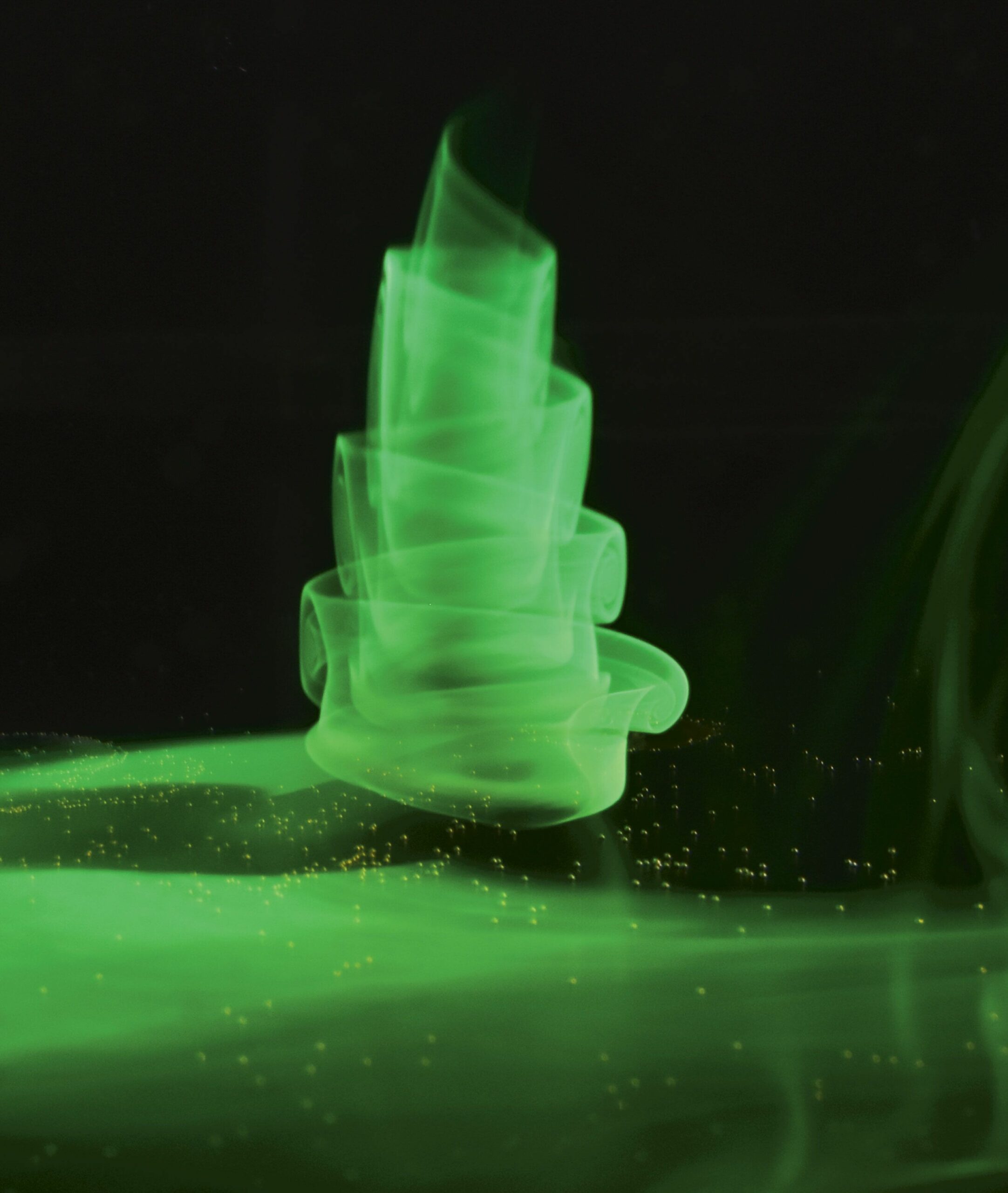
    In 1893, Baron Armstrong demonstrated a peculiar phenomenon — a liquid bridge of water suspended between two beakers with a strong electric charge between them (Image 1). More than a century later, the details of the mechanism remain challenging to pin down thanks to the setup’s combination of electohydrodynamics, heat transfer (Image 2), evaporation, and chemistry (the electrodes can split water).

    Researchers have pinned down a few details, though, like that the break-up of the liquid bridge (Image 3) depends on its effective length and that the effective length grows as applied voltage increases. Researchers also found that inducing an external flow can extend the bridge’s lifetime, though it does not affect the length at which it breaks up. Interestingly, the phenomenon is not limited to water (and its odd chemistry); ethanol and glycerol have been used for liquid bridges, too! (Image and research credit: X. Pan et al.)

  • Featured Video Play Icon

    Schooling Relies on Vision

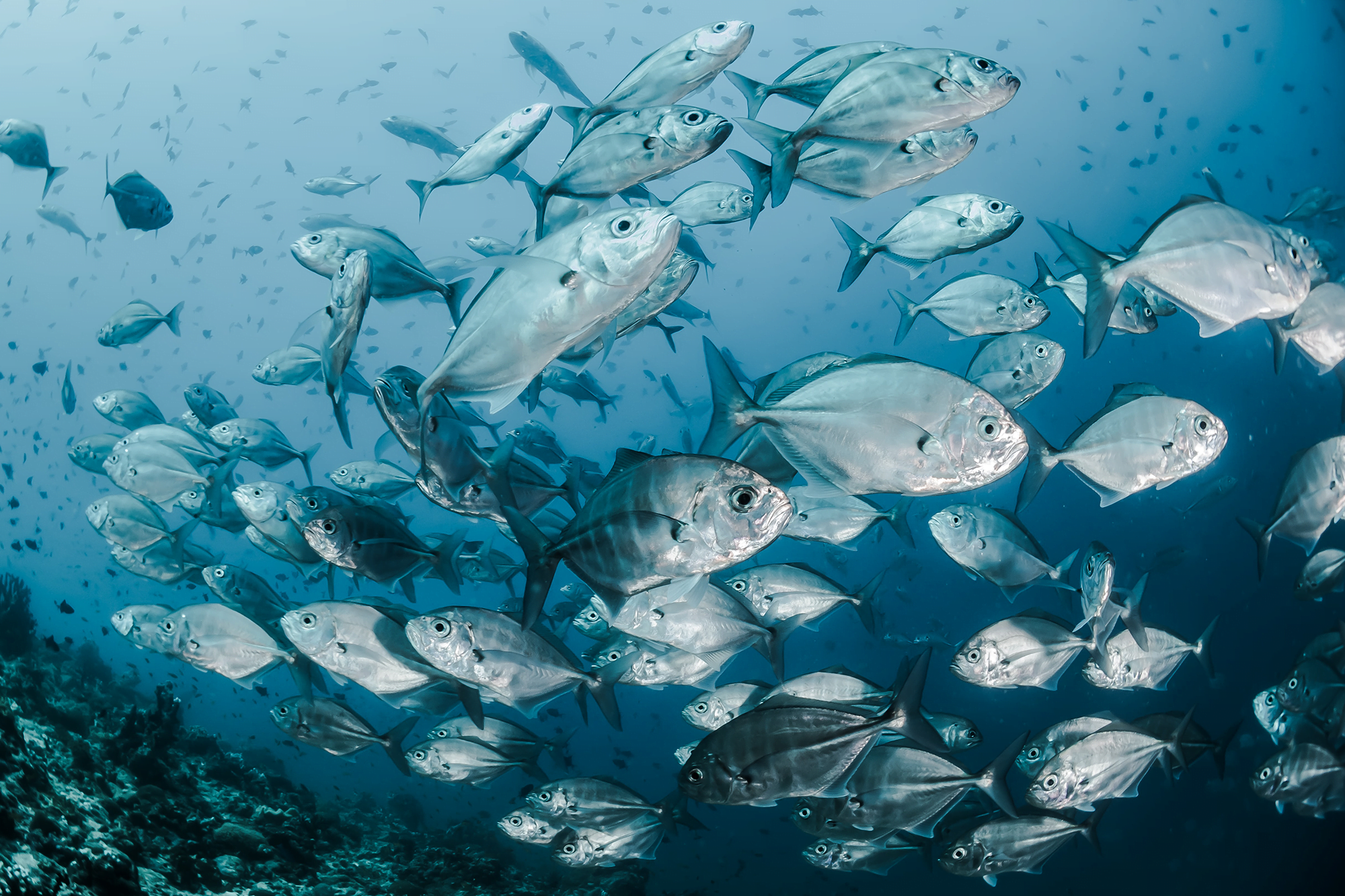
    For fish, collective motions like schooling rely on a few mechanisms, including flow sensing and — as beautifully demonstrated in this experiment — vision. Researchers used an infrared camera to track fish motions both in light and dark conditions and compared how orderly the school of fish was in each. As expected, the school’s motion was much more orderly when the fish could see one another clearly. Interestingly, the researchers then ran an experiment in which the illumination rose continuously from dark to fully bright. The fish school’s organization grew continuously with the light! The better they could see one another, the more organized their schooling. (Video and research credit: L. Baptiste et al.)

  • Turbulence in Flight

    Turbulence in Flight

    Eagles and other birds spend much of their lives in the turbulence of our atmospheric boundary layer. Some of their interactions with turbulence — like using topographical effects to aid their flight — are well-known, but much remains uncertain. One team of researchers looked at a tagged golden eagle’s flight data, compared with known wind conditions, and looked for evidence of turbulence’s influence. To do this, they drew on years of research into how turbulence interacts with inertial particles — particles that are heavier than the surrounding fluid and thus unable to follow the flow exactly.

    What they found is that turbulence seems to be baked into many aspects of the eagle’s flight. Even the basic accelerations of the eagle’s body during flight showed characteristics that match those of turbulent flows. The findings suggest that turbulence — rather than something to be avoided — is an integral part of flight for birds, an energy source they’ve learned to exploit. (Image credit: J. Wang; research credit: K. Laurent et al.; submission by G. Bewley)