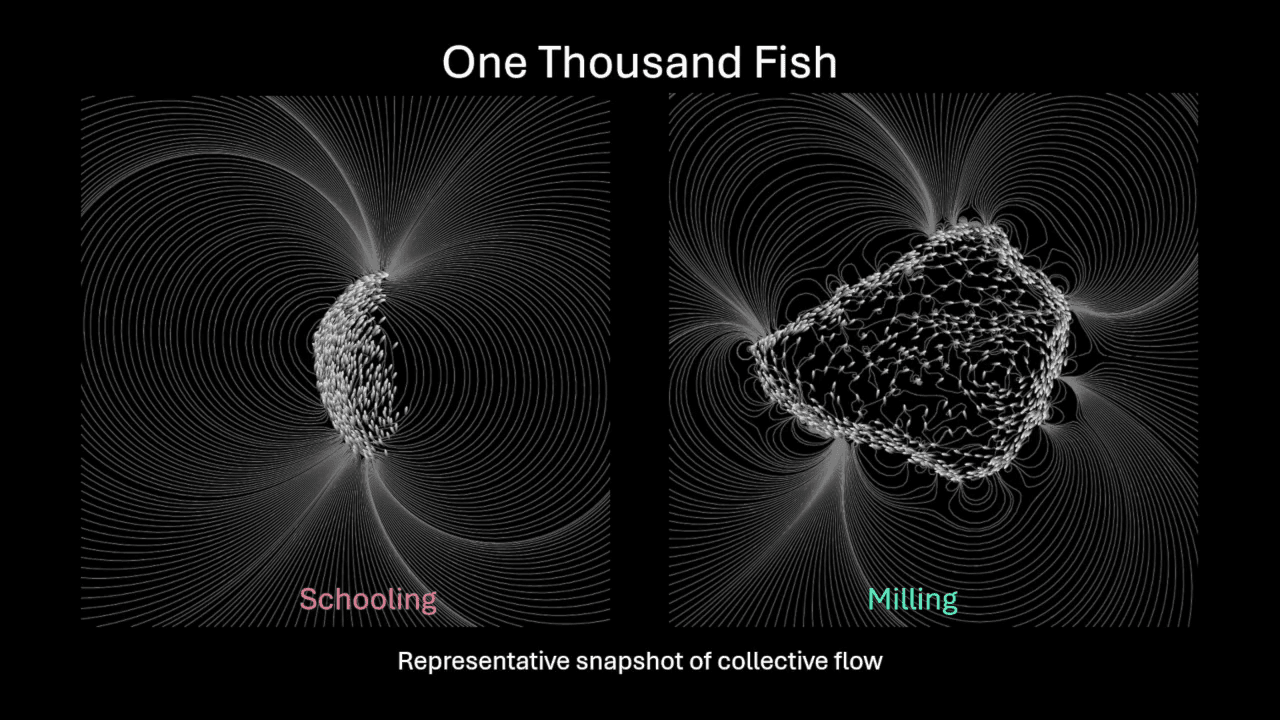
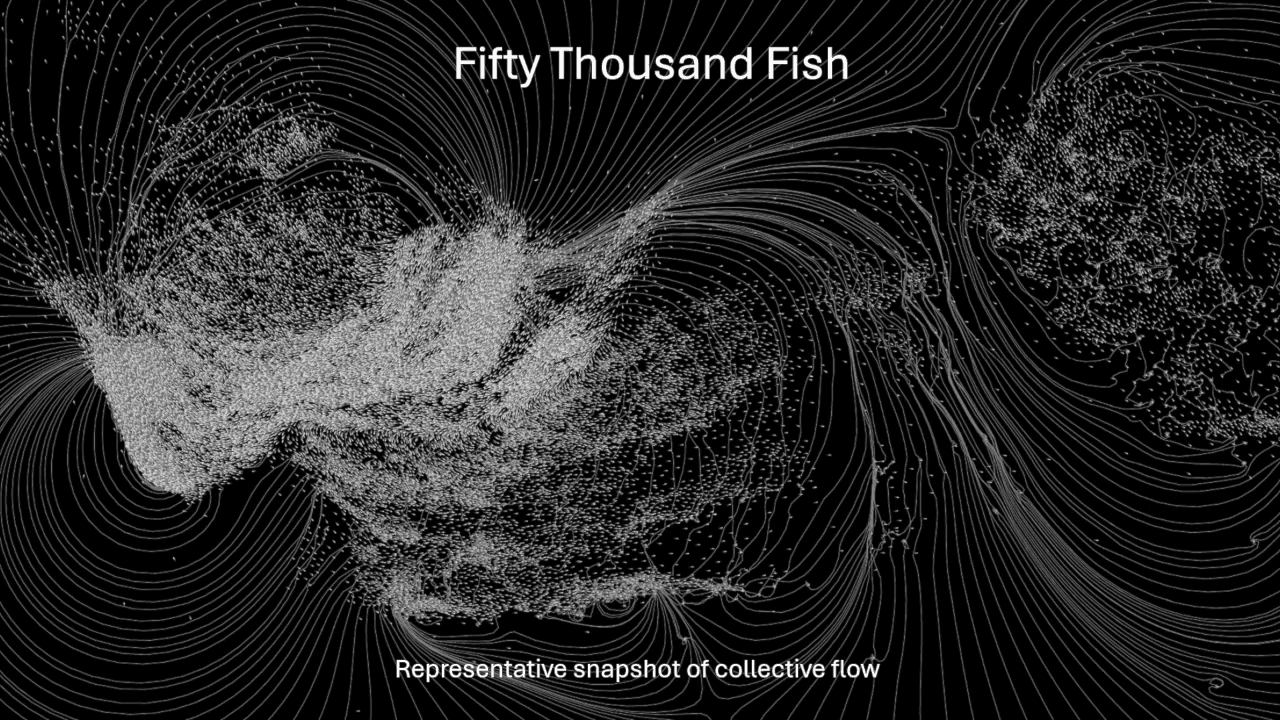
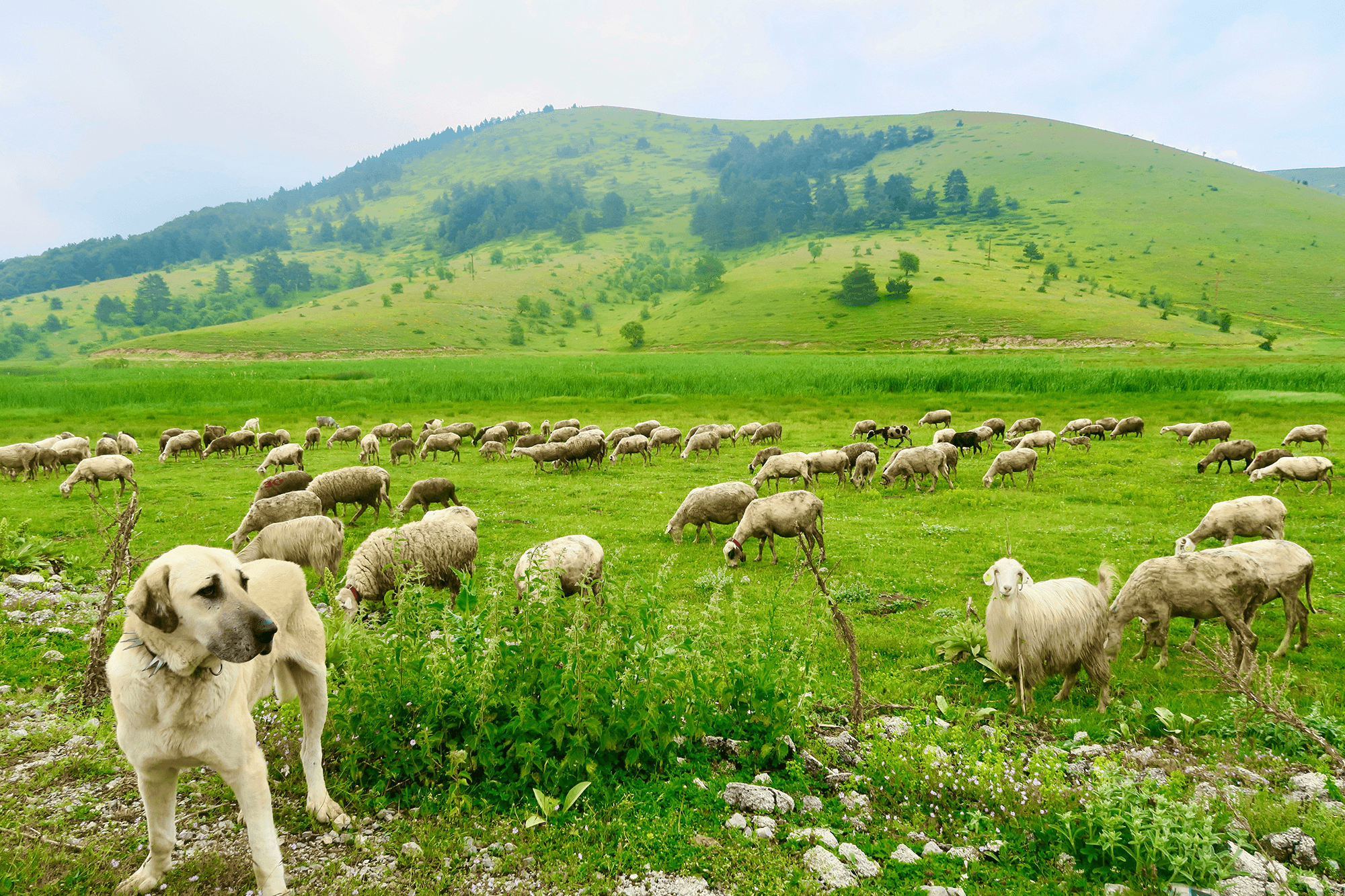
Flocks of birds, schools of fish, and herds of sheep all resemble fluids at times, and physicists have been trying to recreate their collective motion for decades. Many of these models simplify the animals into particles that follow simple rules based on the direction and speed of their neighbors. Over time, the models have grown more complex; for example, some might differentiate a “sheepdog” particle from “sheep” particles. And some models even tweak the “sheep” to account for the personality traits that real sheep show, like how skittish they behave toward a sheepdog. Physics World has a neat overview of several studies in this vein. (Image credit: E. Osmanoglu; via Physics World)
Tag: schooling

Simulating Schools
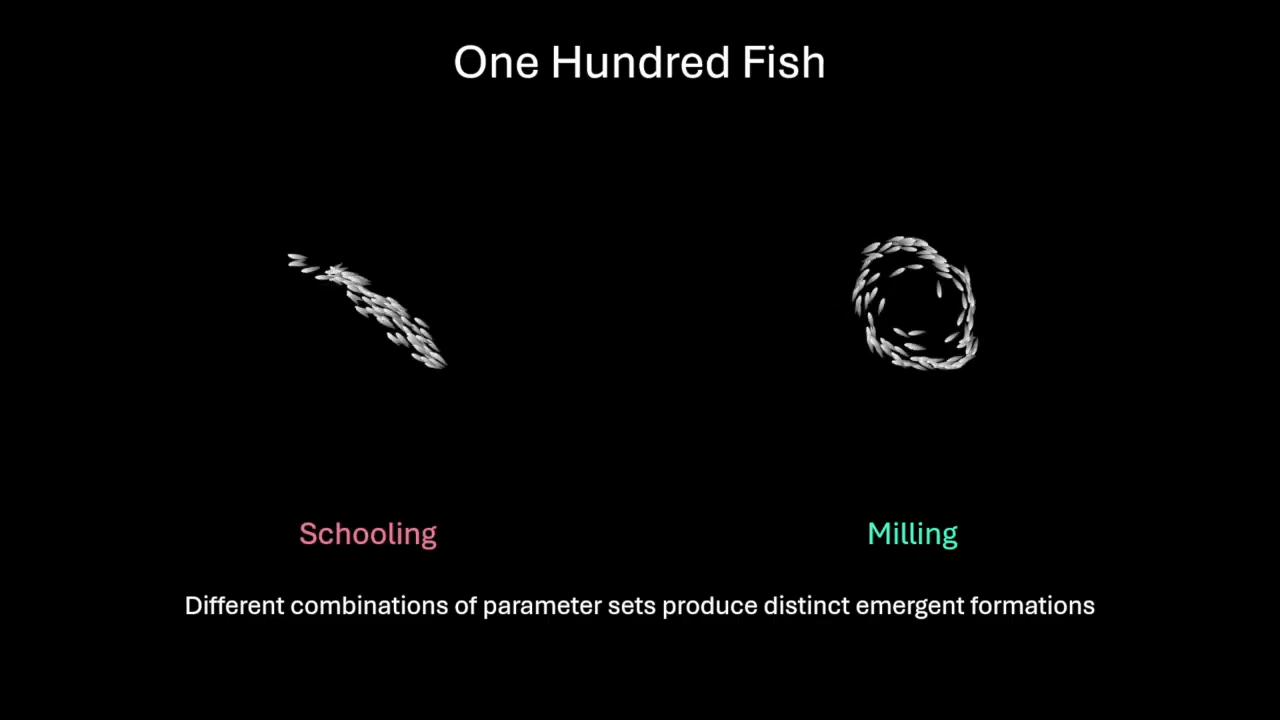
In nature, fish school for many reasons: protection from predators, increased sensing, and hydrodynamic advantages. To capture this complex behavior, researchers are building their own digital fish, governed by known rules. Here, scientists give each fish social rules — based on vision range and preferred distance from a neighbor — and hydrodynamic rules — based on a fish’s wake. With the rules in place, they can then observe the schooling behaviors of their digital fish. Like their real counterparts, these schools show different flocking based on apparent “moods”. (Image and video credit: J. Zhou et al.)

Swimming Together
Scientists have long pondered the possibilities of hydrodynamic benefits to the ways fish school. But most analyses of schooling have assumed a fixed spacing that’s far more orderly than what we observe in nature. In this experiment, researchers instead used a pair of robotic swimmers (essentially hydrofoils) to explore a range of swimming formations. What they found was a map of places where a second swimmer could easily “lock in” to a position relative to the leader and have their positioning stabilized by interactions with the leader’s wake (lower image). Interestingly, the beneficial regions extend much further downstream for fish positioned diagonally to the leader than they do for one directly following. With such a wide range of easily-stabilized following positions, it’s no wonder that schools of fish are amorphous instead of strictly crystalline! (Image credit: top – S. Pena Lambarri, map – J. Newbolt et al.; research credit: J. Newbolt et al.)

The shaded areas of this map represent areas where a second swimmer can passively “lock-in” relative to the leader’s position, shown in gray. This data is based on tests with robotic swimmers. 
Recreating Flocks
Birds, fish, and other creatures form amazing, undulating swarms of individuals. How these collectives comes together and move continues to fascinate scientists. Here, researchers look at simple particles with two “instructions,” if you will. One causes the particle to self-navigate toward a target; the other causes short-range repulsion if the particle gets too close to another one. With only these two simple guidelines, a flock of these particles forms complex, ever-changing flows! (Image and video credit: M. Casiulis and D. Levine)

Schooling Relies on Vision
For fish, collective motions like schooling rely on a few mechanisms, including flow sensing and — as beautifully demonstrated in this experiment — vision. Researchers used an infrared camera to track fish motions both in light and dark conditions and compared how orderly the school of fish was in each. As expected, the school’s motion was much more orderly when the fish could see one another clearly. Interestingly, the researchers then ran an experiment in which the illumination rose continuously from dark to fully bright. The fish school’s organization grew continuously with the light! The better they could see one another, the more organized their schooling. (Video and research credit: L. Baptiste et al.)

Benefits of Schooling
Though fluid dynamicists have long theorized about the hydrodynamic benefits of fish swimming in schools, nailing down the actual physics has been quite difficult. Fish rarely swim exactly as an experimenter would like, and measuring quantities like swimming efficiency in a living fish is tough to do. In the numerical realm, it’s tough to simulate multiple fish swimming at realistic conditions. So some teams have turned to biomimetic robotic platforms to study schooling, as in this new research.
Once you’ve built a robotic fish that swims in a realistic way, that fish will have no problem swimming the same experimental patterns over and over. In this work, the researchers compared their robots swimming solo and swimming with a partner. In the partnered studies, they looked at fish swimming in phase — with their undulations matching one another — and out of phase — where the fish move opposite one another. They found that having a nearby partner improved the speed and efficiency for both fish, regardless of phase. But they also found a peculiar exception.
If one fish modifies their tailbeat frequency relative to their partner, they can slightly increase their power efficiency. But if they do so, it costs their partner more energy. That implies that fish could employ competitive dynamics, but, of course, it doesn’t tell us that they do! (Image and research credit: L. Li et al.; submitted by Kam-Yung Soh)

Collective Catfish Convection
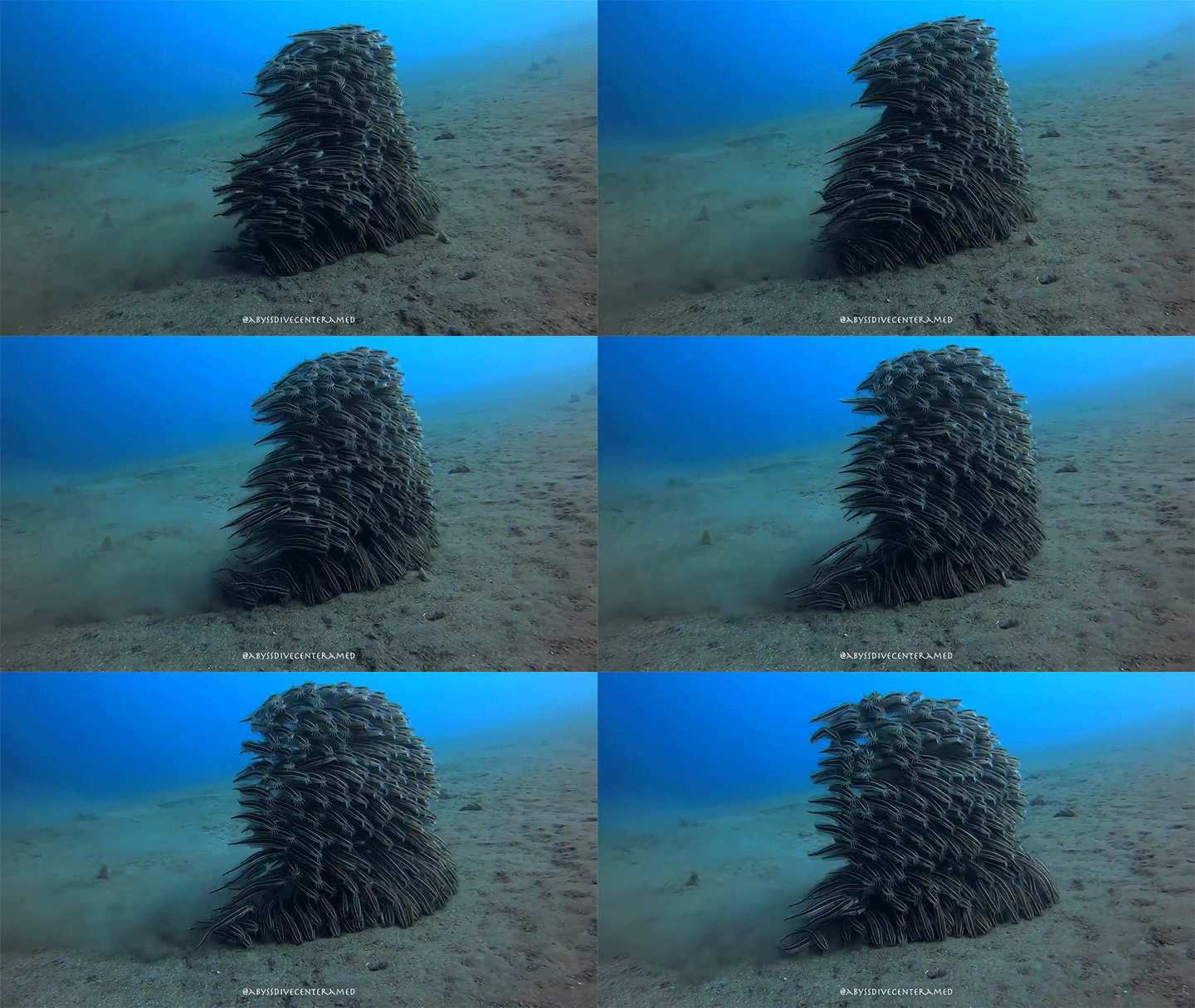
Gather many birds, fish, or humans together and you often get collective motion that’s remarkably fluid-like in appearance. This video shows a group of juvenile striped eel catfish, an (eventually) venomous species that uses strength in numbers for protection while young. Their movement is rather mesmerizing, and if you watch individual catfish, you’ll see a sort of convective motion inside the blob. There’s a general downward trend near the front of the school and a rising one on the backside. Perhaps they’re taking turns feeding near the bottom of the pack? (Image and video credit: Abyss Dive Center; via Colossal)

Collective Motion: Intro
Herds, flocks, schools, and even crowds can behave in fluid-like ways. On Science Friday, Stanford professor Nicholas Ouellette explains some of the physics behind these similarities. Fluids are, after all, made up of a many, many individual particles – typically molecules – just the way a crowd of people or a school of fish contains many individuals. What makes the collective behaviors of groups harder to model than a fluid, however, is a lack of randomness. In something like water, all the molecules move randomly, which allows scientists to make certain simplifications in how we describe that motion.
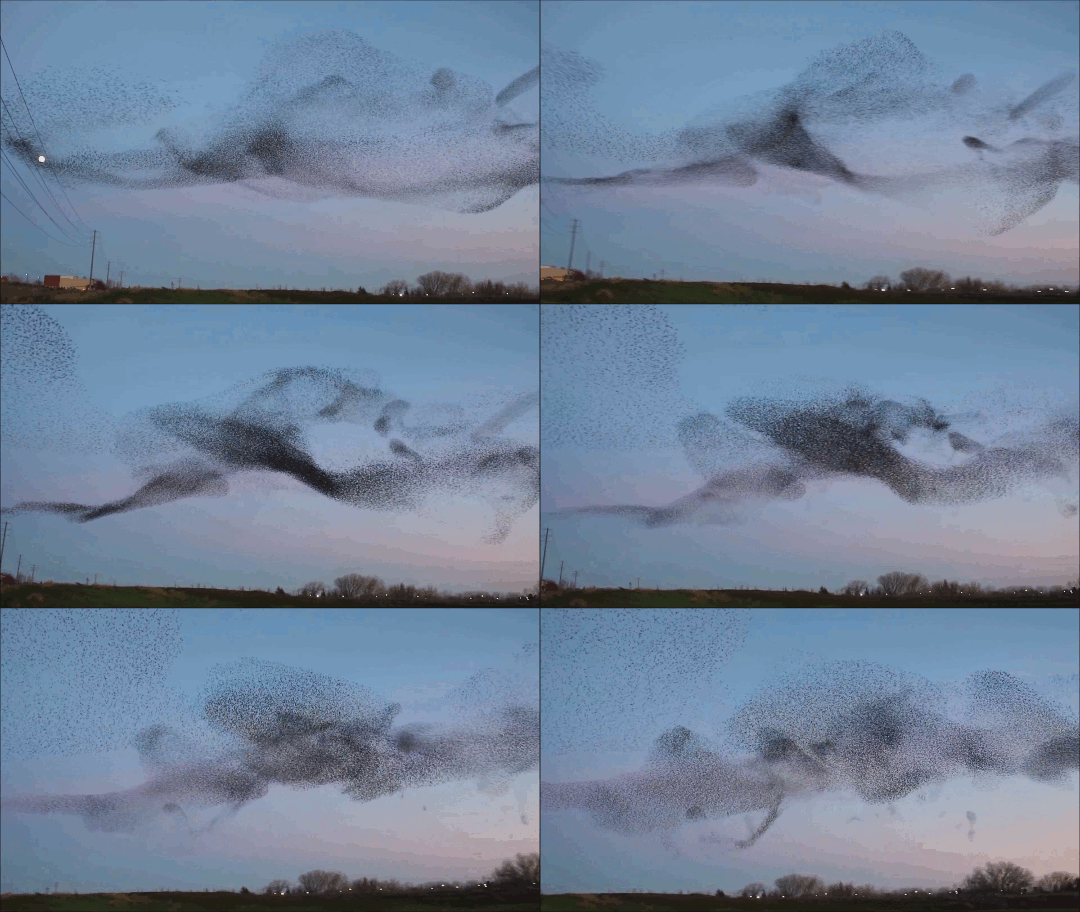
In animal group behaviors, on the other hand, the motion of an individual is not completely random. It instead seems to be governed by relatively simple rules based on the observations that an individual can make. Combine those rules across a large number of individuals and you can get what’s called emergent behavior – exactly the sort of large-scale patterns we see in swarms of insects, flocks of birds, and schools of fish. (Image credits: fish – N. Sharp; starlings – N. Fielding, source; battle – New Line Cinema; podcast credit: Science Friday; submitted by Michelle D.)
This week on FYFD, we’ll explore the world of collective motion and how it overlaps with fluid dynamics.

Building Smart Swimmers
Scientists have long wondered whether the schooling of fish is driven by hydrodynamic benefits, but the complexity of their environment makes unraveling this complex motion difficult. A recent study uses a different tactic, combining direct numerical simulation of the fluid dynamics with techniques from artificial intelligence and machine learning to build and train autonomous, smart swimmers.
The authors use a technique called deep reinforcement learning to train the swimmers. Essentially, the swimmer being trained is able to observe a few variables, like its relative position to the lead swimmer and what its own last several actions have been – similar to the observations a real fish could make. During training, the lead swimmer keeps a steady pace and position, and the follower, through trial and error, learns how to follow the leader in such a way that it maximizes its reward. That reward is set by the researchers; in this case, one set of fish was rewarded for keeping a set distance from their leader, one intended to keep them in a position that was usually beneficial hydrodynamically. Another set of fish was rewarded for finding the most energy-efficient method for following.
Once trained, the smart swimmers were set loose behind a leader able to make random decisions. Above you can see the efficiency-seeker chasing this leader. Impressively, even though this smart swimmer had the option to go it alone (and had never followed such a dynamic leader), it does an excellent job of keeping to the leader’s wake. Compare it with real swimmers and there’s a definite similarity in their behavior, which suggests the technique may be capturing some of an actual fish’s intuition. (Image and research credit: S. Verma et al., source; thanks to Mark W. for assistance)

Schooling Together
Since the 1970s, fluid dynamicists have chased the idea that fish swim in schools for hydrodynamic advantage. The original 2D conception of the idea placed fish in a diamond pattern so that their wakes would constructively interfere and improve swimming efficiency. In nature, that exact pattern is rarely seen, possibly due to 3D effects or the difficulty of maintaining the exact orientation. Fish do, however, show signs of grouping themselves for efficiency – especially when they’re forced to swim quickly.
A recent study found that tetras, a type of small fish often used as pets, prefer a staggered diamond configuration (left) when free-swimming at low speeds around one body length per second. At higher speeds, around four body lengths per second, groups of tetras preferred a side-by-side or “phalanx” configuration (right). Here the fish tended to synchronize their tail-beat frequency with their neighbors, essentially working together for a mutually beneficial wake structure. The researchers found that this configuration was much more efficient than a lone swimmer or uncoordinated group, implying that fish do school for energy-savings when they’re swimming fast. (Image and research credit: I. Ashraf et al., source; via Hakai; submitted by Kam-Yung Soh)