This image, taken from a direct numerical simulation, shows turbulence in a stably stratified flow in which lighter fluid sits atop a denser fluid. In the image lighter colors represent denser fluid. Turbulence is created by the shear forces caused when the lighter fluid on top moves faster than the denser fluid on the bottom; however the stable stratification will tend to counteract or stabilize the turbulence. Note the vast variety and detail of the scales involved in turbulence; this is what makes it such a difficult process to simulate and model. (Image credit: G. Matheou and D. Chung, NASA/JPL-Caltech)
Category: Research

Viscous Fingers
When less viscous fluids are injected into a more viscous medium, the low-viscosity fluid forms finger-like protrusions into the background fluid. This is known as the Saffman-Taylor instability. The video above shows this effect but in a more dynamic setting. Blue-dyed water and a clear solution of water and glycerol fifty times more viscous than the water are injected in alternating fashion to a microfluidic channel. The blue water spreads into the clear glycerol solution via fingers that quickly diffuse, creating a homogeneous–or uniform–mixture. (Video credit: Juanes Research Group)

Martian Lava Coils

NASA’s HiRISE spacecraft has sent back images of lava coils left on the surface of Mars. These features form when lava flows of different speeds move past one another; they’re essentially Kelvin-Helmholtz waves–like the ones often seen in clouds–in the lava flow that have solidified into solid rock! On Earth these coils appear about a foot wide; the Martian versions are 100 feet across. (Photo credit: NASA/JPL/University of Arizona; via Wired; submitted by Brian L)

Why Walking with Coffee is Tough
Almost everyone is familiar with the problem of coffee or tea sloshing over the sides of a mug as one walks, but this may be the first time researchers have systematically studied the problem. The results show that the typical frequency of the human stride closely matches the natural frequency for back-and-forth sloshing of a low-viscosity liquid in a cylindrical container the size of a typical coffee mug. Even though our natural side-to-side motion plays a role in coffee sloshing, its effect is small in comparison. A person’s maximum acceleration, which usually happens early on when walking, sets the initial sloshing amplitude, which is subsequently amplified by the stepping frequency. The researchers did find that the time to spill increased substantially if the subject was focused on not spilling the coffee, though it was unclear if this was due to the subject decreasing their acceleration and step frequency, or whether they were actively damping the oscillations with adjustments in the wrist. If you’re a perpetual coffee spiller, there’s still hope: the authors suggest that flexible cups and/or cups with a series of concentric rings–baffles–could help reduce sloshing in spite of our natural tendency to induce it. (Photo credit: dongga/Flickr; Paper: Mayer and Krechetnikov; submitted by @__pj)
Egg Spinning
Spin a hard boiled egg in a puddle of milk and you get a sprinkler. But how? The science starts at the surface. When the egg spins, the fluid touching its surface is dragged along due to friction, and, because of the fluid’s viscosity, other parts of the fluid will also be spun. Dynamics tells us that the velocity at the surface of the object varies with radius; the velocity at the bottom of a spinning sphere is much smaller than that at its equator because a particle at the equator traverses a larger distance in a single rotation. Likewise, the fluid touching the bottom of the egg is spun slower than the fluid just above it. Bernoulli’s principle tells us that, for an incompressible fluid, the pressure decreases as velocity increases, meaning that a favorable pressure gradient exists along the spinning convex surface. It is this pressure gradient that draws the fluid up the sides of the object. Near the equator, the pressure gradient is weakest and centrifugal force flings the the fluid outward. Surface tension, angular velocity, and viscosity all play a role in the jets and sheets created by the sprinklers. (Video credit: NPR Science Friday with Tadd Truscott et al)
Moving Droplets with Electric Fields
Many microfluidic devices employ techniques that manipulate droplet motion for applications like sorting, manufacturing, or precisely controlling chemical reactions at a small scale. The video above shows the oscillations of a droplet on an inclined surface as it is perturbed with an electric field. (Video credit and submission: K. Nichols)

The Pitch Drop Experiment
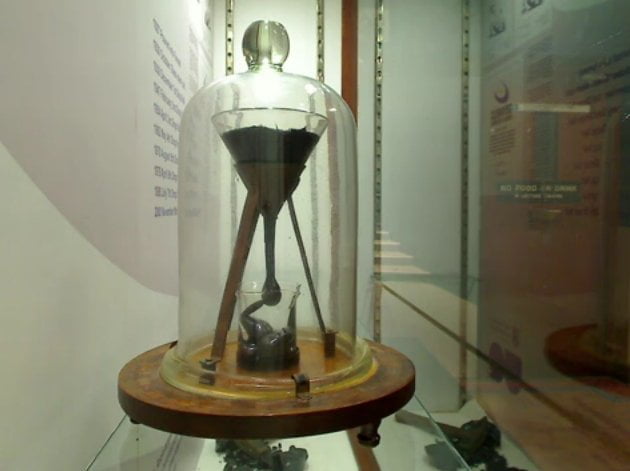
Sometimes everyday materials are more fluid than they seem. In 1927, Professor Thomas Parnell of the University of Queensland started what is now the longest continuously running laboratory experiment when he filled a sealed glass funnel with a sample of heated tar pitch. After allowing 3 years for the pitch to settle, the funnel’s stem was unsealed and the pitch has been slowly dripping ever since. Now, over 80 years later, the ninth drop is still just forming. No one has witnessed the fall of a pitch drop but the odds are good that someone will catch the ninth drop now that it has its own webfeed. The experiment, which won an Ig Nobel Prize in 2005, demonstrates the incredibly high viscosity of pitch, which the researchers estimated at 11 orders of magnitude larger than water at room temperature. (submitted by jshoer)

Icing on Airplane Wings

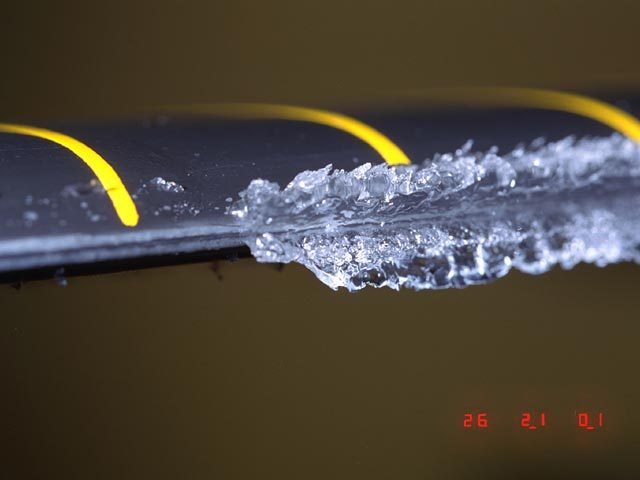
Icing on airplane wings remains little understood and a major hazard. These photos show examples of ice formation along the leading edge of a swept wing. If an aircraft flies through a cloud of supercooled water droplets, the droplets will freeze shortly after impact with the aircraft’s wings. As ice continues to build up in strange shapes, the aerodynamic profile of the wing changes, which can lead to disastrous effects as the stall and control characteristics of the wing shift. (Photo credit: NASA Glenn Research Center)
Salinity Near the Amazon
This numerical simulation shows the variation of salinity in the Atlantic Ocean near the mouth of the Amazon River over the course of 36 months. The turbulent mixing of the fresh river water and salty ocean shifts with the ebb and flooding of the river. Salt content causes variations in ocean water density, which can strongly affect mixing and transport properties between different depths in the ocean due to buoyancy. Understanding this kind of flow helps predict climate forecasts, rain predictions, ice melting and much more. (Video credit: Mercator Ocean)
Supercavitating Penguins
[original media no longer available]
Penguins, already fluid dynamicists by nature, have developed clever methods of increasing their speed to escape from the leopard seals that prey on them. In the clip above, notice from 1:55 onward as the penguins swim for the surface and leap onto the ice – they leave a trail of bubbles in their wake. The penguins are using supercavitation to decrease their drag. When the penguins first dive in to the water, they splay their feathers out in the air and then lock them closed in the water, trapping pockets of air beneath them. When the need for a burst of speed arises, the penguin shifts its feathers to release the air, coating most of its body in a layer of bubbles. Because the drag in air is much less than the drag in water, this enables the bird to achieve much higher speeds than they normally do when swimming.