This numerical simulation shows the variation of salinity in the Atlantic Ocean near the mouth of the Amazon River over the course of 36 months. The turbulent mixing of the fresh river water and salty ocean shifts with the ebb and flooding of the river. Salt content causes variations in ocean water density, which can strongly affect mixing and transport properties between different depths in the ocean due to buoyancy. Understanding this kind of flow helps predict climate forecasts, rain predictions, ice melting and much more. (Video credit: Mercator Ocean)
Category: Research
Supercavitating Penguins
[original media no longer available]
Penguins, already fluid dynamicists by nature, have developed clever methods of increasing their speed to escape from the leopard seals that prey on them. In the clip above, notice from 1:55 onward as the penguins swim for the surface and leap onto the ice – they leave a trail of bubbles in their wake. The penguins are using supercavitation to decrease their drag. When the penguins first dive in to the water, they splay their feathers out in the air and then lock them closed in the water, trapping pockets of air beneath them. When the need for a burst of speed arises, the penguin shifts its feathers to release the air, coating most of its body in a layer of bubbles. Because the drag in air is much less than the drag in water, this enables the bird to achieve much higher speeds than they normally do when swimming.

Bursting Bubbles
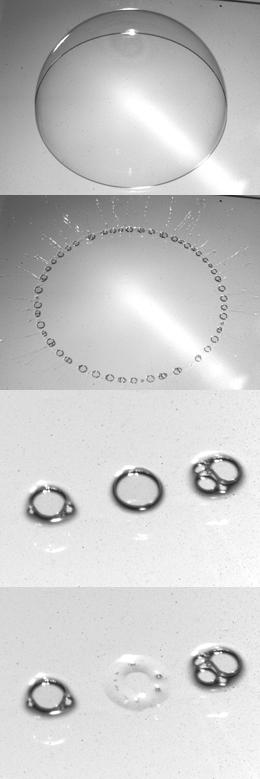
Sometimes bursting one bubble just leads to more bubbles. This high-speed video shows how popping a bubble sitting on a fluid surface can lead to a ring of daughter bubbles. When the surface of the bubble is ruptured, filaments of the liquid that made up the surface are drawn back toward the pool by surface tension, trapping small pockets of the air that had been inside the bubble. A dimple forms on the surface and rebounds as a jet that lacks the kinetic energy to eject droplets. Watch as the jet returns to the interface, and you will notice the tiny bubbles around it. At 56 ms, one of the daughter bubbles on the left bursts. See Nature for more. (Video credit: J. Bird et al)
Flapping to Fly Efficiently
High-speed video shows that bats achieve some of their efficiency in flight by pulling their wings inward on the upstroke, as seen above. While this does affect drag forces on the wing slightly, the primary energy savings comes from the inertial ease of lifting the folded wing. Much the way it is easier to lift your arm when it is folded than when you stretch it outright, it takes less energy for the bat to lift a folded wing than one that is fully extended. (via Wired Science)
Fixing Potholes with Oobleck
Shear-thickening non-Newtonian fluids like oobleck become more viscous as force is applied to them. This behavior causes them to form finger-like structures when vibrated, makes it good liquid armor, and even enables people to run across a pool of it without sinking. Now undergraduates at Case Western Reserve University have found a new use for such fluids: pothole filling. They have created a pothole patch that consists of a waterproof bag filled with a dry solution that, when mixed with water, creates a non-Newtonian fluid capable of flowing to take the shape of the pothole but resisting a car tire like a solid. They cover the patch with a layer of black fabric so that drivers don’t avoid the patch. See the video above for a demonstration and ScienceNOW for more. (submitted by aggieastronaut)
Jumping Water Droplets
Superhydrophobic surfaces resist wetting from water, but it turns out they can also trigger interesting behaviors in the tiny droplets condensing on the surface. High-speed video reveals that when two condensate droplets coalesce, the energy released by surface tension causes the new droplet to jump off the surface. The phenomenon is the same as one observed in some types of mushroom–when a condensate droplet touches a wetted spore, the spore is ejected from the mushroom. (Video credit: J. Boreyko)
Rogue Wave Recreated
For years, mariners have reported occurrences of rogue waves–sudden, isolated waves many times larger than the surrounding surface waves. Until 1995, when a rogue wave was first measured, debate raged as to whether such waves even existed. Scientists have since agreed that nonlinear models of wave interaction are the most likely source of the amplification necessary to create rogue waves. Since the Navier-Stokes equations that govern hydrodynamics are so difficult to solve, scientists have looked to simpler nonlinear wave equations, like the nonlinear Schroedinger equation that governs optics, to generate rogue-wave-like behavior. While the equation gives insight into how a given wave system will evolve, it is still necessary to determine what initial conditions can lead to the formation of a rogue wave. All manner of random conditions exist in the ocean, but to recreate the behavior in a simplified system, we must know which initial conditions are the right ones. Akhmediev et al presented a theoretical perspective on the initial conditions that might lead to rogue wave amplification, and now, for the first time, researchers have been able to create a rogue wave in a wave tank. That little blip that sinks the Lego pirate ship is a great accomplishment toward understanding a phenomenon whose very existence was in question less than twenty years ago. (Video credit: A Chabchoub, N Hoffmann, and N Akhmediev; via Gizmodo; for more, see APS Viewpoints and Akhmediev et al)
Brine Shrimp Swimming
For small creatures, swimming is dominated by viscosity. Here researchers use particle image velocimetry (PIV) to explore the flow field around brine shrimp. Its motion is divided into two vorticity-generating phases–the wide power stroke where the shrimp generates most of its forward motion and the recovery stroke where the shrimp returns its starting position while generating as little motion and drag as it can. (Video credit: B. Johnson, D. Garrity, L. Dasi)
Granular Eruptions
Granular flows, which are made up of loose particles like sand, often display remarkably fluid-like behavior. Here researchers explore the behavior of granular flows when a solid impacts them at high speed. The sand, unlike a fluid, does not have surface tension, yet we still observe many of the same behaviors. Like a fluid, the sand splashes and creates cavities and jets as it deforms around the fallen object. The sand even “erupts” as submerged pockets of air make their way back to the surface.

Tornadogenesis

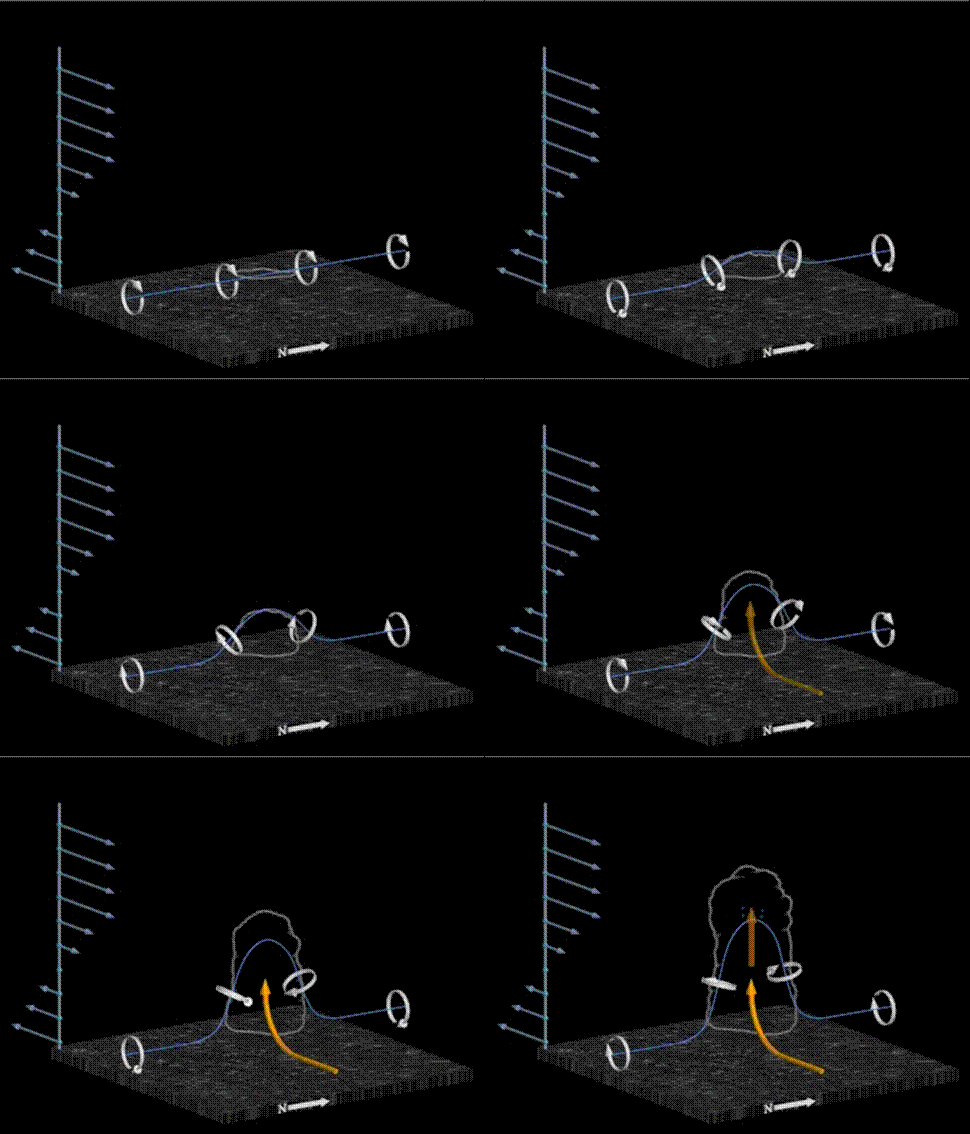
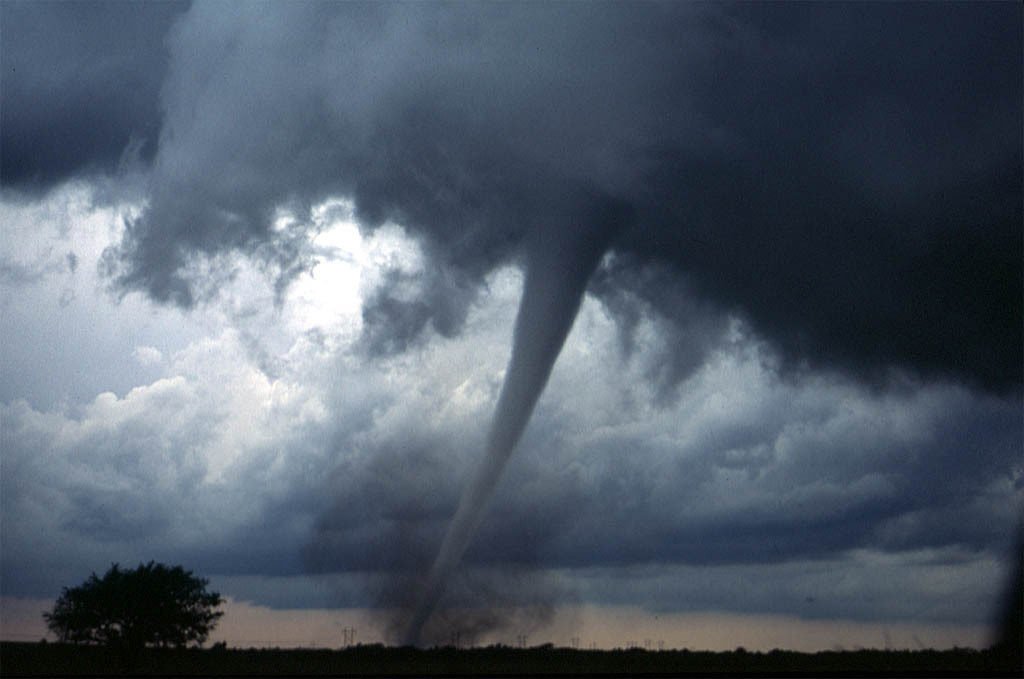
Tornadogenesis–the formation of tornadoes–remains a topic of active research as there is relatively little direct experimental data, owing to the difficulty of prediction as well as measurement. Initially, a variation of wind speed at different altitudes in the atmosphere causes shearing, which can lead to the formation of a horizontal column of rotating air–a vortex line similar to a roll cloud. Beneath a developing storm, the updraft of warm local air can pull this vortex line upwards, creating vertical rotation in the cloud, thereby birthing a supercell. Supercells do not always spawn tornadoes, and the exact causes that result in tornadic or nontornadic supercells are not fully understood. However, the formation of tornadoes within the supercell seems dependent on the downdraft of cool air within the storm as well as stretching of the vortex line, which increases its rate of rotation. For more information, check out this explanatory video and some of the talks by Paul Markowski. (Thanks to mindscrib, aggieastronaut and others for their submissions related to this topic! Photo credits: P. Markowski and D. Zaras)