Researchers have built logic gates–a physical implementation of Boolean logic–using droplets on a superhydrophobic surface. The video above demonstrates their flip-flop memory gate. Incoming droplets travel on a single track, striking a stationary “memory droplet” which then goes into one of the two output tracks according to its memory state. The memory state of the droplet relies on its position; the droplet sits on an infinity-shaped depression. When the incoming droplet strikes the sitting one, the droplet will exit via the track closest to its depression. The droplet that struck it will, as a result of the momentum transfer of the collision, rebound the opposite direction into the other depression, thereby storing the opposite memory state. See here for videos demonstrating other logic gates. (Video credit: H. Mertaniemi et al.; submitted by L. Buss)
Category: Research

The Supersonic Plonk
Everyone knows the familiar plonk of a stone falling into a pond but few realize the complexity of the physics. When a solid object falls into a pool, a sheet of liquid, the crown splash, is sent upward. Simultaneously, the object pulls a cavity of air down with it. As the water moves inward, this cavity is pinched, creating an hourglass-like shape reminiscent of the shape of a rocket’s nozzle. As the diameter of that pinched cavity shrinks, the velocity of the upward escaping air increases, resulting in the formation of an air jet moving faster than the speed of sound. This air jet is followed by a slower liquid jet that may rebound to a height higher than then original height of the dropped object. So next time you throw a stone into a pond, enjoy the knowledge that you’ve broken the sound barrier. (Photo credit: D. van der Meer; see also Physics World)

Bouncing Off
A water droplet falling onto a superhydrophobic surface will rebound and bounce without wetting the surface. Capillary and internal waves reflect in the drop until it comes to rest at a high contact angle, formed at the boundary where the liquid, solid, and air meet. Such surfaces can have interesting interactions with water, as when two droplets coalesce on a surface and then begin bouncing or when superhydrophobic objects are dropped into a bath. (Video credit: Gangopadhyay Group, University of Missouri)

Using Flow Viz for Optimization


Flow visualization is a powerful design tool for engineers. When Google was interested in determining optimal configurations for their heliostat array, they turned to NASA Ames’ water tunnel facility to test upstream barriers to deflect flow off the heliostats. In each photo, flow is from left to right and fluorescent dye is used to mark streamlines and reveal qualitative flow detail. Upstream of the obstacles, the streamlines are coherent and laminar, but after deflection, the flow breaks down into turbulence. In this case, such turbulence is desirable because it lowers the local fluid velocity and thus the aerodynamic loads experienced by each heliostat, potentially allowing for a savings in fabrication. For more, see Google’s report on the project. (Photo credits: google.org)

Falling Oil
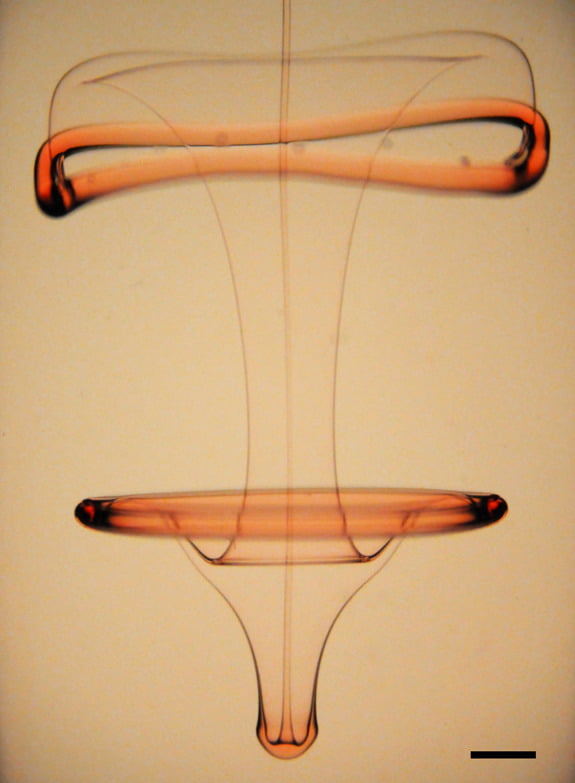
A drop of silicone oil falling through a liquid with lower surface tension distorts into multiple vortex rings connected by thin films. This behavior is caused by the interaction between viscous and capillary forces and is observable for only a narrow range of oil viscosities. (Photo credit: A. Felce and T. Cubaud)

Viscoelastic Fingers
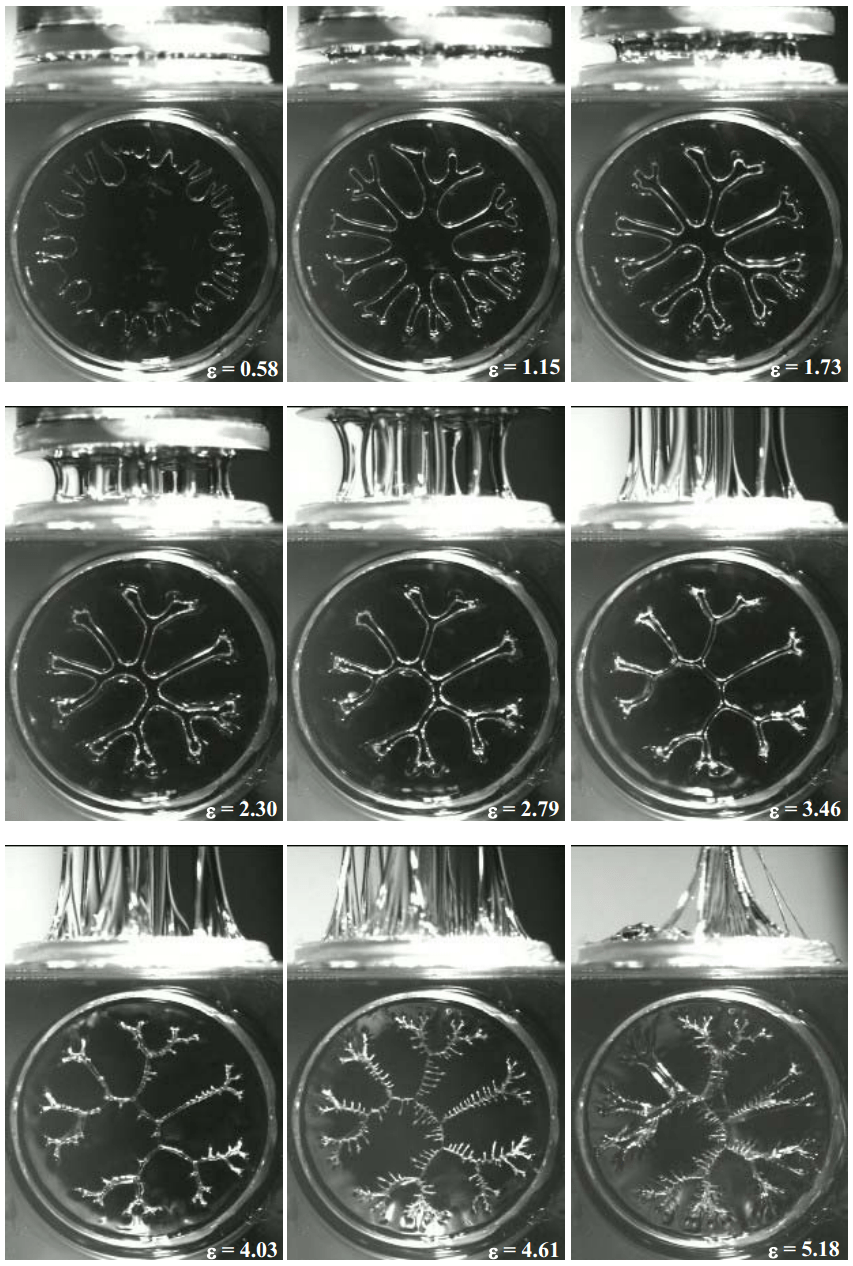
This series of photos shows two plates with a thin layer of polymer-laced, viscoelastic liquid. As the two plates are separated, complex instabilities form. The lower section of each photograph shows the fluid on the plate, with finger-like Saffman-Taylor instabilities forming as air rushes in between the gap in the plates. As the separation increases, the polymers in the liquid stretch under the increased strain, inducing elastic stresses in the fluid that cause the formation of secondary structures. (Photo credit: R. Welsh, J. Bico, and G. McKinley)

Bubbles and Jets

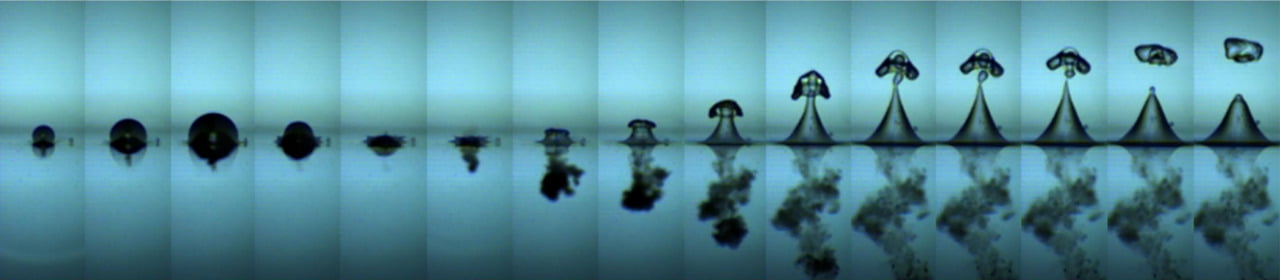
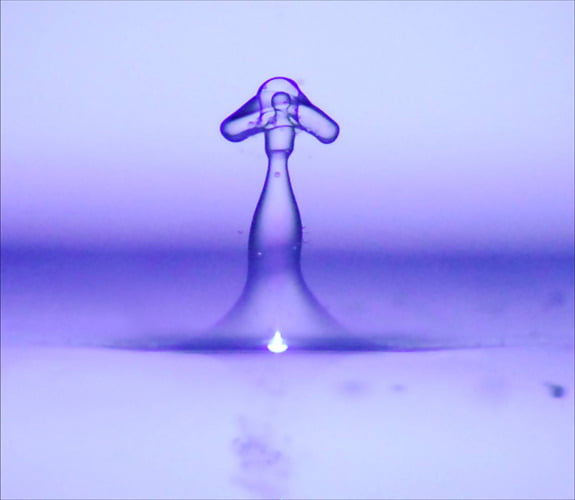
In the photo sequence above, a bubble is created at the interface between two immiscible liquids–water on top and denser hydrofluroether (HFE) below. Initially, the bubble expands explosively due to the vaporization of water generated by a short laser pulse. As the bubble collapses, a jet forms and accelerates into the HFE. After collapse, the bubble remnants injected in the HFE cause the formation of a jet that shoots back into the water above. Surface instabilities make the jet assume a mushroom or crown-like structure that detaches from the jet. Eventually gravity will return the system to its initial undisturbed fluid-fluid interface. (Photo credit: S. Avila et al. 1,2)

Flapping Flags
The flapping of flexible objects like flags have long fascinated mankind. The figure above from Shelley and Zhang 2011 shows several possible flapping states. In (a) a thread immersed in a running soap film displays the standard von Karman vortex street of shed vortices in its wake. Parts (b) and © show the thread in coherent flapping motion; (b) shows an snapshot of the flapping thread in the soap film whereas © is a timelapse of the thread showing its full range of motion. Image (d) shows the effects of a higher flow speed–the flapping motion becomes aperiodic. Image (e) shows a stiff metal wire bent into the shape of a flapping filament; note the strong boundary layer separation around the wire compared to the thread in Image (b). As one might expect, the drag on the unflapping wire is significantly greater than the drag on the flapping thread. (Image credit: M. Shelley and J. Zhang, Shelley and Zhang 2011)
Pinch-Off
This high-speed video reveals a fascinating bit of kitchen sink physics. When a water droplet pinches off from the nozzle, the thin filament of fluid that connected the droplet to the water on the nozzle often breaks off as well. Surface tension snaps the filament together into a sphere, causing wild oscillations and even ejection of microjets in the tiny satellite droplet. (Video from S. Thoroddsen et al. 2008’s Annual Review)

Vortex Cross-Sections

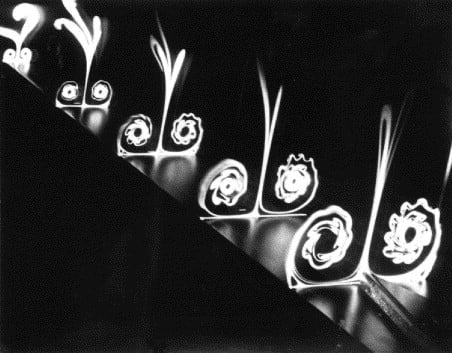
The photos above show cross-sections through the leading edge vortices on a highly swept delta wing at angle of attack. Flow in the photos is from the upper left to lower right. Notice how the vortices grow and develop waviness as they move downstream. When perturbations enter the vortex–for example, due to the shear between the vortex fluid and the freestream–some will grow and eventually cause a break down to turbulence, as in the lower picture. (Photo credits: R. Nelson and A. Pelletier)