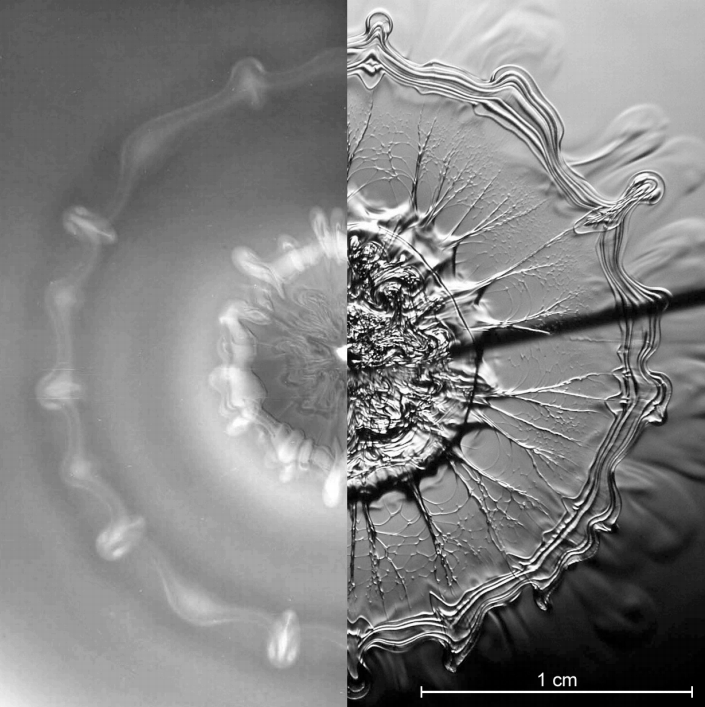
When a drop falls from a moderate height into a shallow pool, its impact creates a complicated pattern. The photo above is a composite image showing a top-down view 100 ms after such an impact. On the left side, the flow is visualized using dye whereas the right shows a schlieren photograph, in which contrast indicates variations in density. Both methods show the same general structure – an inner vortex ring generated at the edge of the impact crater and formed mostly of drop fluid and an outer vortex ring, consisting primarily of pool fluid, formed by the spreading wave. Both regions show signs of instability and breakdown. (Photo credit: A. Wilkens et al.)
Category: Research

The Silence of Owls
Owls are nearly silent hunters, able to swoop down on their prey without the rush of air over their wings giving away their approach, thanks to several key features of their feathers. The trailing edge of their feathers–or any lifting body, like an airplane wing–are a particular source of acoustic noise due to the interaction of turbulence near the surface with the edge. Since owls are especially good at eliminating self-produced noise in a frequency range that overlaps human hearing, investigators want to learn what works for owls and apply to it aircraft. A recent theoretical analysis uses a simplified model of the feather as a porous, elastic plate. The researchers found that the combination of porosity with the elasticity of the trailing edge significantly reduced noise relative to a rigid edge. (Photo credit: N. Jewell; research credit: J. Jaworski and N. Peake)

Pendulum Soap Flow Viz
Soap films are a handy way to create nearly two-dimensional flow fields. Previously we’ve seen them used to show wake structures of pitching foils, flapping flags, and multiple bodies. In this video, we see the dynamics of a pendulum in a soap film. Initially its length is quite long, and the ring end of the pendulum bobs side-to-side in a figure-8 motion. There are two rotational effects here: one is the standard oscillation of a pendulum about its pivot, the other is the rotation of the pendulum’s ring about its attachment point. Interestingly, they have the same frequency. The major destabilizing force for the pendulum is the periodic shedding of vortices we see off the ring. By shortening the pendulum length, the pendulum’s behavior shifts; first it loses the stationary node in its string. Eventually, the string becomes so short that the pendulum no longer oscillates. (Video credit: M. Bandi et al.)
Breaking Up a Ferrofluid
Ferrofluids are known for their fascinating behaviors when subjected to magnetic fields, especially for the distinctive peaks they can form. In this video, we see a very thin ferrofluid drop on a pre-wetted surface just as a uniform perpendicular magnetic field is applied. Immediately the droplet breaks up into tiny isolated peaks that migrate out to the circumference. The interface breaks down from center, where the drop height is largest, and moves outward. Simultaneously, the diffusion of ferrofluid from the circumferential droplets into the surrounding fluid lowers the magnetization of those droplets, making it more difficult for them to repel their neighbors. As a result, they drift outward more slowly and get caught by the faster-moving droplets from within. (Video credit: C. Chen)
Self-Assembly via Evaporation
When working at the microscale, engineering structures like those used for drug delivery systems requires ingenuity. Since it isn’t possible to manipulate particles manually, researchers harness physical effects to do the work for them. Here a droplet filled with millions of polystyrene microparticles sits on a hydrophobic surface, which helps keep the drop’s spherical shape. As the drop evaporates, surface tension and internal flow in the drop help the microparticles self-assemble into a microscopic soccer-ball-like shape. (Video credit: A. Marin et al.; submission by A. Marin)
Watching the Boundary Layer Go By
In experiments, it can be difficult to track individual fluid structures as they flow downstream. Here researchers capture this spatial development by towing a 5-meter flat plate past a stationary camera while visualizing the boundary layer – the area close to the plate. The result is that we see turbulent eddies evolving as they advect downstream. Despite the complicated and seemingly chaotic flow field, the eye is able to pick out patterns and structure, like the merging of vortices that lifts eddies up into turbulent bulges and the entrainment of freestream fluid into the boundary layer as the eddies turn over or collapse. It is also a great demonstration of how the Reynolds number relates to the separation of scales in a turbulent flow. Notice how much richer the variety of length-scale is for the higher Reynolds number case and how thoroughly this mixes the boundary layer. (Video credit: J. H. Lee et al.)

Evaporation and Surface Effects
Surface properties can have surprising effects on fluid behavior. This image shows the evaporation of several droplets over time. All of the initial droplets are of the same volume, but they are placed on a surface which is a) superhydrophobic, b) hydrophobic, or c) hydrophilic. The more hydrophobic the surface, the larger the initial contact angle between the droplet and surface and the smaller the wetted area of the surface. Yet despite this seemingly large surface area exposure to air, the droplet on the superhydrophobic surface is the slowest to evaporate. (Photo credit: C. Choi)
Lifting Liquids
At very small scales, the interaction of solids and liquids is governed by molecular forces. Here researchers demonstrate how carbon nanowires of only a few nanometers in diameter draw liquid up in a film or bead when inserted in a pool. Capillary action is the name we give this gravity-defying force generated between the liquid and solid molecules. Although this behavior was predicted theoretically, it had not been previously observed at this scale due to the need for electron microscopy. Such microscopes require a vacuum, which boils off almost any liquid instantaneously. Researchers used a special fluid that remained in a liquid state even under near-vacuum pressures in order to make these observations. (Video credit: J. Li et al/MIT News; submitted by 20percentvitaminc)
Entering a Viscous Liquid
When a solid object impacts on a liquid a cavity typically forms, entraining air into the pool. But this behavior varies widely according to the surface of the solid as well as the fluid’s properties. This video shows a sphere impacting a highly viscous liquid. The sphere stops shortly after impact while the cavity continues expanding in its wake. With a fluid like water, a long and thin cavity will typically pinch off before the object is decelerated, causing bubbles to form. No such behavior here. Instead the wide cavity pinches off at the surface of the motionless sphere and begins its rebound upwards. It even appears to pull the sphere partially back towards the surface! (Video credit: A. Le Goff et al.)

Turning Sound Into Imagery


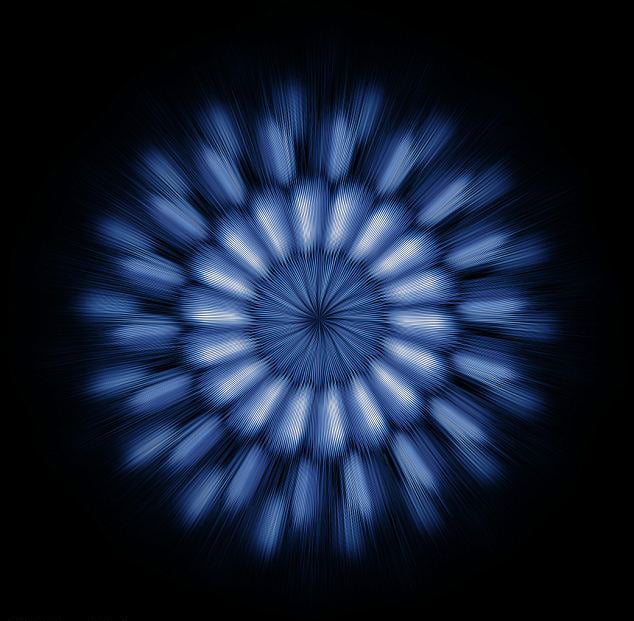

The acoustic signatures of many animals contain features we humans cannot appreciate, given the limited range of frequencies we can hear. In fluid dynamics and many other fields, scientists and engineers have to find ways to analyze and decompose time-series data–like acoustic pressure signals–into useful quantities. Mark Fischer uses one tool for such analysis, a wavelet transform, to turn the calls of whales, birds, and insects into the colorful snapshots seen here. Wavelet transforms are somewhat similar to Fourier transforms but represent a signal with a series of wavelets rather than sinusoids. They’re also widely used for data compression. (Image credits: M. Fischer/Aguasonic Acoustics; via DailyMail)