Underwater explosions are, in general, much more dangerous than those in air. This video shows an underwater blast at 30,000 fps. During the initial blast, a hot sphere of gas expands outward in a shock wave. In air, some of the energy of this pressure wave would be dissipated by compressing the air. Since water is incompressible, however, the blast instead moves water aside as the bubble expands. Eventually, the bubble expands to the point where its pressure is less than that of the water around it, which causes the bubble to collapse. But the collapse increases the gas pressure once more, kicking off a series of expansions and collapses. Each bubble contains less energy than the previous, thanks to the loss of pushing the water aside. (Video credit: K. Kitagawa)
Category: Research

Imitating Flapping Flight

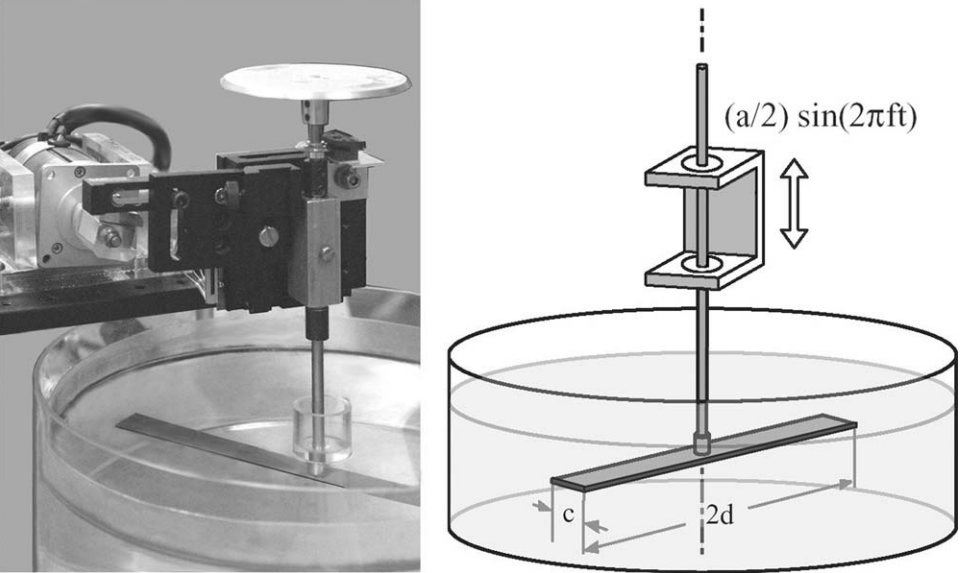
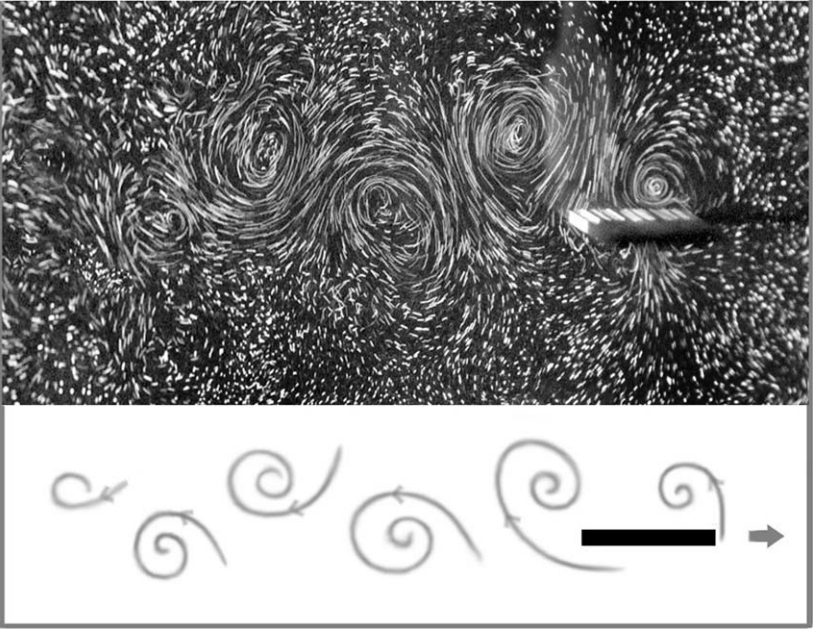
Flapping flight, despite being utilized by creatures of many sizes in nature, remains remarkably difficult to engineer. In this experiment, a simple rectangular wing is flapped up and down sinusoidally. Above a critical flapping frequency, the wing–which is free to rotate–accelerates from rest to a constant speed. This rotation is equivalent to forward flight. The upper image shows a photo and schematic of the setup, while the lower images shows flow visualization of the wing’s wake. The wing moves to the right, shedding thrust-providing periodic vortices in its wake. (Photo credits: N. Vandenberge et al.)

Shocking Droplets
Typical liquid drops will break apart into long, stretched ligaments and a spray of tiny droplets when deformed. But with just a small addition of polymers, these same liquids become viscoelastic and capable of some pretty incredible behaviors. This video shows a viscoelastic drop being struck by a shock wave that passes from right to left. The droplet is smashed and deformed, then stretches into jellyfish-like sheet of liquid. But incredibly, the elastic forces in the droplet are enough to hold it together. Researchers are interested in understanding these behaviors for many applications, including preventing accidental explosions caused by explosive fuels atomizing in air. (Video credit: T. Theofanous et al.)

Bouncing to Mix Oil and Water
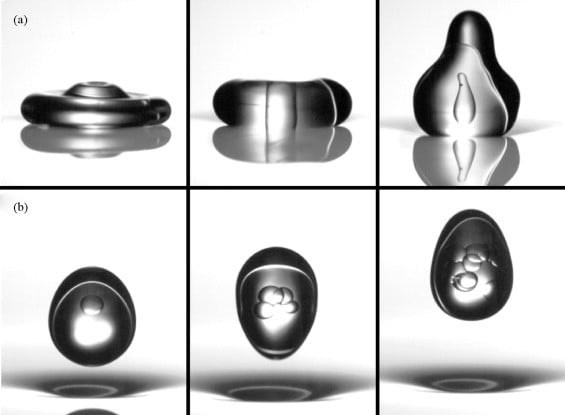
Mixing immiscible liquids–like oil and water–is tough. The best one can usually do is create an emulsion, in which droplets of one fluid are suspended in another. The series of images above shows a double emulsion consisting of oil and water that’s been formed by bouncing the compound droplet on a vibrating bath. The vibration of the liquid surface keeps the droplet from coalescing with the bath and the deformation provides mixing. The top row shows the initial impact while the bottom row of images shows the droplet after many bounces. As time goes on, the layer of oil around the compound drop becomes a cluster of tiny droplets contained within the water portion of the drop. (Photo credit: D. Terwagne et al.)

Penguins Can Be Colder Than Their Surroundings
Thermal imaging of emperor penguins in Antarctica shows that, in still conditions, large portions of their bodies remain colder than ambient temperatures. In the image above, the heads, beaks, eyes, and flippers of this pair of penguin are the warmest while much of their feathered surface remains several degrees colder than the temperature around them. Not only does this indicate that the penguins’ skin and feathers are extremely effective insulators–the core temperature of each penguin is roughly the same as a human’s–but it means that the penguins are losing heat via radiative cooling toward the sky, the same way your car does when frost forms. The measurements in the study are for penguins at least one body length away from any other penguins; of course penguins typically huddle together to generate additional warmth. The mathematics of this behavior are under active research. (Photo credit: D. McCafferty et al.; via Wired)
Gravity’s Effect on Bursting Bubbles
In a gravitational field, the pressure in a fluid increases with depth. You can consider it due to the weight of the fluid above. Outside of scuba diving or hiking at altitude, this effect is not one typically given much thought. But what effect can it have at a smaller scale? This video shows the collapse and rebound of three initially spherical cavitation bubbles inside a liquid. Each bubble is created in a different gravitational field – one in microgravity, one in normal gravity, and one at 1.8x Earth gravity. The bubble in microgravity remains axisymmetric and spherical, but the two bubbles recorded in gravitational fields develop jets during rebound. Even at a scale of only a few millimeters, gravity causes an imbalance in pressure across the bubble that creates asymmetry. (Video credit: D. Obreschkow et al.)
Mixing the Southern Ocean
Motion in the ocean is driven by many factors, including temperature, salinity, geography, and atmospheric interactions. While global currents dictate much of the large-scale motion, it’s sometimes the smaller scales that impact the climate. This visualization shows numerically simulated data from the Southern Ocean over the course of a year. The eddies that swirl off from the main currents are responsible for much of the mixing that occurs between areas of different temperature, which ultimately impacts large-scale temperature distributions, in this case affecting the flux of heat toward Antarctica. (Video credit: I. Rosso, A. Klocker, A. Hogg, S. Ramsden; submitted by S. Ramsden)

The Boundary Layer Visualized
Any time there is relative motion between a solid and a fluid, a small region near the surface will see a large change in velocity. This region, shown with smoke in the image above, is called the boundary layer. Here air flows from right to left over a spinning spheroid. At first, the boundary layer is laminar, its flow smooth and orderly. But tiny disturbances get into the boundary layer and one of them begins to grow. This disturbance ultimately causes the evenly spaced vortices we see wrapping around the mid-section of the model. These vortices themselves become unstable a short distance later, growing wavy before breaking down into complete turbulence. (Photo credit: Y. Kohama)
Breaking Up Falling Beads
In a stream of falling liquid, surface tension instabilities cause the fluid to break up into droplets. This video shows a similar experiment with a stream of glass beads, a granular material. The whole system is housed under a vacuum to eliminate the effects of air drag on the stream, and a camera rides alongside the stream to track the evolution of the falling material in a Lagrangian fashion. As with a liquid stream, we see the granular flow develop undulations as it falls, ultimately breaking up into clusters of beads. The authors suggest that nanoscale surface roughness and van der Waals forces may be responsible for the clustering behavior in the absence of surface tension. (Video credit: J. Royer et al.)
When Skittering Becomes Self-Propulsion
When liquids hit a surface much hotter than their boiling point, a thin layer of gas can form between the drop and surface, allowing the drop to glide along. This Leidenfrost effect is what makes drops of water skitter across a hot pan. But what happens when the pan isn’t flat? The video above shows a Leidenfrost drop on a ratchet-like surface. Instead of gliding or skittering randomly, the drop self-propels toward the steepest section of the ratchet This behavior allows researchers to design surfaces that guide the drops on an intended path. (Video credit: G. Lagubeau and D. Quéré)