Almost everyone has tried skipping rocks across the surface of a pond or lake. Here Professor Tadd Truscott gives a primer on the physics of rock skipping, including some high-speed video of the impact and rebound. In a conventional side-arm-launched skip, the rock’s impact creates a cavity, whose edge the rock rides. This pitches the rock upward, creating a lifting force that launches the rock back up for another skip. Alternatively, you can launch a rock overhand with a strong backspin. The rock will go under the surface, but if there’s enough spin on it, there will be sufficient circulation to create lift that brings the rock back up. This is the same Magnus effect used in many sports to control the behavior of a ball–whether it’s a corner or free kick in soccer or a spike in volleyball or tennis. (Video credit: BYU Splash Lab/Brigham Young University)
Category: Research

Humpback-Inspired Turbine Blades

The bumps–or tubercles–on the edge of a humpback whale’s fins have important hydrodynamic effects on its swimming. Here dye is used to visualize flow over a hydrofoil with tubercle-like protuberances–a sort of artificial whale fin. Dye released from the peaks and troughs of the protuberances flows straight back in a narrow line before breakdown to turbulence. But the dye released from ports on the shoulders of the protuberances twists and spirals into vortices. At angle of attack, these vortices are stronger. They may help keep flow from separating on the upper side of a whale’s fin. (Photo credits: SIDwilliams, H. Johari)

Dye Flow
Fluid flow near a surface–inside the boundary layer–can often be unstable. This image shows one possible instability, formed when a cylinder is rotated back and forth about its longitudinal axis. This oscillation and the curvature of the cylinder destabilize flow in the boundary layer, forming vortices that line the cylinder. This particular behavior is called a Görtler instability. To visualize it, threads soaked in fluorescing dye have been embedded into slits in the cylinder. The cylinder is oscillated in a water tank and ultraviolet light is used to fluoresce the dye for the image. (Photo credit: Miguel Canals/University of Hawaii)

Hummingbirds Singing with their Tail Feathers
Aeroelastic flutter occurs when fluid mechanical forces and structural forces get coupled together, one feeding the other. Usually, we think of it as a destructive mechanism, but, for hummingbirds, it’s part of courtship. When a male hummingbird looks to attract a mate, he’ll climb and dive, flaring his tail feathers one or more times. As he does so, air flow over the feathers causes them to vibrate and produce noise. Researchers studied such tail feathers in a wind tunnel, finding a variety of vibrational behaviors, including a tendency for constructive interference–in other words two feathers vibrating in proximity is much louder than either individually. For more, check out the original Science article or the write-up at phys.org. (Video credit: C. Clark et al.)

Supersonic Oil Flow Viz
This image shows oil-flow visualization of a cylindrical roughness element on a flat plate in supersonic flow. The flow direction is from left to right. In this technique, a thin layer of high-viscosity oil is painted over the surface and dusted with green fluorescent powder. Once the supersonic tunnel is started, the model gets injected in the flow for a few seconds, then retracted. After the run, ultraviolet lighting illuminates the fluorescent powder, allowing researchers to see how air flowed over the surface. Image (a) shows the flat plate without roughness; there is relatively little variation in the oil distribution. Image (b) includes a 1-mm high, 4-mm wide cylinder. Note bow-shaped disruption upstream of the roughness and the lines of alternating light and dark areas that wrap around the roughness and stretch downstream. These lines form where oil has been moved from one region and concentrated in another, usually due to vortices in the roughness wake. Image © shows the same behavior amplified yet further by the 4-mm high, 4-mm wide cylinder that sticks up well beyond the edge of the boundary layer. Such images, combined with other methods of flow visualization, help scientists piece together the structures that form due to surface roughness and how these affect downstream flow on vehicles like the Orion capsule during atmospheric re-entry. (Photo credit: P. Danehy et al./NASA Langley #)
Dropping Through Strata
When a droplet falls through an air/water interface, a vortex ring can form and fall through the liquid. In this video, the researchers investigate the effects of a stratified fluid interface on this falling vortex ring. In this case, a less dense fluid sits atop a denser one. Depending on the density of the initial falling droplet and the distance it travels through the first fluid, the behavior and break-up of the vortex ring when it hits the denser fluid differs. Here four different behaviors are demonstrated, including bouncing and trapping of the vortex ring. (Video credit: R. Camassa et al.)

Mixing Physics
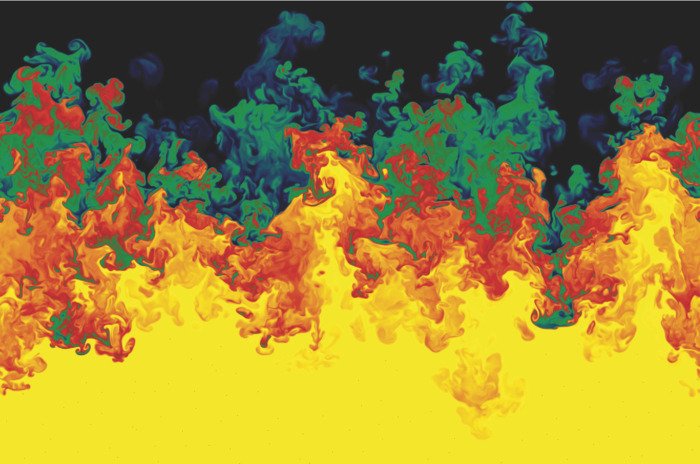
When a dense fluid sits above a lighter fluid in a gravitational field, the interface between the two fluids is unstable. It breaks down via a Rayleigh-Taylor instability, with mushroom-like protrusions of the lighter fluid into the heavier one. The image above comes from a numerical simulation of this effect well after the initial instability; the darker colors represent denser fluids and lighter colors are less dense fluids. The flow here has progressed to turbulence, and the authors of the simulation are exploring the statistical nature of this flow breakdown relative to the classical case of isotropic, homogeneous turbulence. (Photo credit: W. Cabot and Y. Zhou)
Spitting Droplets
Any phenomenon in fluid dynamics typically involves the interaction and competition of many different forces. Sometimes these forces are of very different magnitudes, and it can be difficult to determine their effects. This video focuses on capillary force, which is responsible for a liquid’s ability to climb up the walls of its container, creating a meniscus and allowing plants and trees to passively draw water up from their roots. Being intermolecular in nature, capillary forces can be quite slight in comparison to gravitational forces, and thus it’s beneficial to study them in the absence of gravity.
In the 1950s, drop tower experiments simulating microgravity studied the capillary-driven motion of fluids up a glass tube that was partially submerged in a pool of fluid. Without gravity acting against it, capillary action would draw the fluid up to the top of the glass tube, but no droplets would be ejected. In the current research, a nozzle has been added to the tubes, which accelerates the capillary flow. In this case, both in terrestrial labs and aboard the International Space Station, the momentum of the flow is sufficient to invert the meniscus from concave to convex, allowing a jet of fluid out of the tube. At this point, surface tension instabilities take over, breaking the fluid into droplets. (Video credit: A. Wollman et al.)

Plasma Jets
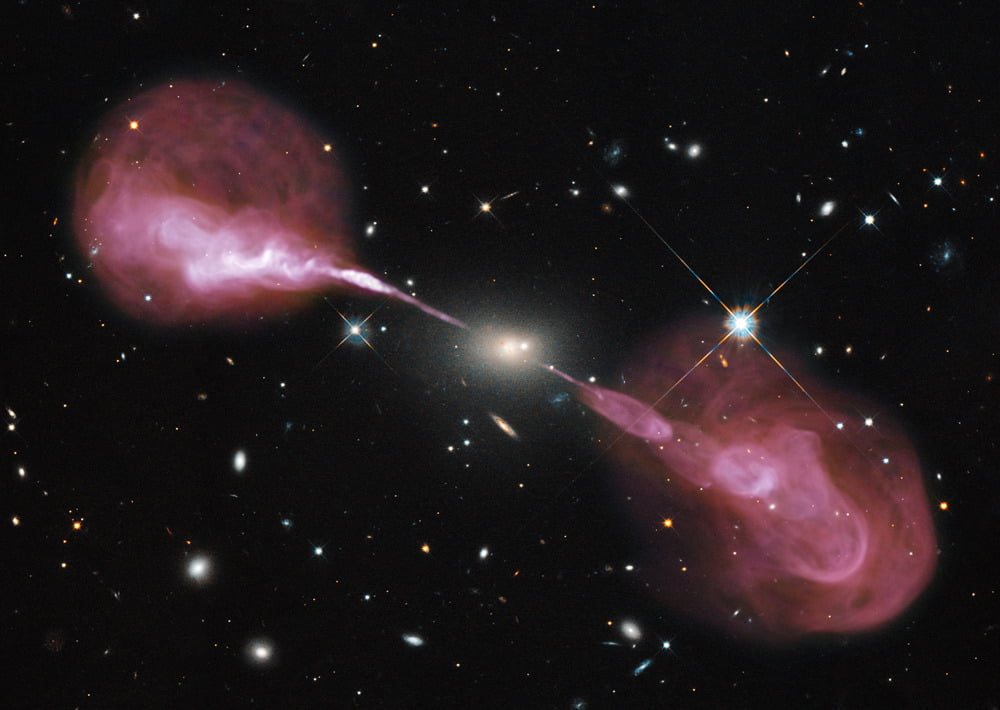
Jets of high-energy plasma and sub-atomic particles explode outward from the Hercules A elliptical galaxy at the center of this photo. The jets are driven to speeds close to that of light due to the gravitation of the supermassive black hole at the center of the elliptical galaxy. Relativistic effects mask the innermost portions of the jets from our view, but, as the jets slow, they become unstable, billowing out into rings and wisps whose turbulent shapes suggest multiple outbursts originating from Hercules A. (Photo credit:NASA, ESA, S. Baum and C. O’Dea (RIT), R. Perley and W. Cotton (NRAO/AUI/NSF), and the Hubble HeritageTeam (STScI/AURA); via Discovery)
Surface Explosions
Underwater explosions often behave non-intuitively. Here researchers explore the effects of surface explosions by setting off charges at the air/water interface. Initially, an unconfined explosion’s blast wave expands a cavity radially into the water. This cavity collapses back toward the surface from the bottom up, ultimately resulting in a free jet that rebounds above the water level. Confined explosions behave very differently, expanding down the glass tube containing them in a one-dimensional fashion. The cavity never extends beyond the end of the glass tube, likely due to hydrostatic pressure. (Video credit: Adrien Benusiglio, David Quéré, Christophe Clanet)