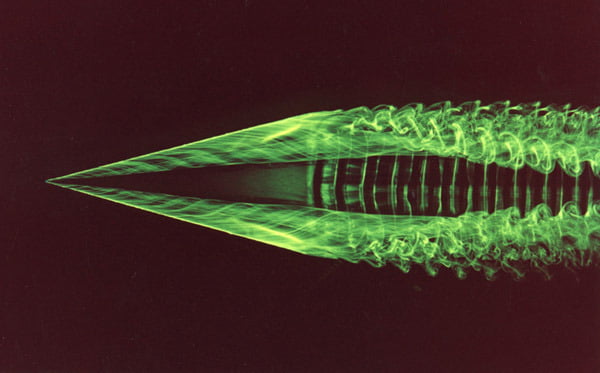
Fluorescent dye illuminated by laser light shows the formation and structure of vortices on a delta wing. A vortex rolls up along each leading edge, helping to generate lift on the triangular wing. As the vortices leave the wing, their structure becomes even more complicated, full of lacy wisps of vorticity that interact. Note how, by the right side of the photo, the vortices are beginning to draw closer together. This is an early part of the large-wavelength Crow instability. Much further downstream, the two vortices will reconnect and break down into a series of large rings. (Photo credit: G. Miller and C. Williamson)
Category: Research

Self-Assembling Ferrofluids
Ferrofluids–colloidal suspensions made up of ferromagnetic nanoparticles and a carrier liquid–are known for their interesting and sometimes bizarre behaviors due to magnetic fields. The video above shows how, when subjected to an increasing magnetic field, a single droplet of a ferrofluid on a superhydrophobic surface will split into several droplets. The process is called static self-assembly, and it results from the ferrofluid seeking a minimum energy state relative to the force supplied by the magnetic field. Change the magnetic field and the droplets shift to the next energy minimum. But what happens when you change the magnetic field continuously and too quickly for the droplets to respond? A whole different set of structures and behaviors are observed (video link). This is dynamic self-assembly, a different ordered state only achieved when the ferrofluid is forceably kept away from the energy minima seen in the first video. For more, see the additional videos and the original paper. (Video credit: J. Timonen et al.; via io9)
The Fluid Dynamical Sewing Machine
Originally posted: 3 Jan 2012 Nonlinearity and chaos are important topics for many aspects of fluid dynamics but can be difficult to wrap one’s head around. But this video provides an awesome, direct example of one of the key concepts of nonlinear systems–namely, bifurcation. What you see is a thread of very viscous fluid, like honey, falling on a moving belt. Initially, the belt is moving quickly and the thread falls in a straight line. When the belt slows down, the thread begins to meander sinusoidally. With additional changes in the belt’s speed, the thread begins to coil. A multitude of other patterns are possible, too, just by varying the height of the thread and the speed of the belt. Each of these shifts in behavior is a bifurcation. Understanding how and why systems display these behaviors helps unravel the mysteries of chaos. (Video credit: S. Morris et al.)
Reminder: There’s still time left to take the reader survey! Please take a couple minutes to help improve FYFD and science outreach. Thank you!

Soap Film Butterfly
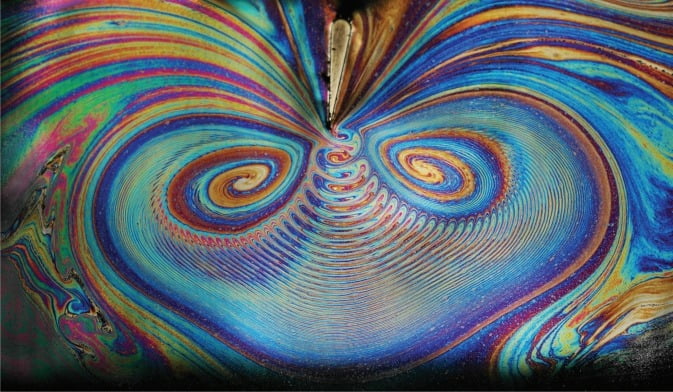
Originally posted: 14 Jan 2011 This gorgeous butterfly-like double spiral roll takes place on a horizontal soap film. The foil (seen top center) inserted in the film flaps back and forth. Each time the foil changes direction a vortex forms at the tip and gets advected away. The vortices stretch and distort in the roll, but if you look at the photograph closely, you’ll see the tiny shed vortices persisting throughout the roll structure. The bright colors that make this flow visible are due to interference patterns related to the local thickness of the film. (Photo credit: T. Schnipper et al.)
Reminder: If you haven’t already, please fill out our reader survey and help us improve FYFD!
Dublin’s Pitch-Drop Experiment
Readers may recall the University of Queensland’s pitch-drop experiment, recognized as the longest continuously running experiment in the world. Back in 1927, a professor started the experiment with the goal of measuring the extremely high viscosity of pitch. Since then, only eight drops have fallen. Queensland’s is not the only version of this experiment, though; Trinity College Dublin has a similar set-up and have just caught a falling pitch drop on camera for the first time ever. Take a look in the video above. Queensland is expecting a drop to fall sometime this year as well. (Video credit: Trinity College Dublin Physics; via SciAm)

Drop-Tower Droplets
A microgravity environment can cause some nonintuitive behaviors in fluids. Many of the effects that dominate fluid dynamics in space are masked by gravity’s effects here on Earth. As a result, it can be very difficult to predict how seemingly straightforward technologies like heat exchangers, refrigeration units, and fuel tanks will behave. The photos above show two bubble jets–created by injecting a liquid-gas mixture into a liquid–colliding in microgravity. This particular experiment was conducted in a drop tower rather than on-orbit, which produced some side effects like the large bubbles seen in the images. These were created by the coalescence of smaller bubbles that congregated near the top of the tank shortly before the experiment attained free-fall. (Photo credit: F. Sunol and R. Gonzalez-Cinca)
Levitation By Sound
Levitation is an effect usually associated with electromagnetic forces, but it’s possible with sound as well. This acoustic levitation is achieved by using the pressure from sound waves to balance gravity’s effect. By manipulating the sound, it’s possible to bring separate objects together while continuing to levitate them. The behavior is demonstrated in the video above by combining solid sodium with a drop of water for what any high school chemist will tell you is a spectacular reaction. (Though, if that’s too small-scale for you, there’s also this video.) (Video credit: D. Foresti et al; via SciAm)
Super-Highway Convection
In the ocean, many forces compete in driving convection, including the temperature and salinity of the water. In the laboratory, it’s possible to mimic these characteristics of oceanic circulation using two different fluids driven by temperature and concentration differences. Recently, researchers were exploring this problem–with the added twist of tilting the fluids ~1 degree–when they discovered a surprising result. After an extended time, the convection self-organized into alternating parallel columns of ascending (dark) and descending (light) fluid. The researchers nicknamed this behavior super-highway convection. Read more about it here or in their paper. (Video credit: F. Croccolo et al; submitted by A. Vailati)

Flow Around a Complex Airfoil
Flow around an airfoil with a leading-edge slat is visualized above. At this Reynolds number, alternating periodic vortices are shed in its wake. Understanding how multi-element airfoils and control surfaces affect local flow is important in controlling aircraft aerodynamics. When multiple instabilities interact–like those in the wing’s boundary layer interacting with the wake’s–it can generate disturbances that are problematic in flight. Being able to predict and avoid such behavior is important for safe aircraft. (Photo credit: S. Makiya et al.)

Water Entry
In the image above we see two spheres of the same size, shape, and material being dropped into water. The left sphere has almost no splash, whereas the one on the right has a spectacular curtain-like splash. Why the big difference? It all comes down to the surface treatments. The glass sphere on the left is hydrophilic, but the right one has been treated to be hydrophobic. As a result, the water-fearing molecules of that sphere push the water away, allowing air to be entrained below the water’s surface instead. This creates a big splash that’s absent when the water moves smoothly around the hydrophilic sphere. (Photo credit: L. Bocquet et al.)