In recent years unmanned aerial vehicles (UAVs) have grown in popularity for both military and civilian application and are shifting from a remotely controlled platform to autonomous control. Since no pilot flies onboard an UAV, these craft are much smaller than other fixed-wing aircraft, with wingspans that may range from a few meters to only centimeters. At these sizes, most fixed-wing airfoil theory does not apply because no part of the wing is isolated from end effects. This complicates the prediction of lift and drag on the aircraft, particularly during maneuvering and necessitates the development of new predictive methods and control schemes. Shown above are flow visualizations of a small UAV executing a perching maneuver, intended to allow the craft to land as a bird does by scrubbing speed with a high-angle-of-attack, high-drag motion. (Photo credit: Jason Dorfman; via Hizook; requested by mindscrib)
Year: 2012

Unsteady Rocket Nozzle
This numerical simulation gives a glimpse of flow inside an unsteady rocket nozzle. The nozzle is over-expanded, meaning that the exhaust’s pressure is lower than that of the ambient atmosphere. A slightly over-expanded nozzle causes little more than a decrease in efficiency, but if the nozzle is grossly over-expanded, the boundary layer along the nozzle wall can separate and induce major instabilities, as seen here. In the first segment of the video, turbulent structures along the nozzle wall boundary layer are shown; note how the boundary layer becomes very thick and turbulent after the primary shock wave (shown in gray). This is due to the flow separating near the wall. The second half of the video shows the unsteadiness this can create. The primary shock wave splits into two near the wall, creating a lambda shock wave, named for the shape of the lower case Greek letter. This shock structure is indicative of strong interaction between the boundary layer and shock wave. (Video credit: B. Olson and S. Lele)

Rocket Exhaust
A fiery jet of exhaust remains amid plumes of smoke as a Soyuz rocket lifts off from Baikonur Cosmodrome bound for the International Space Station. The lengthscales of such turbulence range from tens of meters to only millimeters, highlighting the incredible difficulty of accurately capturing and describing the fluid motion of a practical engineering problem. (Photo credit: NASA/Carla Cioffi; via Visual Science)

Supercomputed Fluids
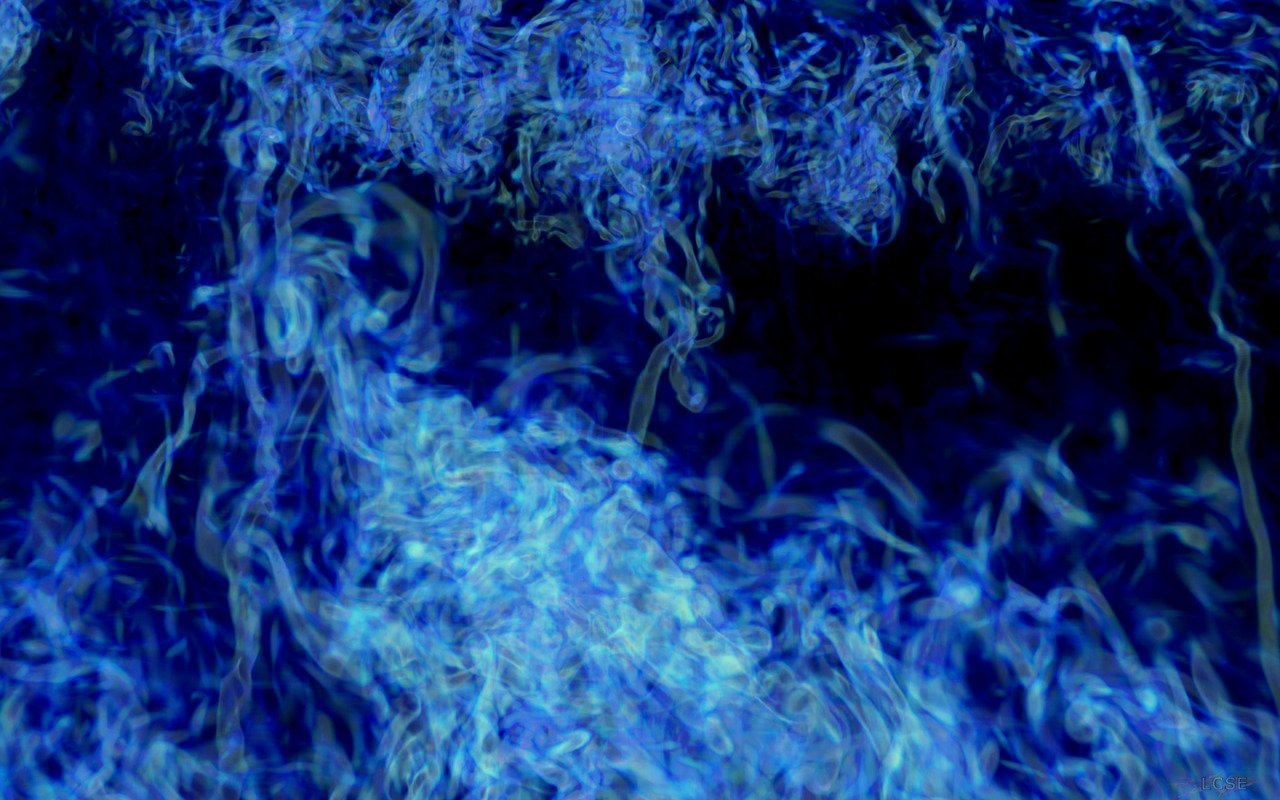
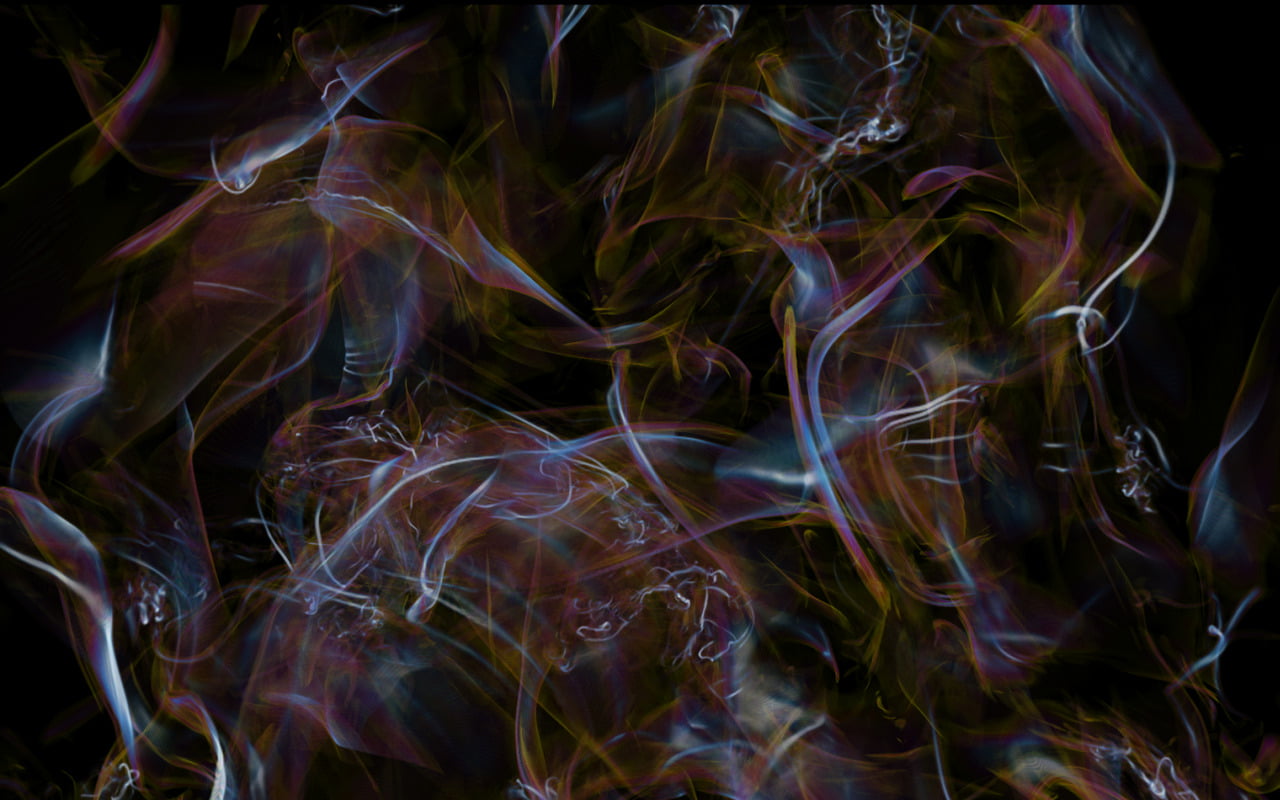
Computational fluid dynamics and supercomputers can produce some stunning flow visualizations. Above are examples of turbulence, the Rayleigh-Taylor instability, and the Kelvin-Helmholtz instability. Be sure to check out LCSE’s website for more; they’ve included wallpapers of some of the most spectacular ones. (Photo credits: Laboratory for Computational Science and Engineering, University of Minnesota, #)

Microgravity Water Balloons
When a water balloon pops in microgravity, waves propagate from the initial point of contact and the final point of contact (where the balloon skin peels away). As these waves come inward toward one another, the water is compressed from its original potato-like shape into a pancake-like one. In most cases, surface tension will provide a damping force on this oscillatory motion, eventually making the water into a sphere. On Earth, in contrast, a water balloon seems to hold its shape after popping. This is because the effect of gravity on the water is much larger than the effect of the propagating waves. This is one reason that it is useful to have a laboratory in space! Without a microgravity environment, it is much harder to study and observe secondary and tertiary-order forces on a physical event. (Video credit: Don Pettit, Science Off The Sphere)

Viscous Fingers
High viscosity silicon oil is sandwiched between two circular plates. As the upper plate is lifted at a constant speed, air flows in from the sides. The initially circular interface develops finger-like instabilities, due to the Saffman-Taylor mechanism, as the air penetrates. Eventually the fluid will completely detach from one plate. (Photo credit: D. Derks, M. Shelley, A. Lindner)

Magnus Force
Physics students are often taught to ignore the effects of air on a projectile, but such effects are not always negligible. This video features several great examples of the Magnus effect, which occurs when a spinning object moves through a fluid. The Magnus force acts perpendicular to the spin axis and is generated by pressure imbalances in the fluid near the object’s surface. On one side of the spinning object, fluid is dragged with the spin, staying attached to the object for longer than if it weren’t spinning. On the other side, however, the fluid is quickly stopped by the spin acting in the direction opposite to the fluid motion. The pressure will be higher on the side where the fluid stagnates and lower on the side where the flow stays attached, thereby generating a force acting from high-to-low, just like with lift on an airfoil. Sports players use this effect all the time: pitchers throw curveballs, volleyball and tennis players use topspin to drive a ball downward past the net, and golfers use backspin to keep a golf ball flying farther. (Video credit: Veritasium)

Vapor Cone
This stunning National Geographic photo contest winner shows an F-15 banking at an airshow and a array of great fluid dynamics. A vapor cloud has formed over the wings of the plane due to the acceleration of air over the top of the plane. The acceleration has dropped the local pressure enough that the moisture of the air condenses. Some of this condensation has been caught by the wingtip vortices, highlighting those as well. Finally, the twin exhausts have a wake full of shock diamonds, formed by a series of shock waves and expansion fans that adjust the exhaust’s pressure to match that of the ambient atmosphere. (Photo credit: Darryl Skinner/National Geographic; via In Focus; submitted by jshoer)

Liquid Lenses
Here astronaut Andre Kuipers demonstrates fluid dynamics in microgravity. A roughly spherical droplet of water acts as a lens, refracting the image of his face so that it appears upside down. The air bubble inside the droplet refracts the image back to our normal perspective again. (Photo credit: Andre Kuipers, ESA; via Bad Astronomy)

The Backward-Facing Step
This photo collage shows vortices shed off a backward-facing step. The flow is left to right. Here the flow is visualized using dye released in water. Initially, the vortex forms near the bottom of the step in the recirculation zone. Because flow over the top of the vortex is much faster than the flow beneath the vortex, a low pressure zone forms over the vortex and gradually draws it up toward the top of the step. Eventually the vortex will rise to the point where the upstream flow pushes it downstream and the process begins anew. (Photo credit: Andrew Carter, University of Colorado)