Any finite length wing produces wingtip vortices–potentially intense regions of rotational flow downstream of the wing’s ends. These vortices are associated both with the production of lift on the wing and with unavoidable induced drag. The tabletop demonstration above shows the region of the vortices’ influence and how strong the rotation is there. Note also that the two vortices have opposite rotational senses–the left side induces a clockwise rotation, whereas the right side induces an anti-clockwise rotation. The larger an aircraft, the stronger and longer lasting its vortices; this can be a source of danger for smaller aircraft passing through the wake. If a pilot crosses one wingtip vortex and overreacts to compensate, crossing the second counter-rotating vortex can cause even greater damage.
Year: 2012

The Supersonic Plonk
Everyone knows the familiar plonk of a stone falling into a pond but few realize the complexity of the physics. When a solid object falls into a pool, a sheet of liquid, the crown splash, is sent upward. Simultaneously, the object pulls a cavity of air down with it. As the water moves inward, this cavity is pinched, creating an hourglass-like shape reminiscent of the shape of a rocket’s nozzle. As the diameter of that pinched cavity shrinks, the velocity of the upward escaping air increases, resulting in the formation of an air jet moving faster than the speed of sound. This air jet is followed by a slower liquid jet that may rebound to a height higher than then original height of the dropped object. So next time you throw a stone into a pond, enjoy the knowledge that you’ve broken the sound barrier. (Photo credit: D. van der Meer; see also Physics World)

Bouncing Off
A water droplet falling onto a superhydrophobic surface will rebound and bounce without wetting the surface. Capillary and internal waves reflect in the drop until it comes to rest at a high contact angle, formed at the boundary where the liquid, solid, and air meet. Such surfaces can have interesting interactions with water, as when two droplets coalesce on a surface and then begin bouncing or when superhydrophobic objects are dropped into a bath. (Video credit: Gangopadhyay Group, University of Missouri)
Didgeridoo Soap Bubble
This high-speed video shows a soap bubble being blown via didgeridoo, a wind instrument developed by the Indigenous Australians. The oscillations of the capillary waves on the surface of the bubble vary with the frequency of note being played. High frequency notes excite small wavelengths, whereas lower notes create large wavelength oscillations. For more fun, check out what you can do with didgeridoos in space. (submitted by Christopher B)

Using Flow Viz for Optimization


Flow visualization is a powerful design tool for engineers. When Google was interested in determining optimal configurations for their heliostat array, they turned to NASA Ames’ water tunnel facility to test upstream barriers to deflect flow off the heliostats. In each photo, flow is from left to right and fluorescent dye is used to mark streamlines and reveal qualitative flow detail. Upstream of the obstacles, the streamlines are coherent and laminar, but after deflection, the flow breaks down into turbulence. In this case, such turbulence is desirable because it lowers the local fluid velocity and thus the aerodynamic loads experienced by each heliostat, potentially allowing for a savings in fabrication. For more, see Google’s report on the project. (Photo credits: google.org)
When Fluids Behave Like Solids
Many common fluids–like air and water–are Newtonian fluids, meaning that stress in the fluid is linearly proportional to the rate at which the fluid is deformed. Viscosity is the constant that relates the stress and rate of strain, or deformation. The term non-Newtonian is used to describe any fluid whose properties do not follow this relationship; instead their viscosity is dependent on the rate of strain, viscoelasticity, or even changes with time. A neat common example of a non-Newtonian fluid is oobleck, a mixture of cornstarch and water that is shear-thickening, meaning that it is resistant to fast deformations. Like the cornstarch-based custard in the video above, these fluids react similarly to a solid when struck, resisting changing their shape, but if deformed slowly, they will flow in the manner of any liquid.

Falling Oil
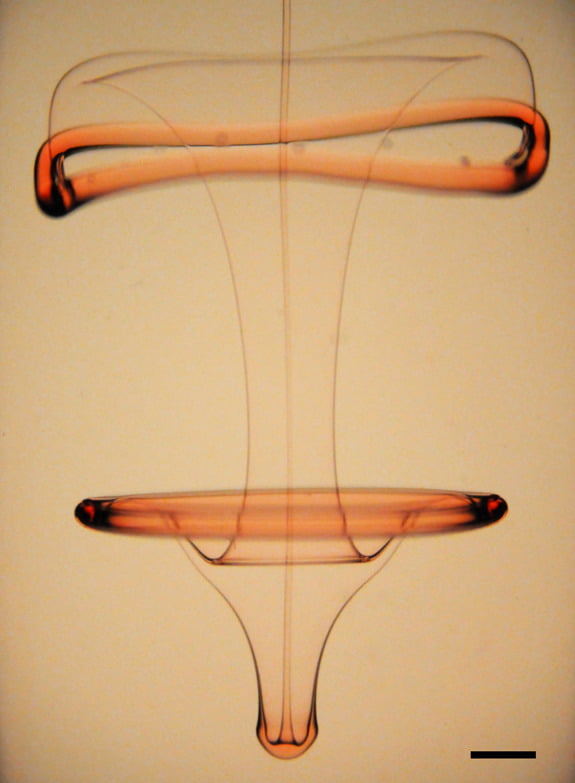
A drop of silicone oil falling through a liquid with lower surface tension distorts into multiple vortex rings connected by thin films. This behavior is caused by the interaction between viscous and capillary forces and is observable for only a narrow range of oil viscosities. (Photo credit: A. Felce and T. Cubaud)
The Sinking of the Lusitania
In 1915, the early days of submarine warfare, the RMS Lusitania was sunk off the coast of Ireland by a torpedo. Eyewitnesses reported a second, more powerful explosion just after the torpedo strike–possibly a boiler or powder explosion–that contributed to the ship sinking in only 18 minutes, resulting in nearly 1200 lives lost. Researchers at Lawrence Livermore National Laboratory have tackled the historic mystery, combining computational efforts with experimentation and historical research to reconstruct the physics of what happened. The full documentary airs tonight on the National Geographic Channel as “Dark Secrets of the Lusitania”. (submitted by Stephanie N)

Viscoelastic Fingers
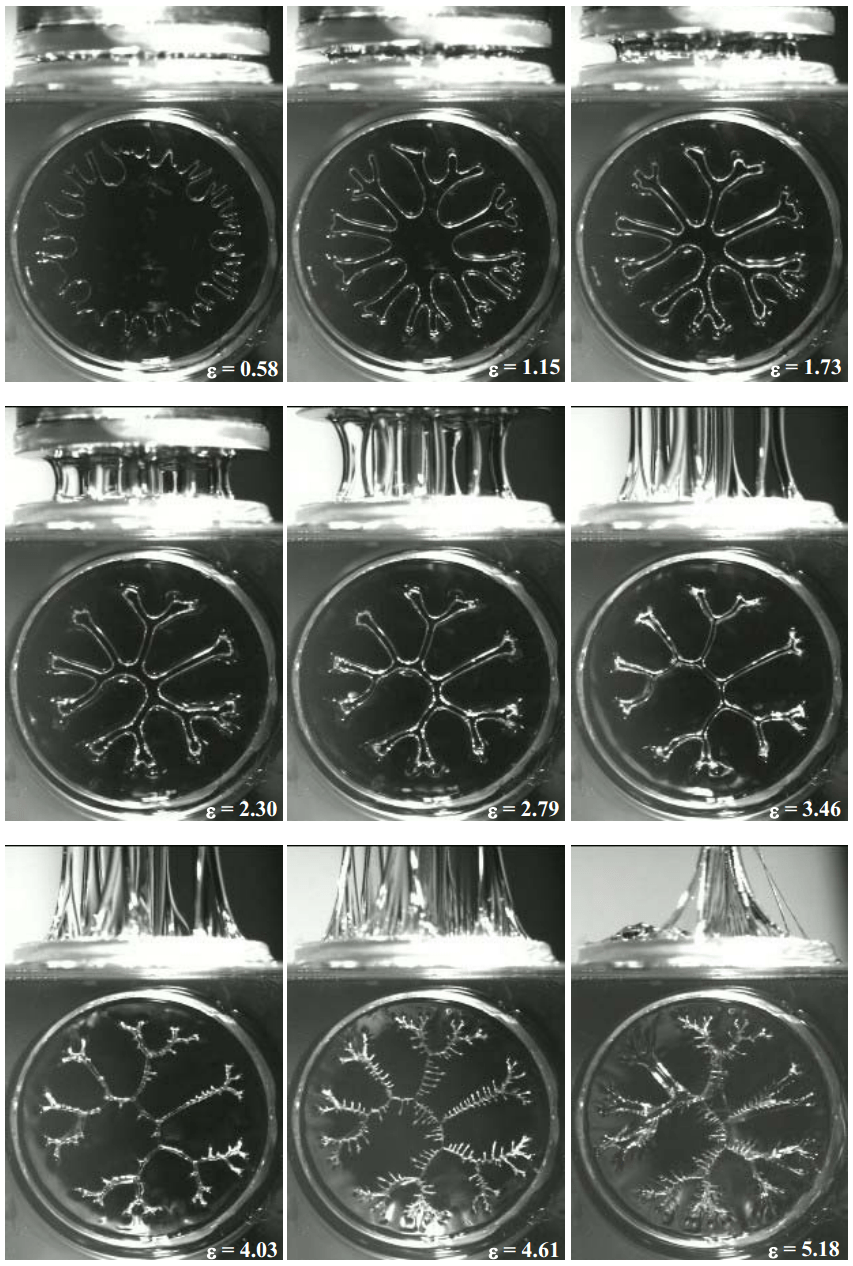
This series of photos shows two plates with a thin layer of polymer-laced, viscoelastic liquid. As the two plates are separated, complex instabilities form. The lower section of each photograph shows the fluid on the plate, with finger-like Saffman-Taylor instabilities forming as air rushes in between the gap in the plates. As the separation increases, the polymers in the liquid stretch under the increased strain, inducing elastic stresses in the fluid that cause the formation of secondary structures. (Photo credit: R. Welsh, J. Bico, and G. McKinley)
Creating Lava
In Syracuse, NY, artists and scientists work together to study volcanic flows by melting crushed basalt in a special furnace before releasing the lava into the parking lot. This particular flow is very prone to boiling behavior, likely because of the cold air and ground temperatures (less than 0 C). The outer layers of rock cool quickly, leaving bubble-shaped chambers which hotter lava can fill before melting out. (via It’s Okay To Be Smart; submitted by @jpshoer)