
It’s fascinating to sit on the beach and watch the waves roll in and break, but rarely do we get a view like the one in this video. Here researchers have created a breaking wave in a wave tank and recorded the wave as it travels the length of the tank with a high-speed camera moving at the same speed as the wave crest. This perspective, moving alongside the fluid, is a Lagrangian coordinate system; if one instead stood still and watched the wave roll past, it would be an Eulerian measurement. Traveling with the wave, we can see how a lip forms on the wave crest, then rolls down, capturing a tube of air. As water begins to flow over the lip, perturbations grow, causing ripples in the laminar curtain. Then the water strikes the main wave and rebounds turbulently, creating a familiar white cap. In the second half of the video, the process is shown from above, highlighting the entrainment of air and the creation of the bubbles that form the white cap of a breaking wave. (Video credit: R. Liu et al)
Year: 2012

Peering Inside the Kettle
Here natural convection is explored experimentally in a quasi-2D environment. The researchers demonstrate how this phenomenon, which is much like that seen in a boiling pot, can be investigated by measuring the refractive distortions caused by the thin heated fluid layer. They also demonstrate types of boiling that can occur. Typically, bubbles nucleate at the heated surface and then rise to pull hot fluid with them. At high enough temperatures above the liquid’s boiling point, however, an unstable layer of vapor can form over the heated surface. This “boiling crisis” or critical heat flux produces a marked reduction in heat transfer due to the insulation provided by the vapor layer. (Video credit: S. Wildeman et al.)

“Surface Tension”


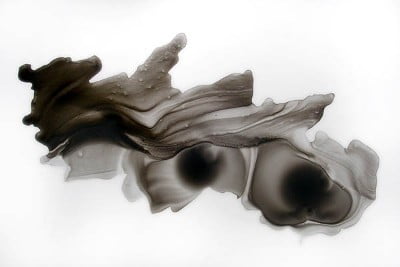

From a series called “Surface Tension,” these ink and water drawings by Marguerite French explore the effects of diffusion, surface tension, and evaporation. The forms left by the thin layer of liquids suggest other natural processes like erosion, weathering, and the rings inside trees. (Photo credits: Marguerite French)
Cavitation in a Bottle
Sudden changes in the pressure or temperature in a liquid can create bubbles in a process known as cavitation. Underwater explosions are just one of the ways to induce cavitation in a liquid. As identified in the above video, the shock waves traveling through the liquid force a change in pressure that creates bubbles. When these bubbles collapse, the container is subjected to an enormous oscillation in pressure, which often results in damage. The same phenomenon is responsible for damage on boat propellers as well as this beer bottle smashing trick. Check out these other high-speed videos of cavitation in a bottle: (Video credit: Destin/Smarter Every Day; submitted by Juan S.)

Those Funny Fins on Airplane Wings
Ever look out an airplane’s window and wondered why a row of little fins runs along the upper side of the wing? These vortex generators help prevent a wing from stalling at high angle of attack by keeping flow attached to the surface. Airflow over the vanes creates a tip vortex that transports the higher-momentum fluid from the freestream closer to the wing’s surface, increasing the momentum in the boundary layer. As a result of this momentum exchange, the boundary layer remains attached over a greater chordwise distance. This also increases the effectiveness of trailing-edge control surfaces, like ailerons, on the wing. (Photo credit: Mark Jones Jr.)

Liquid Mushrooms
The Rayleigh-Taylor instability can form at the interface between two liquids of different density under the influence of gravity, but a similar instability can occur in the absence of gravity. The image sequence above shows the Richtmyer-Meshkov instability, which occurs between two liquids of differing densities (regardless of their orientation) when impulsively accelerated. In this case, the experiment was conducted in a drop tower to simulate microgravity with the apparatus dropped on a spring to provide the impulse. As the instability grows, asymmetries appear. Nonlinear dynamics will amplify these distortions, eventually leading to turbulent breakdown. (Photo credit: C. Niederhaus/NASA Glenn, J. Jacobs/University of Arizona)
Air Entrainment
When a liquid jet falls into a pool, air is often entrained along with the liquid, creating a cavity and, often, bubbles. Shown above is video of a low-speed laminar jet entering a quiescent pool. The jet appears to entrain a thin film of gas, which then breaks up in a three-dimensional fashion, despite the symmetry of the incoming jet. As the speed of the incoming jet is increased and turbulence is introduced, the resulting air entrainment becomes violent and chaotic. For additional information and videos, see Kiger and Duncan 2012 and their supplemental videos. (Video credit: K. Kiger and J. Duncan)
Relighting a Candle
When a candle is blown out, a buoyant plume of unburned fuel/air mixture continues to rise for several seconds. By bringing a combustion source close to the plume, the mixture can ignite and flames will propagate back down to the candle wick to reignite it. Watch the slow motion replay near the end of the video and you can actually see the flame front propagate downward. (Video credit: G. Casavan, University of Colorado)
Leidenfrost Dynamics
When a liquid impacts a solid heated well above the liquid’s boiling point, droplets can form, levitating on a thin film of vapor that helps insulate them from the heat of the solid. This is known as the Leidenfrost effect. Here a very large Leidenfrost droplet is shown from the side in high-speed. A vapor chimney forms beneath the drop, causing the dome in the liquid. When the dome bursts, the droplet momentarily forms a torus before closing. The resulting oscillatory waves in the droplet are spectacular. The same behavior can be viewed from above in this video. (Video credit: D. Soto and R. Thevenin; from an upcoming review by D. Quere)
“Ferienne”
In “Ferienne” artist Afiq Omar utilizes ferrofluids, magnetism, and vibration to create analog visual effects. Most of the dot and labyrinthine patterns result from the reaction of a ferrofluid submerged in a nonmagnetic fluid to an external magnetic field. Diffusion effects and surface tension instabilities are also visible in the way the darker ferrofluid breaks down in the carrier fluid. Also be sure to check out Omar’s previously featured fluid film “Ferroux”. (Video credit: Afiq Omar)


