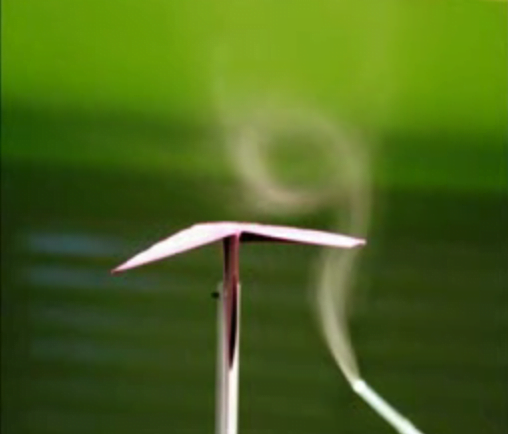
In this still image from a student experiment, smoke visualization shows the formation of a vortex over the wing of a paper airplane during a wind tunnel test. This wing vortex is mirrored on the opposite wing, though there is no smoke to show it. At high angle of attack, the delta-wing shape of the traditional paper air plane creates these vortices on the upper surface, which helps generate the lift necessary to keep the plane aloft. (Photo credit: A. Lindholdt, R. Frausing, C. Rechter, and S. Rytman)
Tag: vortices

The Boundary Layer Visualized
Any time there is relative motion between a solid and a fluid, a small region near the surface will see a large change in velocity. This region, shown with smoke in the image above, is called the boundary layer. Here air flows from right to left over a spinning spheroid. At first, the boundary layer is laminar, its flow smooth and orderly. But tiny disturbances get into the boundary layer and one of them begins to grow. This disturbance ultimately causes the evenly spaced vortices we see wrapping around the mid-section of the model. These vortices themselves become unstable a short distance later, growing wavy before breaking down into complete turbulence. (Photo credit: Y. Kohama)

Humpback-Inspired Turbine Blades

The bumps–or tubercles–on the edge of a humpback whale’s fins have important hydrodynamic effects on its swimming. Here dye is used to visualize flow over a hydrofoil with tubercle-like protuberances–a sort of artificial whale fin. Dye released from the peaks and troughs of the protuberances flows straight back in a narrow line before breakdown to turbulence. But the dye released from ports on the shoulders of the protuberances twists and spirals into vortices. At angle of attack, these vortices are stronger. They may help keep flow from separating on the upper side of a whale’s fin. (Photo credits: SIDwilliams, H. Johari)

Dye Flow
Fluid flow near a surface–inside the boundary layer–can often be unstable. This image shows one possible instability, formed when a cylinder is rotated back and forth about its longitudinal axis. This oscillation and the curvature of the cylinder destabilize flow in the boundary layer, forming vortices that line the cylinder. This particular behavior is called a Görtler instability. To visualize it, threads soaked in fluorescing dye have been embedded into slits in the cylinder. The cylinder is oscillated in a water tank and ultraviolet light is used to fluoresce the dye for the image. (Photo credit: Miguel Canals/University of Hawaii)

Supersonic Oil Flow Viz
This image shows oil-flow visualization of a cylindrical roughness element on a flat plate in supersonic flow. The flow direction is from left to right. In this technique, a thin layer of high-viscosity oil is painted over the surface and dusted with green fluorescent powder. Once the supersonic tunnel is started, the model gets injected in the flow for a few seconds, then retracted. After the run, ultraviolet lighting illuminates the fluorescent powder, allowing researchers to see how air flowed over the surface. Image (a) shows the flat plate without roughness; there is relatively little variation in the oil distribution. Image (b) includes a 1-mm high, 4-mm wide cylinder. Note bow-shaped disruption upstream of the roughness and the lines of alternating light and dark areas that wrap around the roughness and stretch downstream. These lines form where oil has been moved from one region and concentrated in another, usually due to vortices in the roughness wake. Image © shows the same behavior amplified yet further by the 4-mm high, 4-mm wide cylinder that sticks up well beyond the edge of the boundary layer. Such images, combined with other methods of flow visualization, help scientists piece together the structures that form due to surface roughness and how these affect downstream flow on vehicles like the Orion capsule during atmospheric re-entry. (Photo credit: P. Danehy et al./NASA Langley #)

Shedding Vortices
The von Karman vortex street of shed vortices that form the wake of a stationary cylinder are a classic image of fluid dynamics. Here we see a very different wake structure, also made up of vortices shed from a cylindrical body. This wake is formed by two identical cylinders, each rotating at the same rotational rate. Their directions of rotation are such that the cylinder surfaces in between the two cylinders move opposite the flow direction (i.e. top cylinder clockwise, bottom anti-clockwise). This results in a symmetric wake, but the symmetry can easily be broken by shifting the rotation rates out of phase. (Photo credit: S. Kumar and B. Gonzalez)

Flame Thrower Physics
This high-speed video–which we do not recommend recreating yourself–features burning gasoline flying through the air. In addition to the sheer entertainment value, there are some neat physics. In the first segment, when they kick a tray of gasoline, one can see lovely fiery vortices forming around the backside of the tray as it’s launched. This is the start of the tray’s wake. In the latter half of the video, they launch the flaming gasoline from a bucket. Notice how the flames are in the wake while liquid gasoline streams out ahead without burning. This is because it is primarily gaseous petrol that is flammable. As the liquid fuel breaks up into droplets heated by the burning gasoline vapors nearby, the rest of the fuel changes to a vapor state and catches flame. (Video credit: The Slow Mo Guys; submitted by Will T)
Pancake Vortex
In large-scale geophysical flows, rotation and density gradients often play major roles in the structures that form. Here the UCLA SPINLab demonstrates how large, essentially flat vortices–pancake vortices–form in rotating, stratified fluids. The stratification, in this case, is due to the density difference between salt water and fresh water; salt water is denser and therefore less buoyant, so it sinks toward the bottom of the tank. Note how the pancake vortex only forms when the fluid is both stratified and rotating. If it lacks one of the two, the structures will be very different. (Video credit: O. Aubert et al./SPINLab UCLA)
Superfluid Vortices
Cooling helium to a few degrees Kelvin above absolute zero produces superfluid helium, a substance with some very bizarre behaviors caused by a lack of viscosity. Superfluids exhibit quantum mechanical properties on a macroscopic scale; for example, when rotated, a superfluid’s vorticity is quantized into distinct vortex lines, known as quantum vortices. These vortices can be visualized in a superfluid by introducing solid tracer particles, which congregate inside the vortex line, making it appear as a dotted line, as shown in the video above. When these vortex lines approach one another, they can break and reconnect into new vortices. These reconnections provoke helical Kelvin waves, a phenomenon that had not been directly observed until the present work by E. Fonda and colleagues. They are even able to show that the waves they observe match several proposed models for the behavior. (Video credit: E. Fonda et al.)

The Backward-Facing Step
This photo collage shows vortices shed off a backward-facing step. The flow is left to right. Here the flow is visualized using dye released in water. Initially, the vortex forms near the bottom of the step in the recirculation zone. Because flow over the top of the vortex is much faster than the flow beneath the vortex, a low pressure zone forms over the vortex and gradually draws it up toward the top of the step. Eventually the vortex will rise to the point where the upstream flow pushes it downstream and the process begins anew. (Photo credit: Andrew Carter, University of Colorado)


