Shown above is the flow between two concentric cylinders (Taylor-Couette flow). In the laminar regime, the velocity profile between the two cylinders is linear. As the rate of rotation of the inner cylinder increases, the flow develops toroidal vortices known as Taylor vortices, seen in the video above after 9 seconds or so. This is a fluid instability exhibited by transitional flow. Increasing the rotational rate further can result in wavy Taylor vortex flow. At high enough speeds, the flow will become completely turbulent.
Tag: vortices

Flying Snake Video
A follow-up on the flying snakes. This video shows researchers filming the actual snakes gliding and performing maneuvers. See also the Scientific American article on their work. #

Flying Snakes Draft off Themselves
Some snakes in Southeast and South Asia are known to glide some 100 m between trees. Researchers filmed snakes, constructed computational models of their flights, and tested plastic models in a water tunnel. They found that the snakes angled their bodies such that they generate lift to counteract their fall and that the S-configuration they assume increases lift much the way flying in a V-formation does for geese. The wake from the forward portion of the snake interacts with the flow around the back of the snake and reduces downwash, which increases lift. In effect, the back of the snake is drafting off the front. #
Flutter and the Tacoma Narrows Bridge
Sixty years ago yesterday the original Tacoma Narrows Bridge (a.k.a. Galloping Gertie) collapsed as a result of aeroelastic flutter during 42 mph winds. Flutter is a phenomenon in which the fluid dynamics and structural dynamics of a system are closely coupled, in this case resulting in a dramatic failure. The high sustained winds provided an energy source for self-excitation of one of the bridge’s torsional modes; as the bridge contorted, the motion caused additional vortices to be shed from the bridge deck, causing further vibrational forces on the bridge. For an analysis of the bridge’s collapse and its common misrepresentations, see Billah and Scanlan. The bridge’s spectacular collapse prompted reconsideration and redesign of the decks of modern suspension bridges.
Flow Visualization
This video, created by undergraduates as part of a fluid dynamics laboratory course, shows flow visualization of a von Karman vortex street in the wake of a cylinder in comparison to a computational fluid dynamics (CFD) simulation of the same phenomenon. If you’re wondering about the black-and-white segments and the peculiar speech patterns, look no further. The students are parodying a series of videos made by MIT in the 1960s that are still used in classrooms today.

Tip Vortices
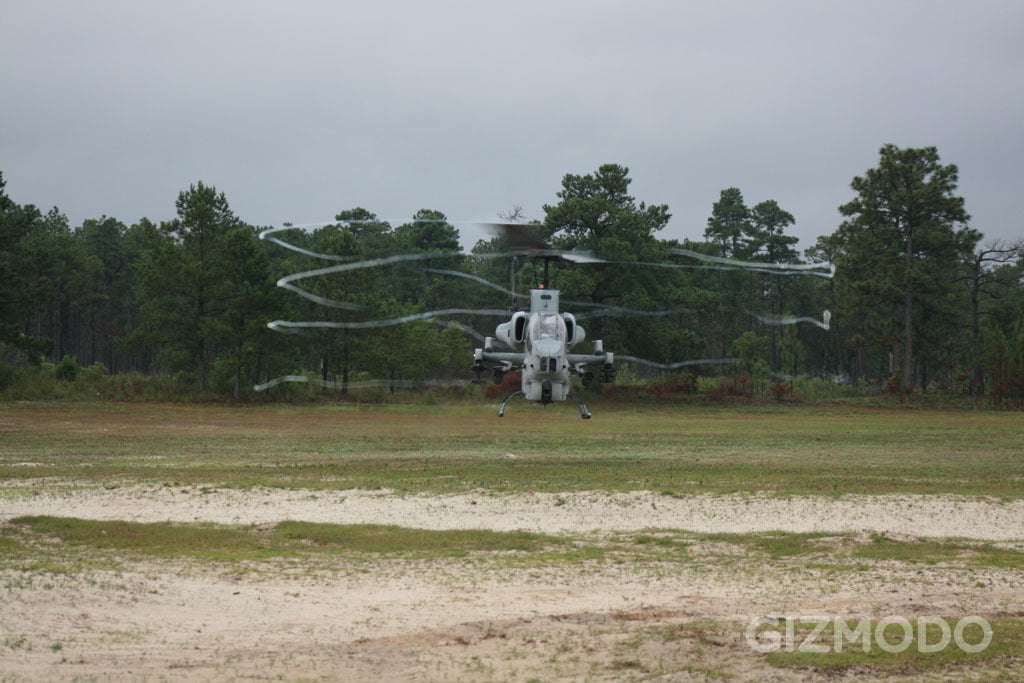
Like airplane wings, helicopter blades have tip vortices. In this photo, the air’s humidity was great enough that the acceleration caused by the passing of the blades caused a pressure drop great enough to condense the moisture, making the tip vortices visible to the naked eye. (See also Prandlt-Glauert singularity.)
Photo credit: Gizmodo.

The Silence of Owls
Owls are among the most silent hunters in nature, thanks to their feathers. The leading edge of the wing, shown in the bottom part of the photo, has a serrated comb-like edge, which breaks flow over the wing into small vortices, which are quieter than larger ones. The fringe-like trailing edge breaks the flow up further and helps absorb the sound produced by the turbulence. The fluffy feathers along the owl’s body can also help muffle noise. Researchers are investigating ways to use these techniques to quiet aircraft. # (via jshoer)

Wingtip Vortices in Ground Effect
In this flow visualization, wingtip vortices from an aircraft have been simulated using an apparatus with a couple of flaps that snap together like a book closing. Dye is pooled on the “ground” below the flaps and gets entrained by the vortices and lit up using laser light. The red vortices are the primary vortex generated by the aircraft wingtips and the green ones are secondary vortices generated by interaction with the ground. The lower half of the picture is a reflection off the ground. This photo was part of the 2009 Gallery of Fluid Motion. #

Island Vortices
The von Karman vortex street isn’t just found in the wake of cylinders in a lab. Wind moving over islands frequently creates the effect, as in this MODIS Aqua image of the coast of Baja California, Mexico. #