Wingtip vortices form on airplanes due to the finite length of their wings. In general, lift on the wings results from low-pressure, high-velocity air moving over the top of the wing and high-pressure, low-velocity air moving below the wing. Near the wingtips, the high-pressure air is able to slip around the edge to the top of the wing, generating a vortex that then trails behind the airplane. The same thing is occurring in the video above, except the edges of the wing’s control surfaces are serving as the tip of the wing. Similar vortices also exist at the wingtips, but they are not made visible by condensation as the aileron vortices are.
Tag: vortices

Cloud Swirls
Two interesting sets of clouds are featured in this satellite photo of the Canary Islands and the coast of Africa. In the upper part of the picture, closed cell stratocumulus clouds cover the ocean. As the wind drives these clouds over the islands, their pattern is disturbed by mountains that force the lower layers of air up and around, forming von Karman vortices and wakes that mingle and twist the cloud patterns to the south of the islands. (Photo credit: European Space Agency; via Wired)

Mackerel vs. Eel: Who Swam It Better?
Which matters more, form or function? This simulation sets out to answer that question by comparing the swimming motion of eels and mackerels. Eels have longer, more rounded body shapes and swim in an undulatory fashion with their whole body, whereas mackerels have shorter bodies with a more elliptical cross-section and primarily move their tails when swimming. The simulation separates body type from swimming motion by creating virtual races between fishes of the same body type using the two forms of swimming. Eels swim at moderate Reynolds numbers where viscous and inertial effects are reasonably balanced. Under those conditions, eel-like swimming was faster, even with a mackerel’s body type. At the higher Reynolds numbers where mackerels usually swim, inertial forces domination and the racing fish moved faster if they swam like a mackerel, even with the body of an eel. The results suggest that the swimming motion matters more in each Reynolds number range than the shape of the swimmer. This is a neat way that simulation can answer questions we cannot test with an experiment! (Video credit: I. Borazjani and F. Sotiropoulos)

Flow Over Swept Wings
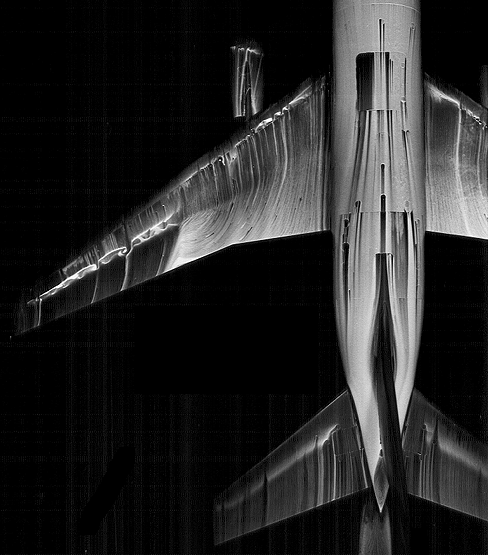
Flow over a swept wing behaves very differently than a straight fixed wing or an airfoil. Instead of flowing straight along the chord of the wing in a two-dimensional fashion, air is also directed along the wing, parallel to the leading edge. The above oil flow visualization on a swept wing airplane model shows this curvature of streamlines. As a result of this three-dimensional flow behavior, boundary layers on swept wings are subject to the crossflow instability, which manifests as co-rotating vortices aligned to within a few degrees of the streamlines. Triggering this boundary layer instability can lead to turbulence and higher drag for the aircraft.
Vortex Ring Collision
Two vortex rings collide head-on in this video. If their vorticities and velocities are matched in magnitude and opposite in direction, their collision results in a stagnation plane–essentially a wall across which the fluid does not pass. In reality, there are slight variations that result in non-zero velocities where the vortices meet, so some mixing occurs, but the overall symmetry remains striking. The collision breaks up the vortex ring into filaments, some of which cross-link with the other vortex’s filaments, resulting in the little halo-like eddies around the perimeter. Videos of the same experiment at different Reynolds numbers can be found here. (Submitted by Charlie H; Video credit: T. Lim and T. Nickels)

Artificial Fins in Tandem
For this image, two artificial fish fins are placed side-by-side and flapped in phase. Flow in the image is upward. The wakes of the fins interact in a complicated vortex street. Researchers hope that studying such flows can help in designing the next generation of autonomous underwater vehicles. (Photo credit: B. Boschitsch, P. Dewey, and A. Smits)

Cloud Streets from Space
Cloud streets flowing south across Bristol Bay hit the Shishaldin and Pavlof volcanoes, which part the air flow into distinctive swirls called von Karman vortex streets. As air flows around the volcano, a vortex is shed first on one side, then the other. Although the usual example for this type of flow is the wake of a cylinder, vortex streets can extend behind any non-aerodynamic body immersed in a flow. The same phenomenon is responsible for the singing of power lines in the wind. As astronaut Dan Burbank observes, “It’s classic aerodynamics, but on a thousands of miles scale.” (Photo credit: Dan Burbank, NASA)

Shark Wakes
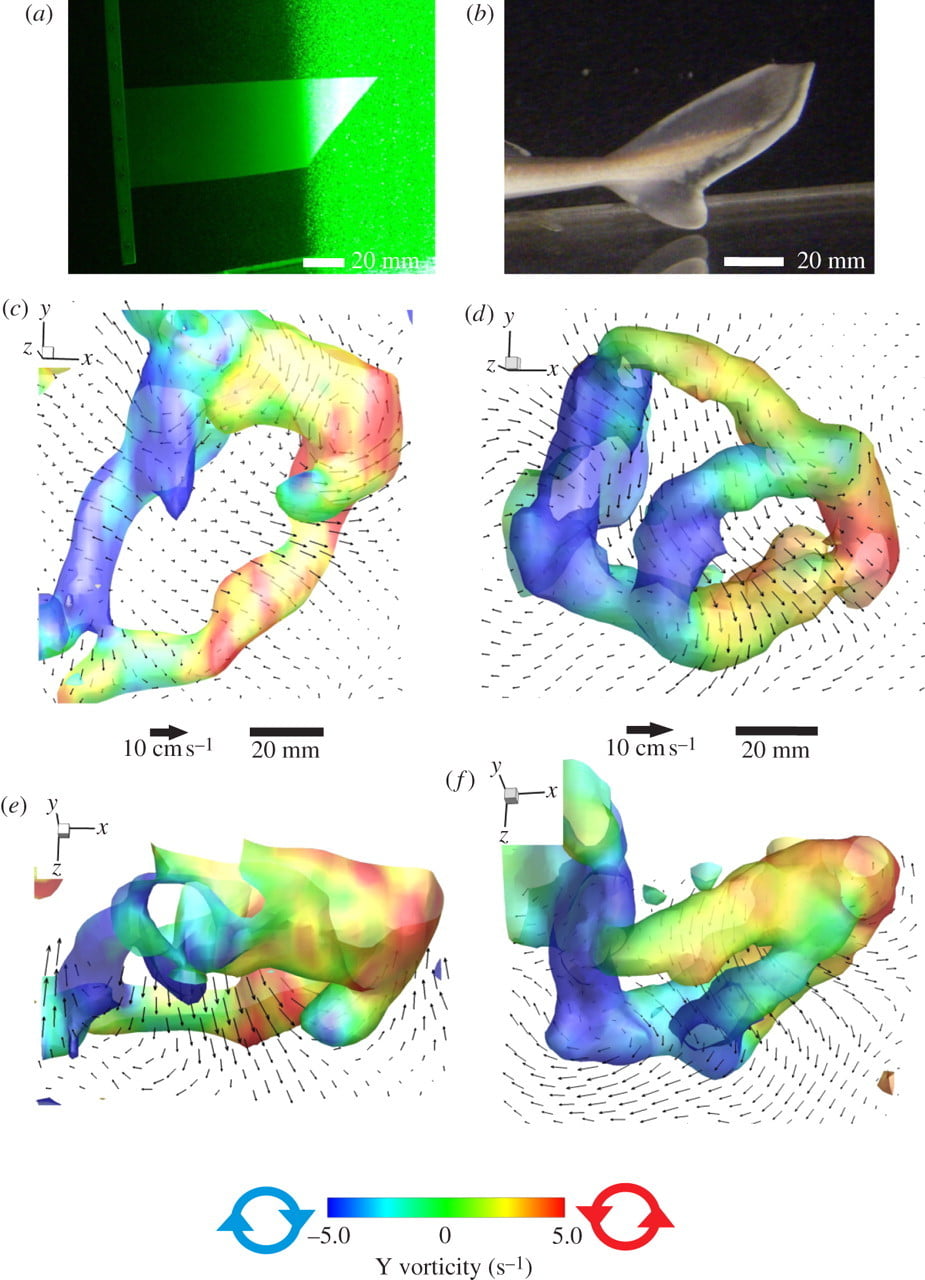
Volumetric imaging of swimming spiny dogfish, a type of shark, shows that their distinctively asymmetric tails produce a set of dual-linked vortex rings with every half beat of their tail. The figure above shows data from the actual shark on the right (b,d,f) and a similarly shaped robotic tail on the left (a,c,e). The second row contains lateral views (c,d) and the bottom row contains dorsal views (e,f) of the vorticity isosurfaces measured. The robotic tail does not demonstrate the same double vortex structure, leading scientists to suspect that the shark may be actively stiffening its tail mid-stroke to control its wake. The finding could help engineers design aquatic robots whose morphing fins help it swim more efficiently. For more, see Wired.

Pitching Plate Flow Viz
This photograph uses fluorescent dye to visualize the wake behind a rigid flat plate pitching about its leading edge. A vortex is shed from the plate twice in each cycle of oscillation. These vortices entangle, producing the structured wake above. The top photo shows a side view of the wake, the bottom photo is a top view. (Photo credit: J. Buchholz and A. Smits)
Wingtip Vortices in Ground Effect
[original media no longer available]
If you’ve ever watched airplane contrails fade, you’ve probably observed the Crow instability, which causes the trailing wingtip vortices of the plane to interact and distort. The same effect is explored in the video above with the addition of ground effect. The first clip shows a pair of counter-rotating vortices from the side, showing a periodic pattern of thickening and thinning along the vortices. The second clip shows cross-sectional slices of the vortices at a thin and a thick point.