A viscous fluid inside a horizontally rotating circular cylinder forms a shark-tooth-like pattern along the fluid’s free surface. This is one of several patterns observed depending on the fluid’s viscosity and surface tension and the rotational rate of the cylinder. (Photo credit: S. Thoroddsen and L. Mahadevan; for more, see Thoroddsen and Mahadevan 1996 and 1997)
Tag: viscosity

When Fluids Behave Like Solids
Many common fluids–like air and water–are Newtonian fluids, meaning that stress in the fluid is linearly proportional to the rate at which the fluid is deformed. Viscosity is the constant that relates the stress and rate of strain, or deformation. The term non-Newtonian is used to describe any fluid whose properties do not follow this relationship; instead their viscosity is dependent on the rate of strain, viscoelasticity, or even changes with time. A neat common example of a non-Newtonian fluid is oobleck, a mixture of cornstarch and water that is shear-thickening, meaning that it is resistant to fast deformations. Like the cornstarch-based custard in the video above, these fluids react similarly to a solid when struck, resisting changing their shape, but if deformed slowly, they will flow in the manner of any liquid.
Fractal Fluids
Part of the beauty of numerical simulation is its ability to explore the physics of a situation that would difficult or impossible to create experimentally. Here the Rayleigh-Taylor instability–which occurs when a heavier fluid sits atop a lighter fluid–is simulated in two-dimensions. Viscosity and diffusion are set extremely low in the simulation; this is why we see intricate fractal-like structures at many scales rather than the simulation quickly fading into gray. (The low diffusion is also what causes the numerical instabilities in the last couple seconds of video.) The final result is both physics and art. (Video credit: Mark Stock)
Honey Coiling
The liquid rope coiling effect occurs in viscous fluids like oil, honey, shampoo, or even lava when they fall from a height. The exact behavior of the coil depends on factors like the fluid viscosity, the height from which the fluid falls, the mass flow rate, and the radius of the falling jet. Here Destin of the Smarter Every Day series outlines the four regimes of liquid coiling behavior commonly observed. As with many problems in fluid dynamics the regimes are described in terms of limits, which can help simplify the mathematics. The viscous regime (2:34 in the video) exists in the limit of a small drop height, whereas the inertial regime (3:15) exists in the limit of large drop height. Many complicated physical problems, including those with nonlinear dynamics, are treated in this fashion. For more on the mathematics of the coiling effect, check out Ribe 2004 and Ribe et al. 2006. (Video credit: Destin/Smarter Every Day; submitted by inigox5)
Viscous Fingers
When less viscous fluids are injected into a more viscous medium, the low-viscosity fluid forms finger-like protrusions into the background fluid. This is known as the Saffman-Taylor instability. The video above shows this effect but in a more dynamic setting. Blue-dyed water and a clear solution of water and glycerol fifty times more viscous than the water are injected in alternating fashion to a microfluidic channel. The blue water spreads into the clear glycerol solution via fingers that quickly diffuse, creating a homogeneous–or uniform–mixture. (Video credit: Juanes Research Group)
Microgravity Cornstarch
We’ve seen the effects of vibration on shear-thickening non-Newtonian fluids here on Earth before in the form of “oobleck fingers” and “cornstarch monsters”, but, to my knowledge, this is the first such video looking at the behavior in space. The vibrations of the speaker cause shear forces on the cornstarch mixture, which causes the viscosity of the fluid to increase. This is what makes it react like a solid to sudden impacts while still flowing like a liquid when left unperturbed. In microgravity there is one less force working against the rise of the cornstarch fingers, so the formations we see in this video are subtly different from those on Earth.
“Compressed” Outtakes
Bubbles, viscosity, diffusion, capillary action, and ferrofluids all feature in the artistic experiments of Kim Pimmel. Be sure to check out his previous film featured here. (Video credit: Kim Pimmel)

The Pitch Drop Experiment
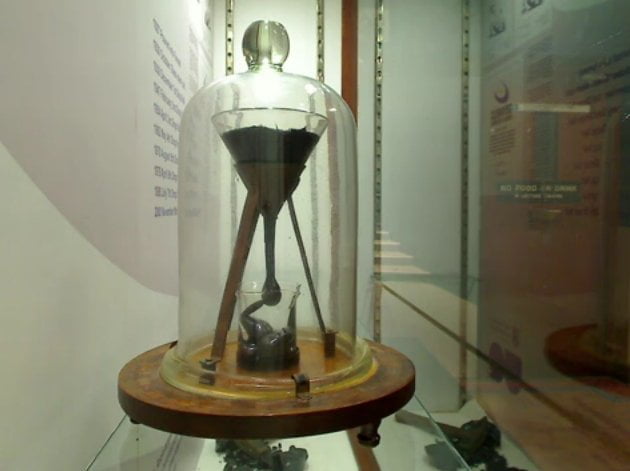
Sometimes everyday materials are more fluid than they seem. In 1927, Professor Thomas Parnell of the University of Queensland started what is now the longest continuously running laboratory experiment when he filled a sealed glass funnel with a sample of heated tar pitch. After allowing 3 years for the pitch to settle, the funnel’s stem was unsealed and the pitch has been slowly dripping ever since. Now, over 80 years later, the ninth drop is still just forming. No one has witnessed the fall of a pitch drop but the odds are good that someone will catch the ninth drop now that it has its own webfeed. The experiment, which won an Ig Nobel Prize in 2005, demonstrates the incredibly high viscosity of pitch, which the researchers estimated at 11 orders of magnitude larger than water at room temperature. (submitted by jshoer)

Drops Through Drops
The splashes from droplets impacting jets create truly mesmerizing liquid sculptures. Corrie White is one of the masters of this type of high-speed macro photography. Her work captures the instantaneous battles between viscosity, surface tension, and inertia. The fantastic structure seen here through the falling droplets is created by a series of drops timed so that the later ones strike the Worthington jet produced by the initial drop’s impact. (Photo credit: Corrie White)
Reversing a Flow
The reversibility of laminar mixing often comes as a surprise to observers accustomed to the experience of being unable to separate two fluids after they’ve been combined. As you can see above, however, inserting dye into a highly viscous liquid and then mixing it by turning the inner of two concentric cylinders can be undone simply by turning the cylinder backwards. This works because of the highly viscous nature of Stokes flow: the Reynolds number is much less than 1, meaning that viscosity’s effects dominate. In this situation, fluid motion is caused only by molecular diffusion and by momentum diffusion. The former is random but slow, and the latter is exactly reversible. Reversing the rotation of the fluid undoes the momentum diffusion and any distortion remaining is due to molecular diffusion of the dye.