The Mythbusters walk on “water” using non-Newtonian fluids. I think everyone wants to do this at least once in their life.
Tag: viscosity

Pouring Paint
In this artwork by Holton Rower, paint (typically a non-Newtonian fluid) is poured down a rectangular prism; the result is a neat demonstration of shearing in laminar flows. Paint is usually shear-thinning, meaning that its viscosity decreases under shear; this is why the color stripes on the vertical panels expand more than those on the horizontal surfaces do. # (submitted by Stephan)

Volcanic Turbulence
One of the characteristics of turbulence is its large range of lengthscales. Consider the ash plume from this Japanese volcano. Some of the eddy structures are tens, if not hundreds, of meters in size, yet there is also coherence down to the scale of centimeters. In turbulence, energy cascades from these very large scales to scales small enough that viscosity can dissipate it. This is one of the great challenges in directly calculating or even simply modeling turbulence because no lengthscale can be ignore without affecting the accuracy of the results. #
Reader Question: Froude vs. Reynolds
@spooferbarnabas asks: I was wondering what the difference is between Froude’s number and Reynold’s number? they seem very similar
Fluid dynamicists often use nondimensional numbers to characterize different flows because it’s possible to find similarity in their behaviors this way. The Reynolds number is the most common of these dimensionless numbers and is equal to (fluid density)*(mean fluid velocity)*(characteristic length)/(fluid dynamic viscosity). The Reynolds number is considered a ratio of total momentum (or inertial forces) to the molecular momentum (or viscous forces). A small Reynolds number indicates a flow dominated by viscosity; whereas a flow with a large Reynolds number is considered one where viscous forces have little effect.
The Froude number, in contrast, focuses on resistance to flow caused by gravitational effects, not molecular effects. It is defined as (mean fluid velocity)/(characteristic wave propagation velocity). Initially, it was developed to describe the resistance of a model floating in water when towed at a given speed. As the boat’s hull moves through the water, it creates a wave that travels forward (and backward in the form of the wake), carrying information about the boat–much like pressure waves travel before and behind a subsonic aircraft. The speed of the wave created by the boat depends on gravity (see shallow water waves). The closer the boat’s speed comes to the water wave’s speed, the greater the resistance the boat experiences. In this respect, the Froude number is actually analogous to the Mach number in compressible fluids.
I hope that helps explain some of the differences!

Smokestack Plumes
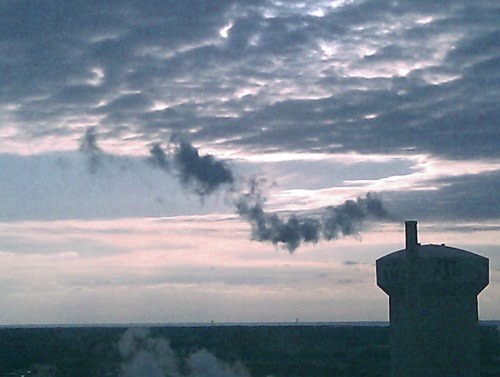
On a cold and windy day, the plume from a smokestack sometimes sinks downstream of the stack instead of immediately rising (Figure 1). This isn’t an effect of temperature–after all, the exhaust should be warm compared to the ambient, which would make it rise. It’s actually caused by vorticity.

Figure 2: Simple geometry (side view) In Figure 2, we see a simplified geometry. The wind is blowing from right to left, and its velocity varies with height due to the atmospheric boundary layer. Mathematically, vorticity is the curl of the velocity vector, and because we have a velocity gradient, there is positive (counterclockwise) vorticity generated.

Figure 3: Vortex lines (top view) According to Helmholtz, we can imagine this vorticity as a bunch of infinite vortex lines convecting toward the smokestack, shown in Figure 3. Those vortex lines pile up against the windward side of the smokestack–Helmholtz says that vortex lines can’t end in a fluid–and get stretched out in the wake of the stack. If we could stand upstream of the smokestack and look at the caught vortex line, we would see a downward velocity immediately behind the smokestack and an upward velocity to either side of the stack. It’s this downward velocity that pulls the smokestack’s plume downward.

Figure 4: Vortex wrapped around stack Now Helmholtz’s theories actually apply to inviscid flows and the real world has viscosity in it–slight though its effects might be–and that’s why this effect will fade. The vortex lines can’t sit against the smokestack forever; viscosity dissipates them.
Thixotropic and Rheopectic Fluids
There’s more to non-Newtonian fluids than shear-thickening and shear-thinning. The viscosity of some fluids can also change with time under constant shear. A fluid that becomes progressively less viscous when shaken or agitated is called thixotropic. The opposite (and less common) behavior is a fluid that becomes more viscous under constant agitation; this is known as a rheopectic fluid. This video demonstrates both types of fluids using a rotating rod as the agitator. The rheopectic fluid actually appears to climb the rod–similar to the Weissenberg effect–while the thixotropic fluid moves away from the rod.
Ants as a Fluid
The collective behavior of ants can mirror the flow of a viscous fluid. It would be interesting to see if any such parallels carry over to the flocking of birds or schooling of fish. The latter two behaviors are thought to increase aero- and hydrodynamic efficiency for the group. #
Superfluid Helium Leaks from its Container
Below a temperature of 2.17 Kelvin, helium becomes a superfluid, a state of matter boasting several unique properties including zero viscosity (resistance to flow). In this video, scientists demonstrate that property. When they pull the glass “bucket” of helium out at 2:50, the helium starts to leak out. The glass is solid but it contains numerous tiny spaces between its atoms. In its normal state, the viscosity of helium prevents it from escaping through those holes. But as a superfluid, its resistance to flowing goes to zero and it leaks right through the solid glass.
Flying Paint
High speed footage of flying paint demonstrates a world of viscosity and surface tension, as well as another great example of fluid dynamics as art. (via Gizmodo)
If you enjoy FYFD, why not take a minute to recommend us in the Tumblr directory? Thanks!

Viscous Fingers
This photo shows the Saffman-Taylor instability in a Hele-Shaw cell. Here a viscous fluid has been placed between two glass plates and a second less viscous fluid inserted, resulting in a finger-like instability as the less viscous fluid displaces the more viscous one. This is an effect that can be easily explored at home using common liquids like glycerin, water, dish soap, or laundry detergent. #