High-speed video reveals the complexity of fluid instabilities leading to atomization–the breakup of a liquid sheet into droplets. A thin annular liquid sheet is sandwiched between concentric air streams. As the velocity of the air on either side of the liquid sheet varies, shear forces cause the sheet to develop waves that result in mushroom-like shapes that break down into ligaments and droplets. Quick breakup into droplets is important in many applications, most notably combustion, where the size and dispersal of fuel droplets affects the efficiency of an engine. (Video credit: D. Duke, D. Honnery, and J. Soria)
Tag: shear

When Fluids Behave Like Solids
Many common fluids–like air and water–are Newtonian fluids, meaning that stress in the fluid is linearly proportional to the rate at which the fluid is deformed. Viscosity is the constant that relates the stress and rate of strain, or deformation. The term non-Newtonian is used to describe any fluid whose properties do not follow this relationship; instead their viscosity is dependent on the rate of strain, viscoelasticity, or even changes with time. A neat common example of a non-Newtonian fluid is oobleck, a mixture of cornstarch and water that is shear-thickening, meaning that it is resistant to fast deformations. Like the cornstarch-based custard in the video above, these fluids react similarly to a solid when struck, resisting changing their shape, but if deformed slowly, they will flow in the manner of any liquid.

Vortex Cross-Sections

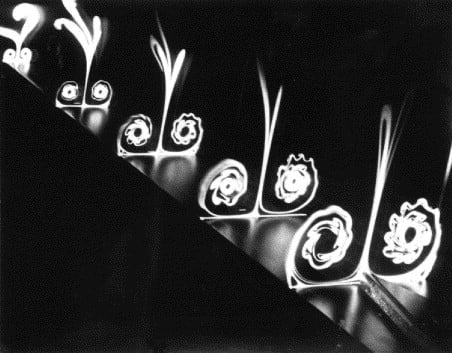
The photos above show cross-sections through the leading edge vortices on a highly swept delta wing at angle of attack. Flow in the photos is from the upper left to lower right. Notice how the vortices grow and develop waviness as they move downstream. When perturbations enter the vortex–for example, due to the shear between the vortex fluid and the freestream–some will grow and eventually cause a break down to turbulence, as in the lower picture. (Photo credits: R. Nelson and A. Pelletier)
Antibubbles
Antibubbles–a liquid droplet surrounded by a thin film of gas and immersed in more liquid–are fragile things. This video explores how antibubbles behave when placed in proximity to a tornado-like whirl. When placed near the eye, where fluid motion is primarily vertical, the antibubble is stretched vertically. When placed in the rotating eyewall, the antibubble is distorted into a ring-like shape before it breaks down. (Video credit: D. Terwagne et al; APS Gallery of Fluid Motion 2009)
Microgravity Cornstarch
We’ve seen the effects of vibration on shear-thickening non-Newtonian fluids here on Earth before in the form of “oobleck fingers” and “cornstarch monsters”, but, to my knowledge, this is the first such video looking at the behavior in space. The vibrations of the speaker cause shear forces on the cornstarch mixture, which causes the viscosity of the fluid to increase. This is what makes it react like a solid to sudden impacts while still flowing like a liquid when left unperturbed. In microgravity there is one less force working against the rise of the cornstarch fingers, so the formations we see in this video are subtly different from those on Earth.

Tornadogenesis

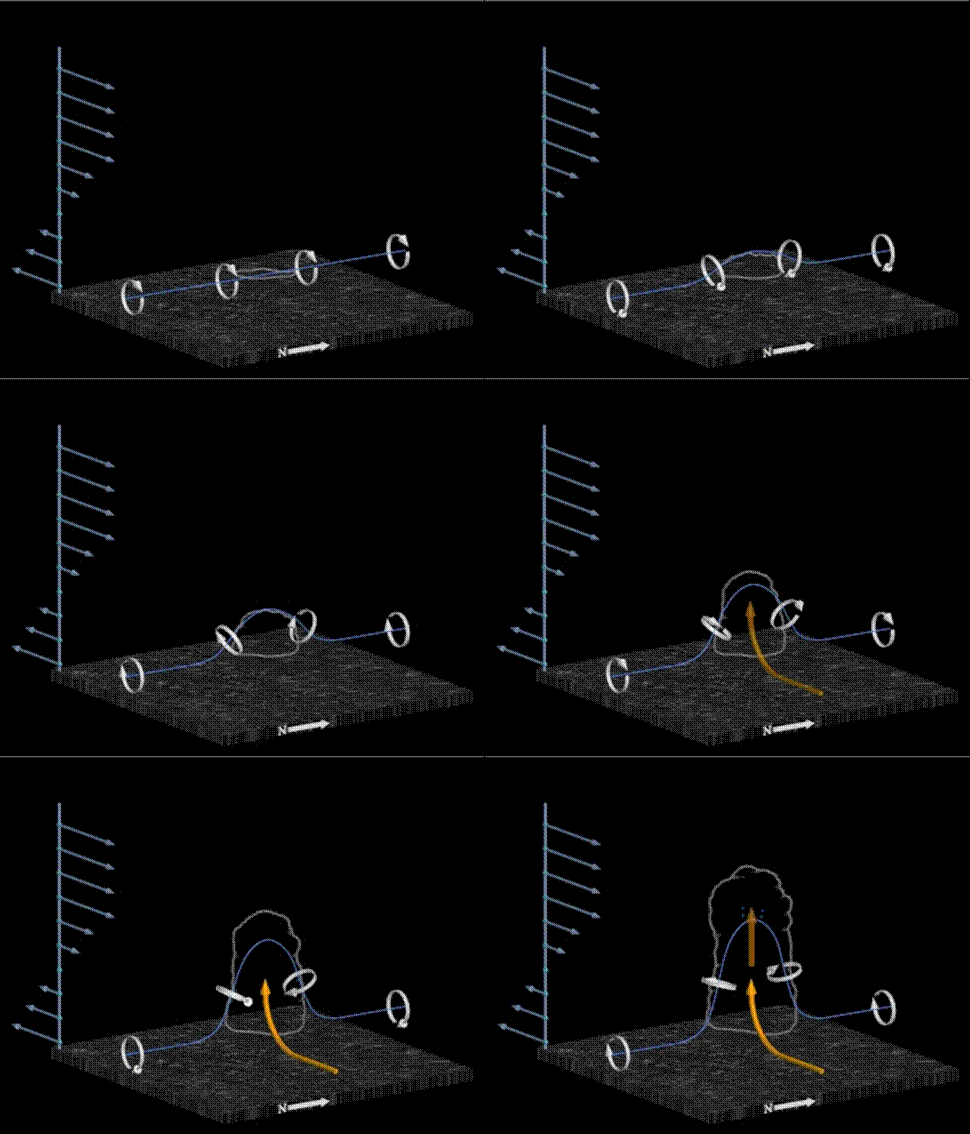
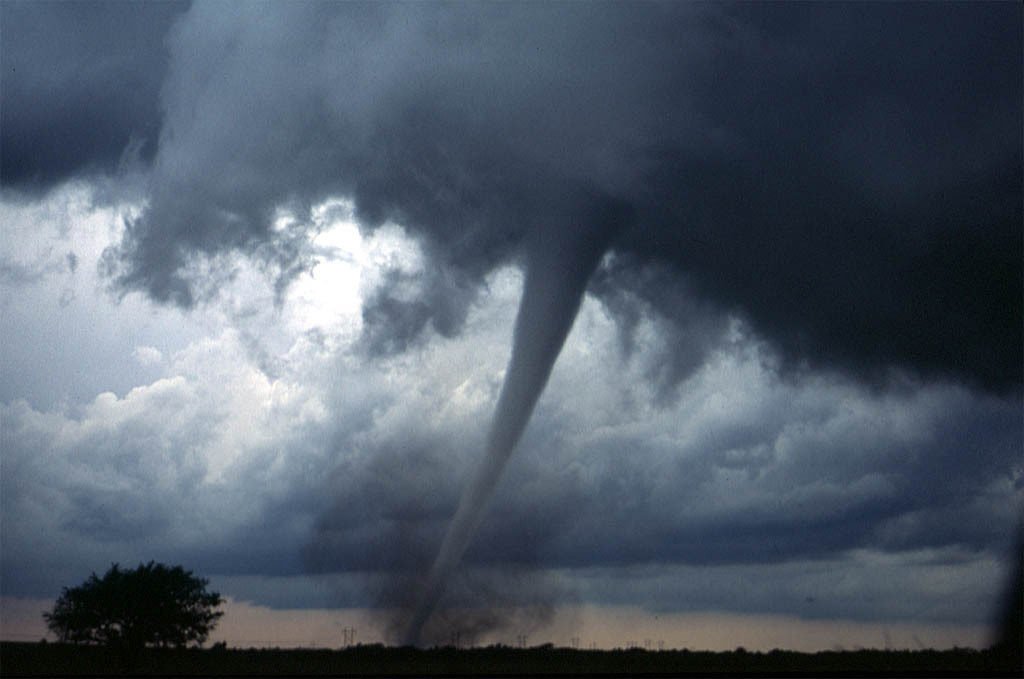
Tornadogenesis–the formation of tornadoes–remains a topic of active research as there is relatively little direct experimental data, owing to the difficulty of prediction as well as measurement. Initially, a variation of wind speed at different altitudes in the atmosphere causes shearing, which can lead to the formation of a horizontal column of rotating air–a vortex line similar to a roll cloud. Beneath a developing storm, the updraft of warm local air can pull this vortex line upwards, creating vertical rotation in the cloud, thereby birthing a supercell. Supercells do not always spawn tornadoes, and the exact causes that result in tornadic or nontornadic supercells are not fully understood. However, the formation of tornadoes within the supercell seems dependent on the downdraft of cool air within the storm as well as stretching of the vortex line, which increases its rate of rotation. For more information, check out this explanatory video and some of the talks by Paul Markowski. (Thanks to mindscrib, aggieastronaut and others for their submissions related to this topic! Photo credits: P. Markowski and D. Zaras)

Where Jupiter Got Its Swirls
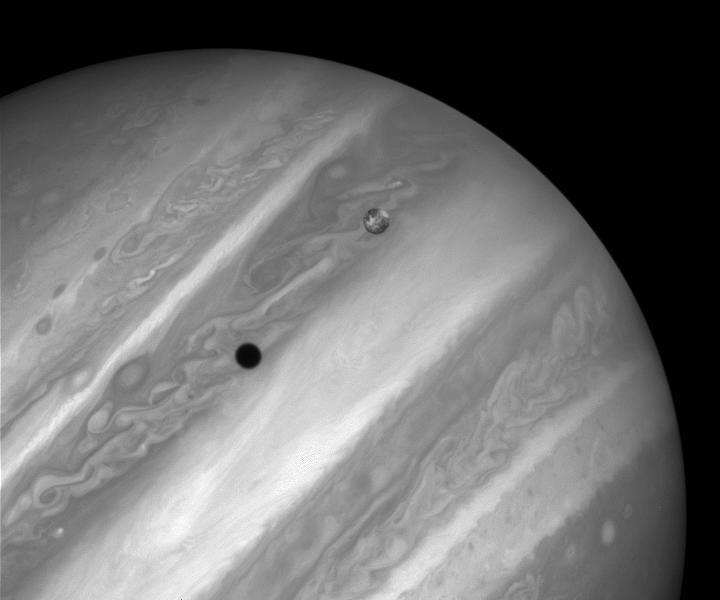
When layers of a fluid are moving at different relative velocities, they shear against one another. This shear can trigger the Kelvin-Helmholtz instability, which develops as a waves along the interface. Here Hubble captures Kelvin-Helmholtz waves along the cloud bands of Jupiter, but such clouds are also not uncommon here on Earth. (Photo credit: J. Spencer and NASA)
Smoke Flow Viz
Smoke visualization, illuminated by a laser sheet, shows a 2D slice from an axisymmetric jet as it breaks down to turbulence. The flow is laminar upon exiting the nozzle, but the high velocity at the edge of the jet and low velocity of the surrounding air causes shear that leads to the Kelvin-Helmholtz instability. This instability leads to the formation of small vortices that grow as they are advected downstream until they are large enough to interrupt the jet and it breaks down into fully turbulent flow. (Video credit: B. O. Anderson and J. H. Jensen)
Breakup of an Annular Sheet
A thin annular sheet of water is sandwiched between two concentric air streams. This airflow on either side of the water causes shearing and Kelvin-Helmholtz-type instabilities develop, causing the sinuous waves along the water surface. Periodic behavior of the sort observed here is frequently observed in fluid mechanical instabilities. #
Water Balloon Physics
[original media no longer available]
This video explores some of the physics behind the much-loved bursting water balloon. The first sections show some “canonical” cases–dropping water balloons onto a flat rigid surface. In some cases the balloon will bounce and in others it breaks. The bursting water balloons develop strong capillary waves (like ripples) across the upper surface and have some shear-induced deformation of the water surface as the rubber peals away. Then the authors placed a water balloon underwater and vibrated it before bursting it with a pin. They note that the breakdown of the interface between the balloon water and surrounding water shows evidence of Rayleigh-Taylor and Richtmyer-Meshkov instabilities. The Rayleigh-Taylor instability is the mushroom-like formation observed when stratified fluids of differing densities mix, while the Richtmyer-Meshkov instability is associated with the impulsive acceleration of fluids of differing density.