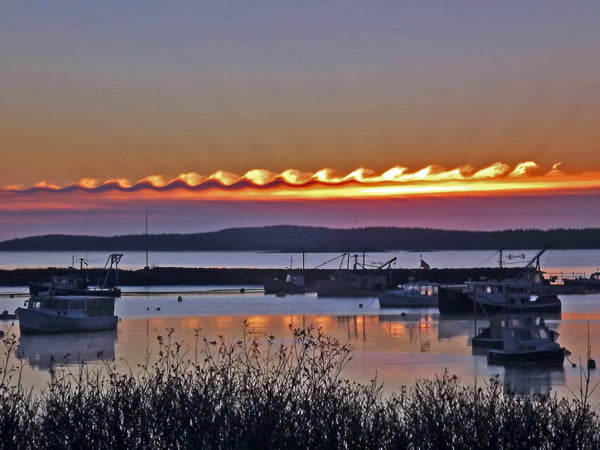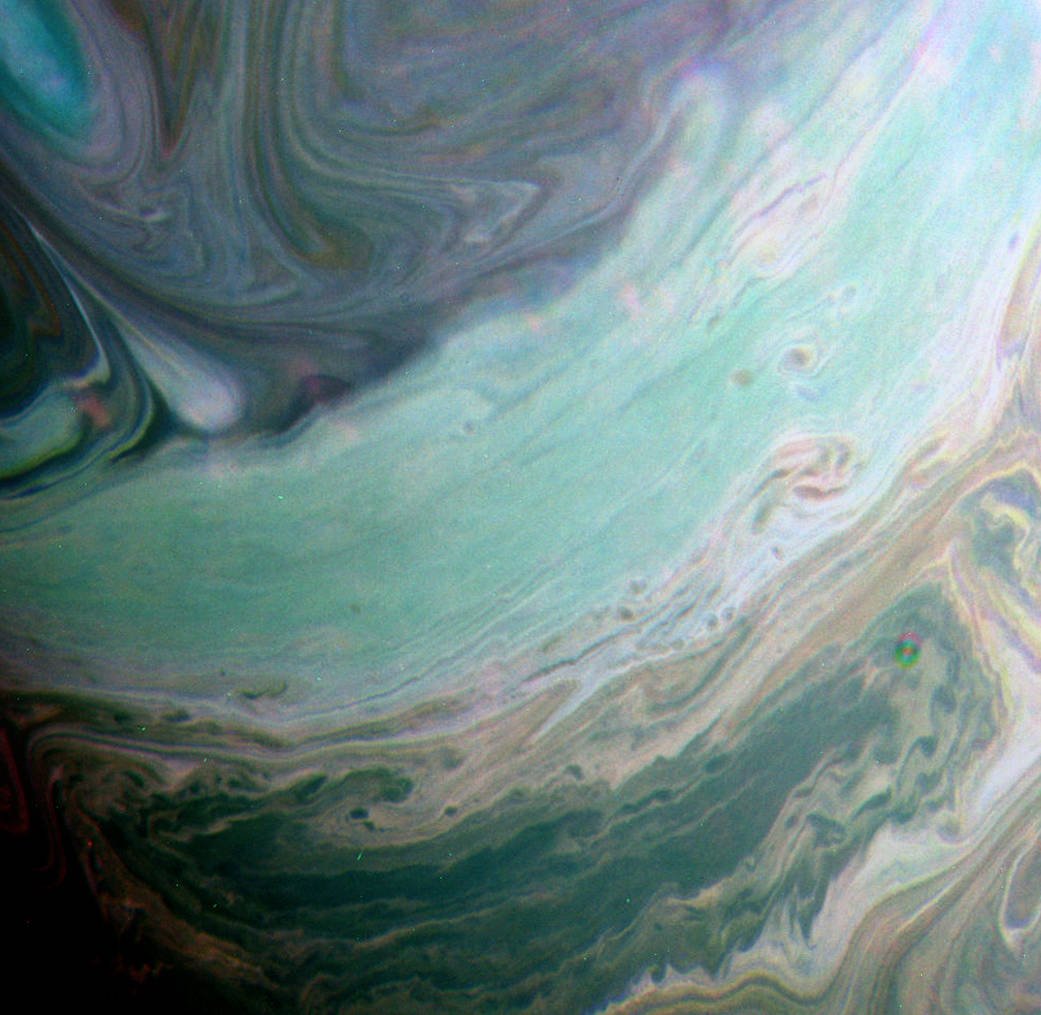
It may look like an oil slick, but the photo above actually shows the clouds of Saturn. The false-color composite image reveals the gas giant in infrared, at wavelengths longer than those visible to the human eye. NASA uses this infrared photography to identify different chemical compositions in Saturn’s atmosphere based on how they reflect sunlight. You can see an example of how they construct these images here. This detail shot appears to show cloud bands of different compositions mixing. You can see hints of shear instabilities forming along the edges where the light and dark bands meet. (Image credit: NASA; via Gizmodo)
Tag: shear

Shear Across the Water
This photo series shows the development of a Kelvin-Helmholtz instability. It’s formed when two layers of fluid move past one another at different speeds. In this case, the two fluids meet off the back of a flat plate (seen at the left of the top image) when fast-moving flow from the top of the plate encounters slower fluid beneath. Friction and shear between the fluid layers causes billows to rise up and form waves very similar to those on the ocean (wind across the water works the same way!). Those waves turn over into vortex-like spirals and keep mixing until they break down into turbulence. This pattern crops up pretty frequently, especially in clouds. (Image credit: G. Lawrence)

Wave Clouds Over the Galapagos
This dramatic example of Kelvin-Helmholtz clouds was taken near the Galapagos Islands last week. The shark-fin-like clouds are the result of two air layers moving past one another. The velocity difference at their interface creates an unstable shear layer that quickly breaks down. The resemblance of the clouds to breaking ocean waves is no coincidence – the wind moving over the ocean’s surface generates waves via the same Kelvin-Helmholtz instability. In the case of the clouds above, the lower layer of air was moist enough to condense, which is why the pattern is visible. Clouds like these don’t tend to last for long because the disturbances that drive the instability grow exponentially quickly, leading to turbulence. (Image credit: C. Miller; via Washington Post; submitted by @jmlinhart)
——————
Help us do some science! I’ve teamed up with researcher Paige Brown Jarreau to create a survey of FYFD readers. By participating, you’ll be helping me improve FYFD and contributing to novel academic research on the readers of science blogs. It should only take 10-15 minutes to complete. You can find the survey here.

Kelvin-Helmholtz Clouds
When differing layers of fluid move past one another, friction between them causes shear. This shear quickly transforms a simple flat interface between fluid layers into a wavy unstable boundary that resembles a series of breaking ocean waves. This effect is known as the Kelvin-Helmholtz (KH) instability. In the atmosphere, this instability causes air layers with differing temperatures and moisture content to form wave-like clouds where the two layers meet. Other examples of the effect are widespread. On earth, many ocean waves are generated by wind shearing the water; elsewhere in our solar system, the cloud bands of Jupiter are lined with spinning eddies from the KH instability. (Photo credit: H. Bondo)

Jupiter Timelapse
This timelapse video shows Jupiter as seen by Voyager 1. In it, each second corresponds to approximately 1 Jupiter day, or 10 Earth hours. Be sure to fullscreen it so that you can appreciate the details. The timelapse highlights the differences in velocity (and even flow direction!) between Jupiter’s cloud bands. It is these velocity differences that create the shear forces which cause Kelvin-Helmholtz instabilities–the series of overturning eddies–seen between the bands. Earth also has bands of winds moving in opposite directions, but there are fewer of them and the composition of our atmosphere is such that they do not make for such a dramatic naked eye view of large-scale fluid dynamics. (Video credit: NASA/JPL/B. Jónsson/I. Regan)
Kelvin-Helmholtz in the Lab
The Kelvin-Helmholtz instability looks like a series of overturning ocean waves and occurs between layers of fluids undergoing shear. This video has a great lab demo of the phenomenon, including the set-up prior to execution. When the tank is tilted, the denser dyed salt water flows left while the fresh water flows to the right. These opposing flow directions shear the interface between the two fluids, which, once a certain velocity is surpassed, generates an instability in the interface. Initially, this disturbance is much too small to be seen, but it grows at an exponential rate. This is why nothing appears to happen for many seconds after the tilt before the interface suddenly deforms, overturns, and mixes. In actuality, the unstable perturbation is present almost immediately after the tilt, but it takes time for the tiny disturbance to grow. The Kelvin-Helmholtz instability is often seen in clouds, both on Earth and on other planets, and it is also responsible for the shape of ocean waves. (Video credit: M. Hallworth and G. Worster)

Ocean Waves in the Sky
These wave-like Kelvin-Helmholtz clouds can form due to shear between different layers of air in the atmosphere. When one region of air has a higher velocity than the other, their interface forms a shear layer, which can break down in this wavy pattern. In this case, the lower layer of air was moist enough to form condensation and clouds, making the pattern visible to the naked eye. (Photo credit: Gene Hart; via Flow Visualization)
Merry Christmas
[original media no longer available]
Sit back, relax, and enjoy some science-y goodness with Bill Nye as he explains fluids. Happy holidays, everyone!

Saturn’s Polar Vortex

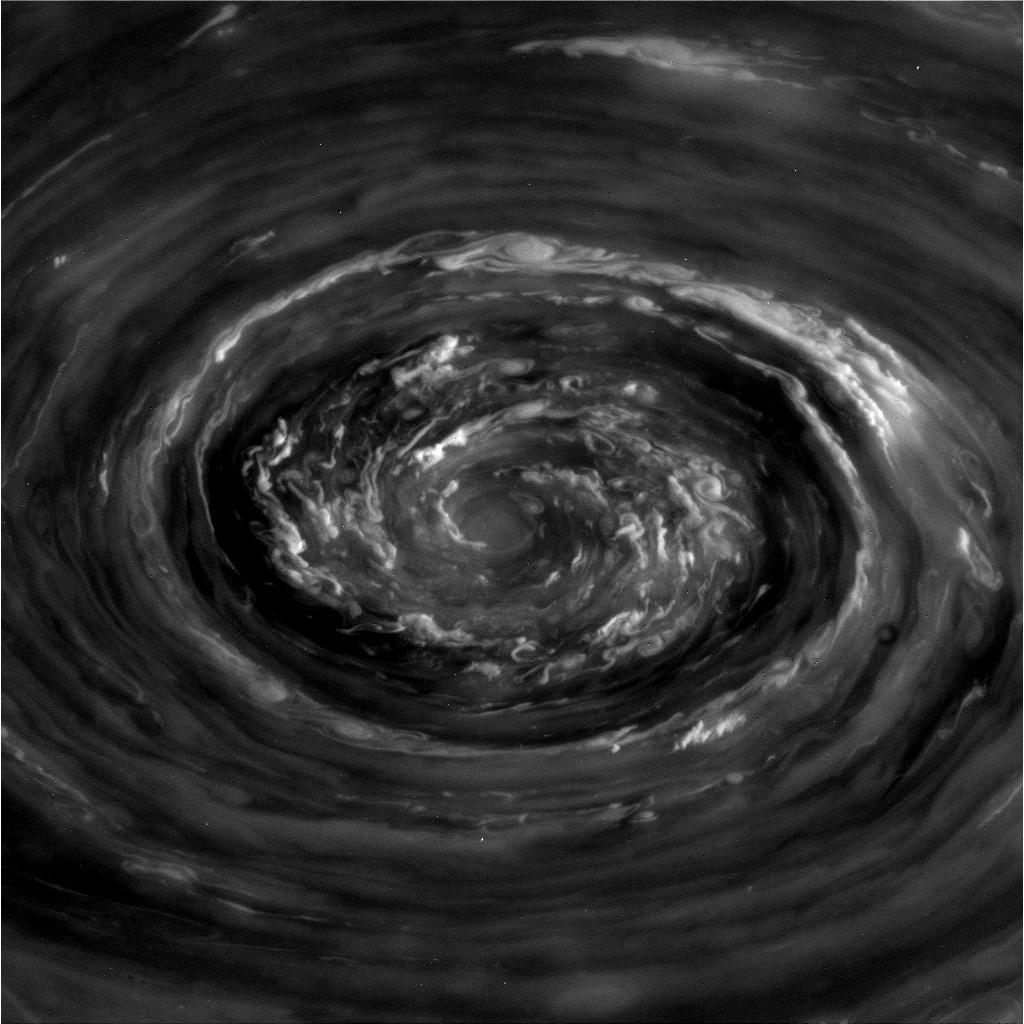
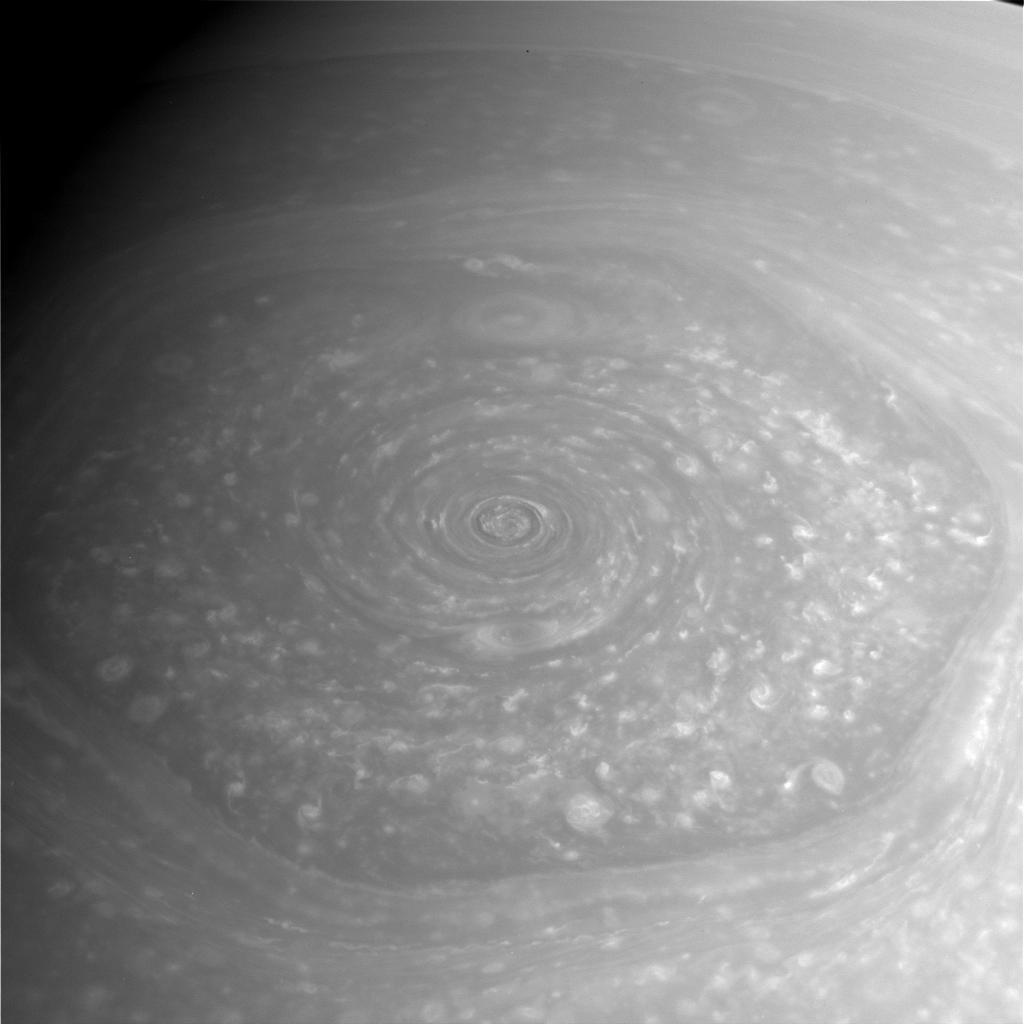

Nothing quite compares to the beauty of fluid dynamics on astronomical scales. What you see here are raw photographs of recent storms at Saturn’s north pole. The recent change in Saturnian seasons has afforded Cassini a sunlit view of the northern pole, which had previously lain in darkness. A roiling vortex filled with clouds being twisted and sheared was revealed near the center of its famed polar hexagon. (Photo credit: NASA/JPL-Caltech/Space Science Institute; submitted by J. Shoer)
Viscoelastic Jets
Unlike Newtonian fluids, such as air and water, viscoelastic fluids exhibit non-uniform reactions to deformation. In this video, researchers explore the effects of this behavior when a liquid jet falls into another fluid. When fluids move past one another at different speeds in this manner, there is a shearing force which often leads to the wave-like Kelvin-Helmholtz instability between the fluids. Here we see for a variety of wavelengths how the breakdown of a Newtonian and viscoelastic jet differ. The Newtonian jets form clean lines and complicated tulip-like shapes, but the viscoelasticity of the non-Newtonian jets inhibits the growth of these instabilities, surrounding the central jet with wisps of escaping fluid. For more, see Keshavarz and McKinley. (Video credit: B. Keshavarz and G. McKinley)