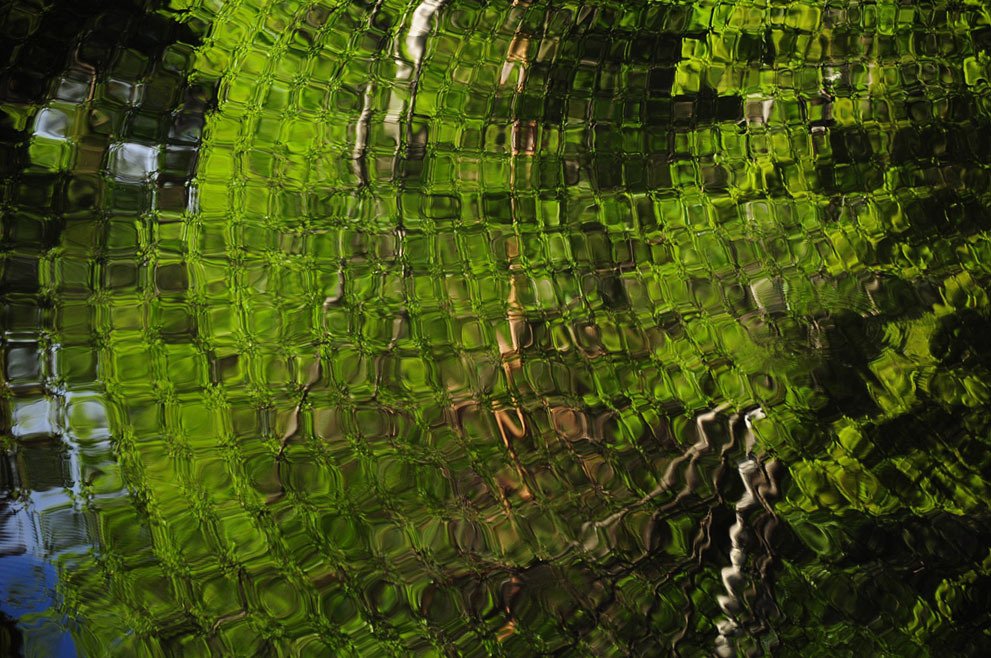
Capillary waves–ripples–interfere with one another after the photographer throws objects into a narrow point in a small lake. The reflections of these waves off the lake’s boundaries and against one another creates a mosaic-like geometric effect on the liquid surface. (Photo credit: Jorgen Tharaldsen/National Geographic Photo Contest)
Tag: science

Flame Thrower Physics
This high-speed video–which we do not recommend recreating yourself–features burning gasoline flying through the air. In addition to the sheer entertainment value, there are some neat physics. In the first segment, when they kick a tray of gasoline, one can see lovely fiery vortices forming around the backside of the tray as it’s launched. This is the start of the tray’s wake. In the latter half of the video, they launch the flaming gasoline from a bucket. Notice how the flames are in the wake while liquid gasoline streams out ahead without burning. This is because it is primarily gaseous petrol that is flammable. As the liquid fuel breaks up into droplets heated by the burning gasoline vapors nearby, the rest of the fuel changes to a vapor state and catches flame. (Video credit: The Slow Mo Guys; submitted by Will T)

Lenticular Clouds
Lenticular clouds, such as the one shown above, are stationary lens-shaped clouds that form over a mountain or range of mountains. Moist air is deflected up over the mountain, and, if the temperature at higher altitudes is below that of the dew point, the water vapor in the air can condense, forming a cloud that sits over the peak of the mountain. Once the air traverses the mountain and reaches warmer, lower altitudes on the far side, it will often transition back to a gaseous state. Lenticular clouds are sometimes also called UFO clouds, due to their distinctive shape and the way they seem to hover over a peak. (Photo credit: James Woodcock, Billings Gazette via Associated Press)
Champagne Science
Today many a glass of champagne will be raised in honor of the end of one year and the beginning of a new. This French wine, known for its bubbly effervescence, is full of fascinating physics. During secondary fermentation of champagne, yeast in the wine consume sugars and excrete carbon dioxide gas, which dissolves in the liquid. Since the bottle containing the wine is corked, this increases the pressure inside the bottle, and this pressure is released when the cork is popped. Once champagne is in the glass, the dissolved carbon dioxide will form bubbles on flaws in the glass, which may be due to dust, scratches, or even intentional marks from manufacturing. These bubbles rise to the surface, expanding as they do so because the hydrodynamic pressure of the surrounding wine decreases with decreasing depth. At the surface, the bubbles burst, creating tiny crowns that collapse into Worthington jets, which can propel droplets upward to be felt by the drinker. For more on the physics of champagne, check out Gerard Liger-Belair’s book Uncorked: The Science of Champagne and/or Patrick Hunt’s analysis. Happy New Year! (Video credit: AFP/Gerard Liger-Belair)
Bouncing in a Corral
About a year ago, we featured a video in which a fluid droplet bouncing on a vibrating pool demonstrated some aspects of the wave-particle duality fundamental to quantum mechanics. Work on this system continues and this new video focuses on studying some of the statistics of such a bouncing droplet–called a walker in the video–when it is confined to a circular corral. Using strobe lighting and capturing one frame per bounce, the vertical motion of these droplets is filtered out and the walking motion and the surface waves that guide it are captured. When the droplet is allowed to walk for an extended time, its path appears complicated and seemingly random, but it is possible to build a statistical picture and a probability density field that describe where the walker is most likely to be, much the way one describes the likelihood of locating a quantum particle. Parallels between the physical macroscale system and quantum-mechanical theory are drawn. (Video credit: D. Harris and J. Bush; submission by D. Harris)
INK World v01
In this video, mixtures of inks (likely printer toners) and fluids move and swirl. Magnetic fields contort the ferrofluidic ink and make it dance, while less viscous fluids spread into their surroundings via finger-like protuberances. (Video credit and submission: Antoine Delach)
Perpetual Motion?
In the 17th century, scientist Robert Boyle proposed a perpetual motion machine consisting of a self-filling flask. The concept was that capillary action, which creates the meniscus of liquid seen in containers and is responsible for the flow of water from a tree’s roots upward against gravity, would allow the thin side of the flask to draw fluid up and refill the cup side. In reality, this is not possible because surface tension will hold it in a droplet at the end of the tube rather than letting it fall. In the video above, the hydrostatic equation is used to suggest that the device works with carbonated beverages (it doesn’t; the video’s apparatus has a hidden pump) because the weight of the liquid is much greater than that of the foam. Of course, the hydrostatic equation doesn’t apply to a flowing liquid! The closest one can come to the hypothetical perpetual fluid motion suggested by Boyle is the superfluid fountain, which flows without viscosity and can continue indefinitely so long as the superfluid state is maintained. (Video credit: Visual Education Project; submission by zible)
Merry Christmas
[original media no longer available]
Sit back, relax, and enjoy some science-y goodness with Bill Nye as he explains fluids. Happy holidays, everyone!
Santa and the Egg
[original media no longer available]
If I were Santa–or the egg in this video–I don’t think I’d particularly like getting sucked through a chimney in this fashion. I wonder if Santa re-kindles the fire and tries to increase air pressure in the house relative to the outside in order to get back out the chimney. (Video credit: Hooked on Science)
Reader Question: Snow from Boiling Water?
[original media no longer available]
Reader kylewpppd asks:
Have you seen the post of a man in Siberia throwing boiling water off of his balcony? Can you provide a better explanation of what’s going on?
As you can see in the video (and in many similar examples on YouTube), tossing near boiling water into extremely cold air results in an instant snowstorm. Several effects are going on here. The first thing to understand is how heat is transferred between objects or fluids of differing temperatures. The rate at which heat is transferred depends on the temperature difference between the air and the water; the larger that temperature difference is the faster heat is transferred. However, as that temperature difference decreases, so does the rate of heat transfer. So even though hot water will initially lose heat very quickly to its surroundings, water that is initially cold will still reach equilibrium with the cold air faster. Therefore, all things being equal, hot water does not freeze faster than cold water, as one might suspect from the video.
The key to the hot water’s fast-freeze here is not just the large temperature difference, though. It’s the fact that the water is being tossed. When the water leaves the pot, it tends to break up into droplets, which quickly increases the surface area exposed to the cold air, and the rate of heat transfer depends on surface area as well! A smaller droplet will also freeze much more quickly than a larger droplet.
What would happen if room temperature water were used instead of boiling water? In all likelihood, a big cold bunch of water would hit the ground. Why? It turns out that both the viscosity and the surface tension of water decrease with increasing temperature. This means that a pot of hot water will tend to break into smaller droplets when tossed than the cold water would. Smaller droplets means less mass to freeze per droplet and a larger surface area (adding up all the surface area of all the droplets) exposed. Hence, faster freezing!

