One way to damp a bouncing ball is to partially fill it with a fluid (a) or granular material (b). For the fluid, the initial impact sloshes the liquid. That doesn’t change the trajectory of the initial bounce noticeably, but it interferes with the second impact, drastically damping the rest of the ball’s bounces until it comes to a stop. A grain-filled ball is similar, at least to begin with. The initial bounce sends the grains flying, forming a granular gas inside the ball. This doesn’t affect the trajectory of the first bounce, but the second impact collapses the granular gas. All the impacts of the grains with one another dissipate the energy of the bounce, and the ball comes to a complete stop. This suggests that a partially-grain-filled container can make a good damper in sport or industrial applications. It also suggests that it might be even better for water-bottle flipping than water is. (Image and research credit: F. Pacheco-Vázquez & S. Dorbolo)
Tag: science

Plate Tectonics
We don’t typically think of the ground beneath our feet as anything but solid, but over geologically long time scales, even mountains can flow. Buoyant convection inside the Earth’s mantle is thought to drive the plate tectonics that have shaped the Earth as we know it. The video above explains some of the major processes and events that shaped the modern North American continent, including collisions, subduction, volcanism, and erosion. (Video credit: Ted-Ed)
“Monsoon IV”
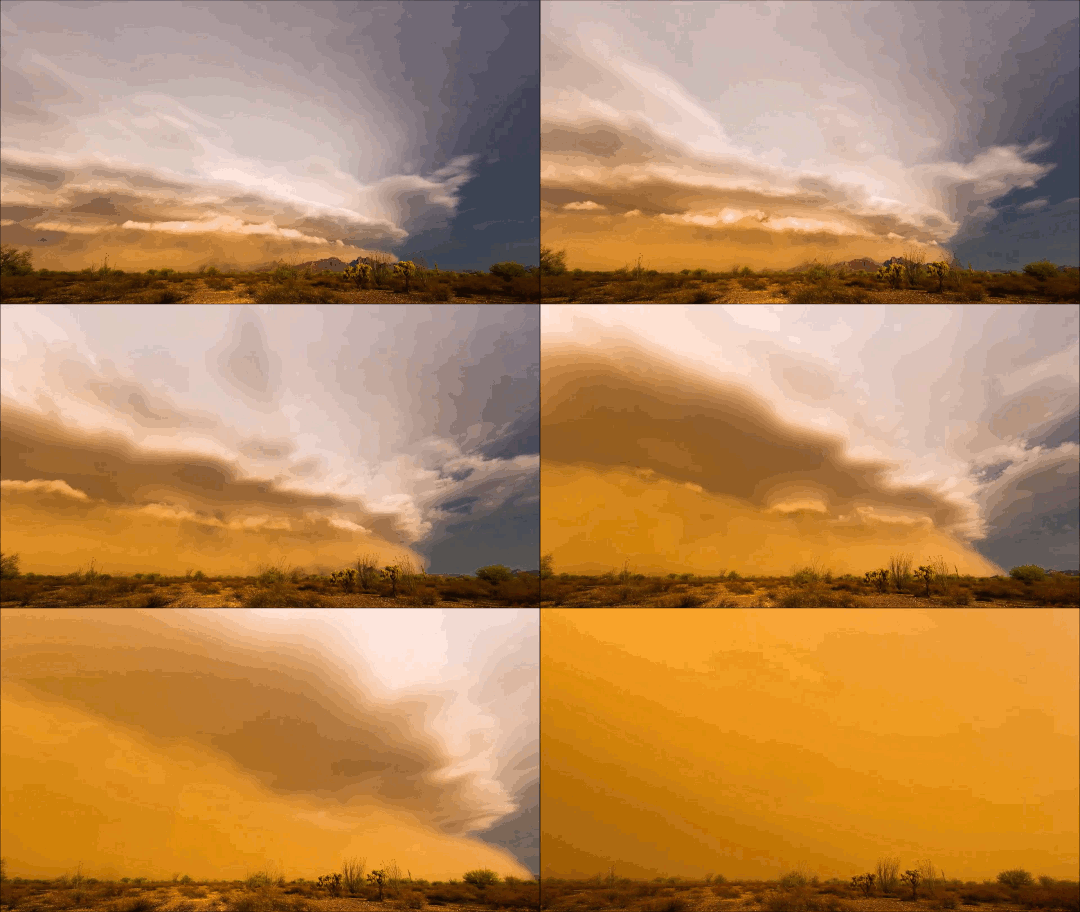
It’s a cliché to claim that the sky is bigger in the American West, but the wide, open views in that region do offer a very different perspective on weather. Photographer Mike Olbinski’s works give viewers a taste of that perspective of far-off thunderstorms, towering anvil clouds, and massive downpours in the distance. At the same time, many of his sequences illustrate the birth and death of these massive storms. As warm, moist air rises, a puffy cumulus cloud (below) swells upward as fresh moisture condenses. When it reaches a thermal cap and can rise no further, precipitation begins to fall, dragging surrounding air with it. This is the mature stage of a storm, when both updrafts and downdrafts exist simultaneously.
Eventually, the storm’s power begins to wane as the downdrafts cut off the updrafts that feed the storm. Sometimes this occurs in a massive downdraft where cool air sinks straight down and, upon encountering the ground, spreads radially outward. In dry regions, this outward burst of ground-level winds can pick up dirt, dust, and sand, forming a wall-like haboob (below) that advances past the remains of the storm. Watch the entire video to see some examples in their full glory! (Video and image credit: M. Olbinski, source; via Rex W.)


Revealing Stress


What goes on inside of a granular material like sand when an object moves through it? Individual grains will shift and may impact one another or simply slide past. Researchers use special photoelastic materials to see these forces in action. A photoelastic material responds to changes in stress by polarizing light, revealing areas of stress concentration. For an entire network of photoelastic beads, forces between the grains appear like a web of lightning. Individual strands are known as force chains. Bright lines indicate areas where grains are jammed against one another in opposition to the object’s movement. As the intruder is pulled against the force chain network, grains shift and new force chains form. (Image credit: Y. Zhang and R. Behringer, source)
Blowing Bubbles in Space
Blowing bubbles in your fruit juice is a bad idea when you’re in space, as astronaut Jack Fischer demonstrates. On Earth, gravity dominates water’s behavior, except when things are very small. But in microgravity, a liquid’s other characteristics become more obvious. Adhesion between the straw and juice guides it up and onto Fischer’s face. Surface tension is strong enough to hold the expanding juice bubble together. Capillary action, the ability of fluids to climb up narrow spaces, is far more apparent in microgravity as well, although it’s not important for this demo. We sometimes forget how powerful these forces can be, but microgravity is a good reminder that fluids are more complicated than we think. (Image credit: J. Fischer, source)

APS DFD 2017
This year’s American Physical Society Division of Fluid Dynamics meeting starts this Sunday. I have a couple events scheduled:
– Student Lunch, Monday, November 20, 12:55-13:45 (sold out)
– FYFD: Getting started in science communication, Monday, November 20, 16:44-16:57, Four Seasons Ballroom
Yes, the ballroom! If you’ve ever struggled to get into an FYFD talk, you shouldn’t have to this year! Also, dear DFD attendees, if you guys manage to pack the ballroom, I will love you forever.
You’ll also see me out and about at the conference, sporting fresh new FYFD t-shirts. I’ll have selected sticker designs for sale in person, too – $3 each, buy 4 and get the 5th free.
The best way to keep up with me during the conference is through Twitter, and if you need to contact me, you can get to me there or via email at fyfluids[at]gmail.com.
Hope to see you at APS DFD!

Lagoon Flows
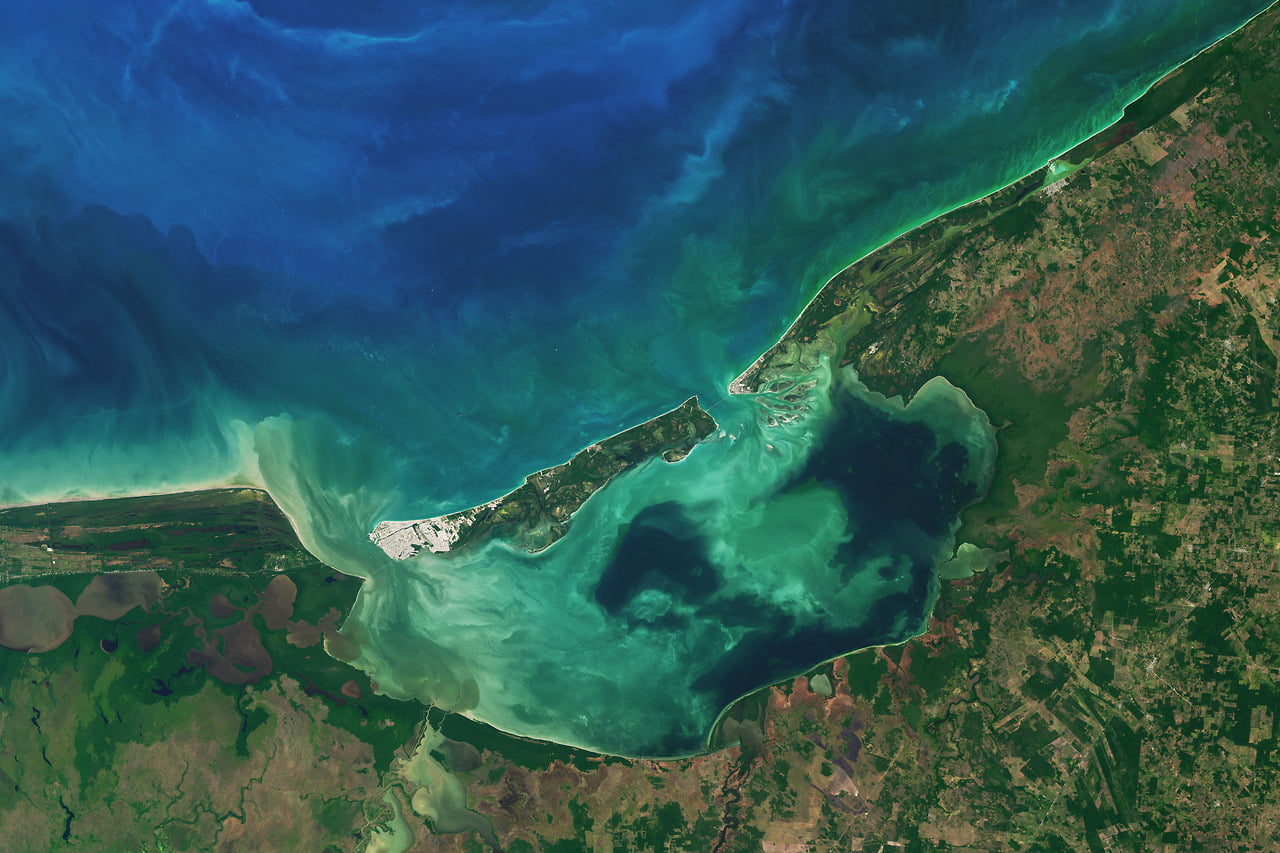
The meeting of land and sea often creates a rich and colorful environment. This satellite image shows Mexico’s Laguna de Términos, a coastal lagoon off the Gulf of Mexico. A skinny barrier island forms the lagoon’s two connections to the ocean; the eastern side is the usual inlet (right), while the western side forms an outlet. Rivers feed freshwater into the lagoon from the south and southwest. These introduce sediments that cause some of the lighter swirls in the image. Winds and tides also contribute to this turbidity. The sheltered nature of the lagoon allows fresh and salt water to mix gradually, providing harbor for many forms of life. Oyster beds thrive in the river mouths; seagrasses prefer the calmer, saltier waters, and mangrove trees line the shore, slowly desalinating water for themselves as their roots shelter young fish and shrimp. (Image credit: NASA Earth Observatory)

FYFD Merch!



Whether you’re into stickers or t-shirts, experimental fluid dynamics or CFD, we’ve got you covered. I’m running a special introductory sale through December 15th – holiday shopping anyone? – so it’s a great time to grab some merch!
See a design you want available on more products? Got a concept for a new design? Let me know!
For those attending the APS DFD meeting here in Denver in a few days, I’ll be sporting some of the new t-shirts there, and I’ll be selling selected sticker designs in person (no shipping costs for you!). More DFD details to come.
In the meantime, everyone go check out the store!
Pigeon Flutter
Birds are well-known for their vocalizations, but this isn’t their only way to produce noise. A new study on crested pigeons finds that the birds’ wings produce distinctive high and low notes during take-off. A low note takes place during each upstroke, and a high note is heard during the downstroke. A major source of the noise is the highly modified P8 feather. When airflow over the feather is fast enough, it sets off twisting and torsion in the feather through aeroelastic flutter. It’s this vibration that causes the noise. By playing back the notes at different speeds, researchers found that the crested pigeons use the notes’ timing as an alarm. When the cycle of high and low repeats in quick succession, they respond by taking off to escape the perceived danger.
Other bird species are also known to use aeroelastic flutter to make noise. Check out these hummingbirds, which use flutter in their mating displays. (Video credit: Science; research credit: T. Murray et al.)
Oceans of Clouds
One of the most amazing things about fluid dynamics, in my opinion, is that the same rules apply across an incredible array of situations. The equations of motion are the same whether your fluid is water, air, or honey. Your flier can be a Cessna airplane or a fruit fly; again, the equations are the same. This is part of the reason that patterns in flows are repeated whether in the laboratory or out in nature – and it’s the reason why a timelapse of fog clouds can look just like ocean waves. Ultimately, the physics is the same; clouds just move slower than ocean waves! (Image credit: L. Leber, source; via James H.)