Conventional wind tunnels are great, but some aerodynamic testing requires facilities of a different nature. The video above is from the WindEEE dome, a hexagonal chamber with sixty fans on one wall, eight directional fans on the other five walls, and six fans in the upper chamber. Each is individually computer controlled, allowing the researchers to create straight flows as well as complex vortical ones. The video shows their tornado flow, which stands 5 m tall and swirls at 30 m/s. They can also move the tornado around the chamber at 2 m/s. This capability enables a kind of scale-model analysis of tornadoes and their impact that’s not possible in most facilities. You can read more about the dome at New Scientist or the WindEEE website. (Video credit: New Scientist/WindEEE; submitted by entropy-perturbation)
Tag: physics

Rowing Water Striders

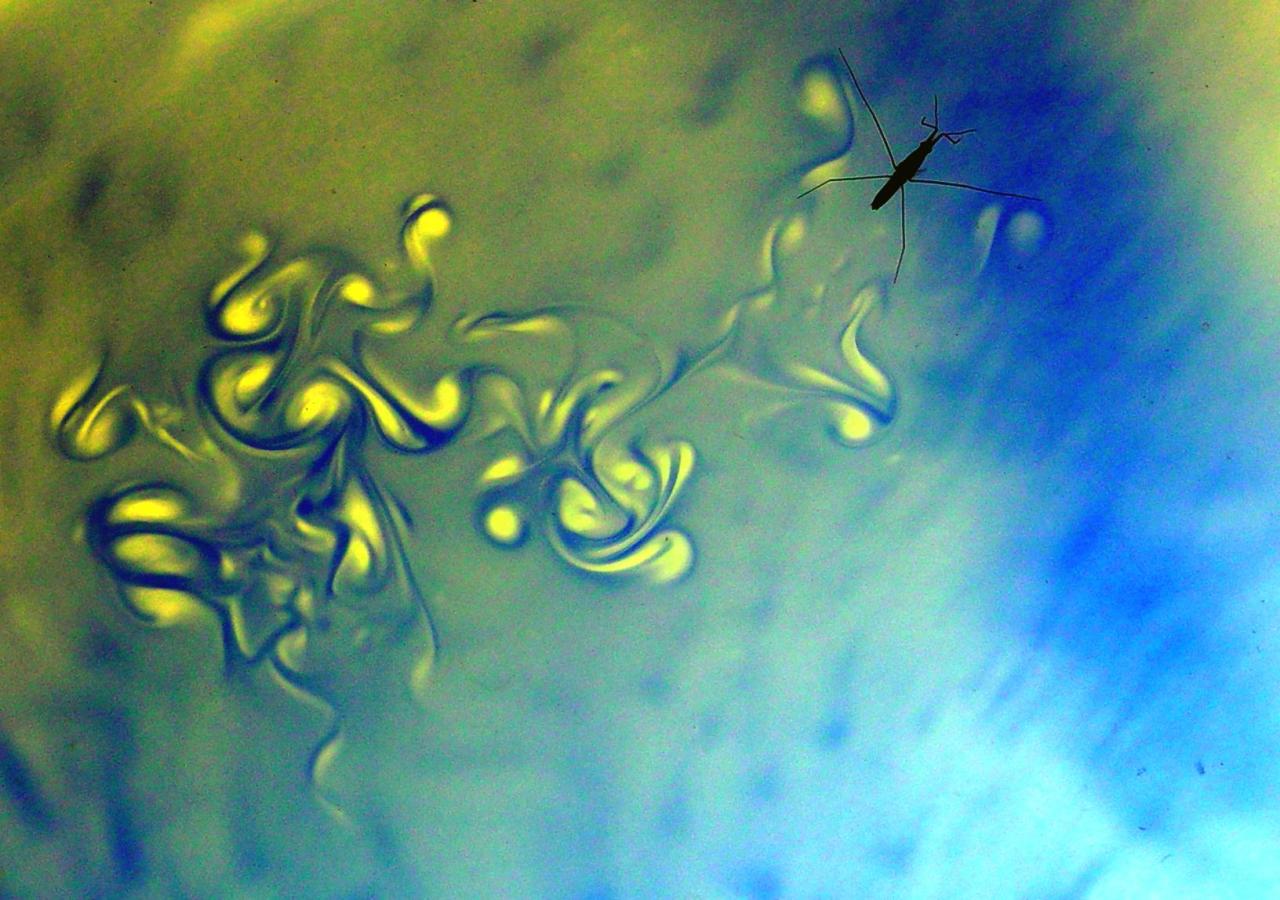
Water strider insects are light enough that their weight can be supported by surface tension. For some time, they were thought to propel themselves by using their long middle legs to generate capillary waves–ripples– that pushed them forward, but juvenile water striders are too small for this technique to work. Instead researchers found that water striders move by using their middle legs like oars. The leg motion creates vortices about 4 mm below the water surface, and this water moving backward propels the insect forward. In the photos above, the scientists visualized the flow by sprinkling thymol blue on the water and letting the striders move freely. You can learn more about the work here or in this Science Friday episode. (Photo credits: J. Bush et al.)

Dancing Droplets


What makes drops of food coloring able to dance, chase, sort themselves, or align with one another? This unexpected behavior is a consequence of food coloring consisting of two mixed liquids: water and propylene glycol. Both have their own surface tension properties and evaporation rates, which ultimately drives the behavior you see in the animations above. Both long-range and short-range interactions are observed. The former are due to vapor from each droplet adsorbing onto the glass around the droplet, thereby changing the local surface tension and causing nearby drops to feel an attractive force. The short-range effects are also surface-tension-driven. Droplets with lower surface tension will naturally try to flow toward areas of higher surface tension, which causes them to “chase” dissimilar adjacent drops. You can learn more about the research in the videos linked below (especially the last two), or you can read about the work in this article or the original research paper. (Image credit: N. Cira et al., source videos 1, 2, 3, 4; GIFs via freshphotons; submitted by entropy-perturbation)

“Jack and the Giant”
This fantastic music video by Kim Pimmel is a beautiful merger of art and fluid dynamics. Using household goods (and some slightly more exotic ferrofluid), the video shows how mesmerizing diffusion, buoyancy, Marangoni flow, and other fluid effects can be up close. It may also be the first time I’ve ever seen fluid dynamics–specifically bubbles–used as characters! Also be sure to check out some of his previous videos, many of which also feature cool fluid dynamics. (Video credit and submission: K. Pimmel)

Encapsulating Drops

Building and manipulating drops containing multiple chemicals is useful in pharmaceutical applications. But it can be a challenge to encapsulate multiple fluids without mixing them immediately. The research poster above describes a clever and simple method of building these compound drops. It uses a crosswise array of fibers, as seen in the top image. Dyed water droplets are placed at each intersection, pinning them in place. Then a larger drop of oil is added to the vertical fiber. As it runs down the fiber, it collects and encapsulates the individual droplets, creating the compound drop seen in the bottom photo. (Photo credit: F. Weyer et al.)
Sand Dunes
Sand dunes form with a gentle incline facing the wind and a steeper slip face pointing away from the wind. Most slip faces are angled at about 30 to 34 degrees–called the angle of repose. The shape is determined by the dune’s ability to support its own weight; add more sand and it will cascade down the slip face in a miniature avalanche. Similarly, if you disturb sand on the slip face by digging a hole at the base, you get the cascading collapse seen in this video. By removing sand, the dune’s equilibrium is broken and it can no longer support its weight. This makes sand flow down the slip face until enough is shifted that the dune can support itself. Being a granular material, the sand itself appears to flow much like a fluid, with waves, ripples and all. (Video credit: M. Meier; submitted by Boris M.)

Reader Question: When Mercury Meets Lava
Reader lucondri asks:
What happens when mercury touches lava?
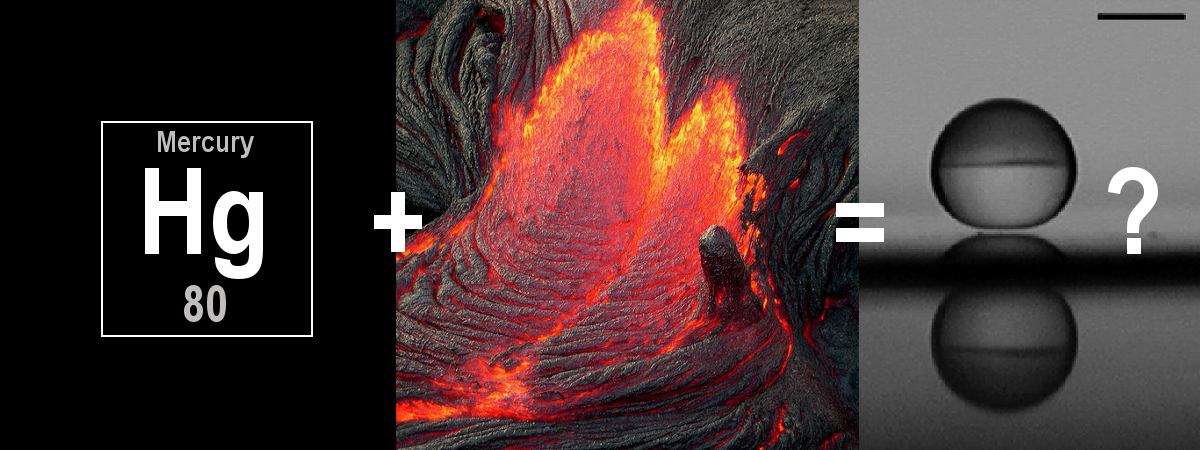
That’s an interesting thought experiment, but hopefully no one tries it any time soon given mercury’s toxicity. So, what might happen? Mercury has a boiling point just under 630 Kelvin, and, although the temperature of molten lava varies, it’s between 970 and 1470 Kelvin when it first erupts. So mercury would definitely vaporize (i.e. boil) on contact with lava. (Again, this is very bad for anyone nearby.) If you’re curious what boiling liquid mercury looks like, wonder no further.
Molten lava is much, much hotter than the boiling point of mercury, though, so there’s a possibility that the mercury won’t boil away instantly. This is because of the Leidenfrost effect, where a thin layer of vapor forms between a liquid and an extremely hot surface. The vapor has such low friction that the liquid can essentially skate across a surface, and it doesn’t boil away instantly because the vapor insulates it from the extreme heat. After some digging, I found a paper that placed the Leidenfrost temperature of mercury between about 850 and 950 Kelvin, meaning that fresh lava is probably hot enough to generate mercury Leidenfrost drops.
So pouring a lot of mercury on lava will probably result in some boiling, but there’s also a good chance that it will form a bunch of skittering mercury droplets that will stick around awhile before they evaporate into toxic mercury gas. That said, it’s a lot easier and safer to watch awesome Leidenfrost drop videos with other liquids. (Collage credit: N.Sharp; images sources: Z. T. Jackson, and A.Biance)
Magnetic Putty
Sometimes fluids are slow-moving enough that it takes timelapse techniques to reveal the flow. Fog is one example, and, as seen above, magnetic silly putty is another. The putty is an unusual fluid in a couple of ways. First, having been impregnated with ferromagnetic nanoparticles, it is sensitive to magnetic fields, making it a sort of ferrofluid. And secondly, being silly putty, it’s a non-Newtonian fluid, meaning that it has a nonlinear response to deformation – a fact that will be familiar to anyone who has tried to knead putty versus striking it. With a strong enough magnet, the putty makes for an impressively tenacious creeping flow. (Video credit: I. Parks; via io9; submitted by Chad W.)
When Lava Meets Ice
What happens when lava meets ice or water? Artists and geologists are working together to explore these interactions by melting crushed basalt and pouring it onto different substrates. Ice is their classic example; instead of melting instantly through the ice, the lava is so hot that it creates a layer of steam between it and the ice. This steam helps the lava flow due to lower friction while also insulating the ice from the lava. It’s an example of the Leidenfrost effect. The end result is a very bubbly lava flow thanks to the steam trying to escape through the viscous lava. (Video credit: Science Channel; submitted by @jchawner)
Earth’s Aerosols
The motions of Earth’s atmosphere move more than just air and moisture. As seen in this animation built from NASA satellite data, the atmosphere also transports large amounts of small solid particles, or aerosols, such as dust. Each year the wind carries millions of tons of Saharan dust across the Atlantic, depositing much of it in the Amazon basin. This provides much needed nutrients like phosphorus to plants and animals in the Amazon; check out this video from the Brain Scoop to see what happens in areas that don’t receive these nutrients. Dust is only one of many sources for atmospheric aerosols, though. Sea salt, volcanic eruptions, and pollution are others. All of these aerosols serve as potential nucleation sites for raindrops or snowflakes, and their transport all around the globe by atmospheric winds means that seemingly local effects–like a regional drought or increased pollution in developing countries–can have global effects. (Video credit: NASA Goddard; submitted by entropy-perturbation)