The motions of Earth’s atmosphere move more than just air and moisture. As seen in this animation built from NASA satellite data, the atmosphere also transports large amounts of small solid particles, or aerosols, such as dust. Each year the wind carries millions of tons of Saharan dust across the Atlantic, depositing much of it in the Amazon basin. This provides much needed nutrients like phosphorus to plants and animals in the Amazon; check out this video from the Brain Scoop to see what happens in areas that don’t receive these nutrients. Dust is only one of many sources for atmospheric aerosols, though. Sea salt, volcanic eruptions, and pollution are others. All of these aerosols serve as potential nucleation sites for raindrops or snowflakes, and their transport all around the globe by atmospheric winds means that seemingly local effects–like a regional drought or increased pollution in developing countries–can have global effects. (Video credit: NASA Goddard; submitted by entropy-perturbation)
Tag: physics

Reader Question: Rippling Runoff

Reader junolivi asks:
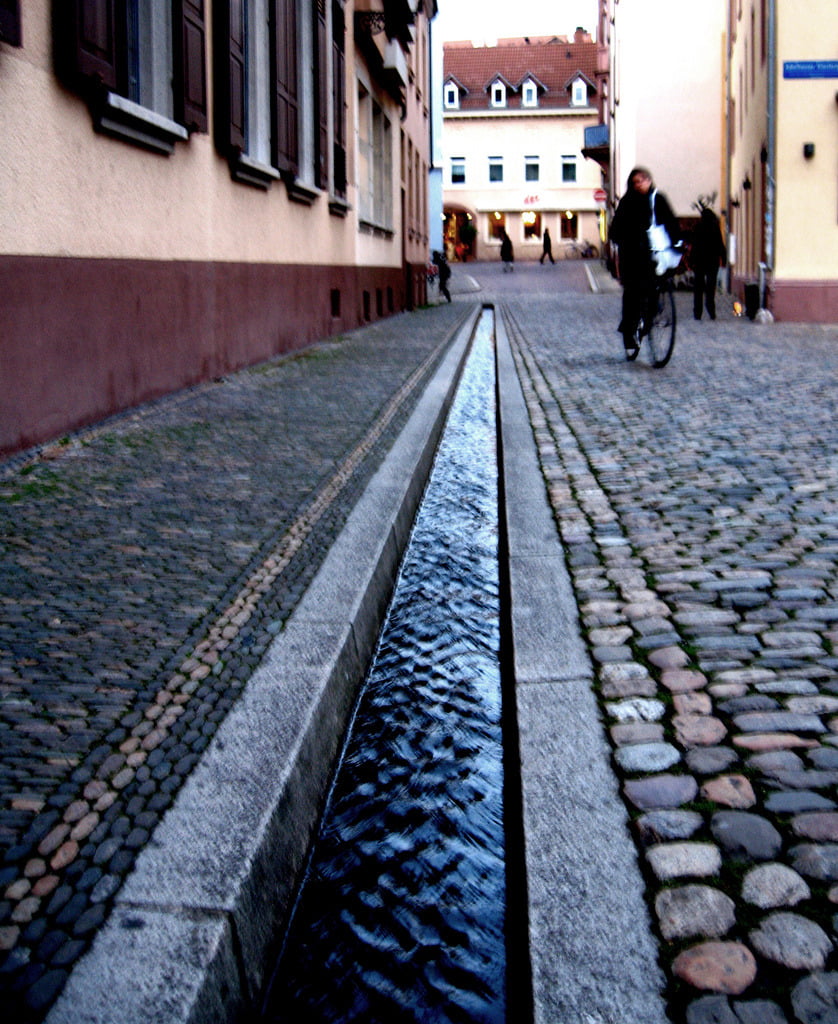
When shallow water (like runoff from melting snow) flows across pavement, it creates small repeated wave-like ripples. What creates that texture and why isn’t it just a steady flow?
This is a great question that’s probably crossed the mind of anyone who’s seen water running down the gutter of a street after a storm. The short answer is that this gravity-driven flow is becoming unstable.
Fluid dynamicists often like to characterize flows into two main types: laminar and turbulent. Most flows in nature are turbulent, like the wild swirls you see behind cars driving in the rain. But there are laminar flows in nature as well. Often flows that begin as laminar will become turbulent. This happens because those laminar flows are unstable to disturbances.
The classic example of stability is a ball on a hill. If the ball is at the top of the hill and you disturb it, it will roll down the hill because its original position was unstable. If, on the other hand, the ball is in a depression, then you can prod the ball and it will eventually settle back down into its original place because that position was stable. Another way of looking at it is that, in the unstable case, the disturbance–how far the ball is from its original position–grows uncontrollably. In the stable case, on the other hand, the disturbance can be initially large but eventually decays away to nothing.
There are many ways to disturb a laminar flow–surface roughness, vibrations, curvature, noise, etc., etc. These disturbances enter the flow and they can either grow (and become unstable) or decay (because the flow is stable to the disturbance). Just as one can look at the stability of a pendulum, one can mathematically examine the stability of a fluid flow. When one does this for water flowing down an incline, one finds that the flow is quite unstable, even in the ideal case of a pure, inviscid fluid flowing down a smooth wall.
The reason that one sees distinctive waves with a particular wavelength (assuming that they aren’t caused by local obstructions) is directly related to this idea of instability. Essentially, the waves are the disturbance, having grown large enough to see. One could imagine that any wavelength disturbance is possible in a flow, but mathematically, what one finds, is that different wavelengths have different growth rates associated with them. The wavelength we observe is the most unstable wavelength in the flow. This is the wavelength that grows so much quicker than the others that it just overwhelms them and trips the flow to turbulence. This is very common. For example, you can see distinctive waves showing up before the flow goes turbulent in both this mixing layer simulation and this boundary layer flow.
(Image credits: anataman, mo_cosmo; also special thanks to Garth G. who originally asked a similar question via email)

Martian Dust Devil
This photo from the Mars Reconnaissance Orbiter stares almost straight down a dust devil on Mars. Like their earthbound brethren, Martian dust devils form when the surface is heated by the sun, causing warm air to rise. The rising air causes a low pressure area that the surrounding air flows into. Any rotational motion of the air intensifies as it is entrained. This is a consequence of conservation of angular momentum. Just as a spinning ice skater spins faster when he pulls his arms in, the vorticity of the inward-flowing air increases, forming a vortex. In addition to dust devils, this same physical mechanism applies to waterspouts and fire tornadoes, although the heating source for those is different. (Photo credit: NASA; via APOD)

Asteroid Impact
I often receive questions about how fluids react to extremely hard and fast impacts. Some people wonder if there’s a regime where a fluid like water will react like a solid. In reality, nature works the opposite way. Striking a solid hard enough and fast enough makes it behave like a fluid. The video above shows a simulated impact of a 500-km asteroid in the Pacific Ocean. (Be sure to watch with captions on.) The impact rips 10 km off the crust of the Earth and sends a hypersonic shock wave of destruction around the entire Earth. There’s a strong resemblance in the asteroid impact to droplet impacts and splashes. Much of this has to do with the energy of impact. The asteroid’s kinetic (and, indeed, potential) energy prior to impact is enormous, and conservation of energy means that energy has to go somewhere. It’s that energy that vaporizes the oceans and fluidizes part of the Earth’s surface. That kinetic energy rips the orderly structure of solids apart and turns it effectively into a granular fluid. (Video credit: Discovery Channel; via J. Hertzberg)
Popcorn Popping
The familiar popping behavior of popcorn is the combination of several events. When heated, unpopped kernels act like pressure vessels, managing to contain their boiling water content until a critical temperature of 180 degrees Celsius. At this temperature, nearly all kernels fracture. Popcorn’s jump doesn’t come from the fracture, though. Most of its acrobatics occur when a leg of starch branches out of the popping kernel. The starch acts somewhat like a muscle – after being compressed against the ground, it springs back, propelling the corn upward. Finally, by synchronizing high-speed video and audio recordings of popping corn, researchers determined that the pop in popcorn is not caused by fracture or rebound but instead is the result of the release of water vapor. (Image credit: TAMU NAL, source; research credit: E. Virot and A. Ponomarenko; submitted by Chad W.)

How Eyelashes Work
New research shows that eyelashes divert airflow around the eye, serving as a passive filter that reduces dust collection and controls evaporation. Mammal hairs in places like the nose act as ram filters that trap the particles that hit them and which require regular cleaning via sneezing. Eyelashes, on the other hand, prevent dust collection by altering airflow at the surface of the eye. At the optimal length of roughly 1/3rd the width of an eye, eyelashes create a stagnation zone near the eye surface that forces air to travel above rather than through the eyelashes. This results in lower shear stress and lower flow speeds at the eye surface, both of which help reduce evaporation and shield the eye from dust. Lashes can get too long, though; the researchers found that longer lashes tended to channel higher flow speeds toward the eye surface, leading to faster evaporation rates. Thus, donning longer fake eyelashes may dry out your eyes. (Image credit: G. Diaz Fornaro; research credit: G. Amador et al.; via skunkbear)
Making a Bottle Resonate
If you’ve ever blown across the top of a bottle to make it play a note, then you’ve created a Helmholtz resonator. Air flow across the top of the bottle causes air in and around the bottle neck to vibrate up and down. Like a mass on a spring, the air oscillates with a particular frequency that depends on the system’s characteristics. We hear this vibration as a a deep hum, but in the high-speed video above, you’re actually seeing the vibration as smoke pulsing in and out of the bottle. Helmholtz resonance shows up more than just in blowing across beer bottles; it’s also a factor in many resonating instruments, like the guitar. To learn more about the physics and mathematics of the effect, check out this page from the University of New South Wales. (Video credit: N. Moore)

Testing a Supersonic Car
How do you test a supersonic car like the Bloodhound SSC in a wind tunnel? With free-flying objects like airplanes, wind tunnel testing is relatively straightforward. Mounting a stationary model in a supersonic flow gives an equivalent flow-field to that object flying through still air at supersonic speeds. The same does not hold true for the supersonic car, though, because you need to account for the effect of the ground on airflow. One option is to build a moving wall in the wind tunnel. For low-speed applications, this is feasible but incredibly complicated and very expensive. For supersonic speeds, it’s impossible. You could achieve the same moving-wall effect at supersonic speeds with a rocket sled, but that is also expensive and difficult to fit in most experimental facilities. The simplest solution is the one you see above – build two models and mount them belly-to-belly. Reflecting the models makes the plane of symmetry a stagnation plane, which, fluid dynamically speaking, acts like an imaginary ground plane relative to the model. For more on the project and the technique, check out this article. (Photo credit: B. Evans; via ThinkFLIP; submitted by G. Doig)

The Milk Crown
This frequently imitated photograph of a drop of milk splashing was taken by engineer Harold Edgerton in 1934. Edgerton pioneered the application of stroboscopic photography to everyday objects, allowing him to capture images with an effective shutter speed much faster than could be mechanically achieved. The photo captures the crown or coronet of a splash. The momentum of the incoming drop flings a thin sheet of liquid radially outward. The rim of this sheet breaks down into thin ligaments that eject tiny droplets at their tips when surface tension can no longer hold the milk together. (Image credit: H. Edgerton, via The Art Reserve; submitted by Vince G)
5 Years of SDO
NASA’s Solar Dynamics Observatory (SDO) is our premiere source for data on the sun. In honor of its five-year anniversary, NASA released this beautiful video compiling some of the highlights among the 2600 terabytes of data the spacecraft has recorded. SDO has captured some truly stunning footage over the years of sunspots, prominences, and eruptions. The latter two are examples of plasma flows and visible magnetohydrodynamics. SDO’s observations are also helping researchers determine what goes on just beneath the sun’s surface, where convection and buoyancy are major forces in the transport of heat generated from fusion in the star’s core. Incidentally, SDO’s launch featured some uncommonly stunning fluid dynamics as well. (Video credit: NASA Goddard)