When you blow out a candle, you can re-light the wick using the smoke trail left behind. This is a topic we’ve discussed before, but I’m thrilled to finally see the process in true high-speed, thanks to the Slow Mo Guys. The plume that rises from the extinguished candle is an atomized mixture of fuel (wax) and air. When you bring a new combustion source–the match–close enough, that mixture ignites and the flame spreads downward back to the wick. (Video credit: The Slow Mo Guys)
Tag: physics

3D Printing Fluids
Most flows vary in three spatial dimensions and time. In experimental fluid dynamics, the challenge is measuring as much of this information as possible. For those who use computational fluid dynamics to study flows, their simulations provide massive amounts of data and the challenge comes in visualizing and processing that data in a useful way. Unless you can find and analyze the important aspects of the simulation results, they’re just a bunch of numbers. As computers have advanced, the size and complexity of simulation results has increased, too, making the task even more difficult. Using technologies like virtual reality projections (above) or 3D printing (below) allow researchers to interact with flow information in completely new but intuitive ways, hopefully leading to new insights into the data.
(Video credit: M. Stock; photo credit: K. Taira et al.)
** The 3D-printed vortices are an image I took of a poster at the APS DFD Gallery of Fluid Motion in 2013, but I’m missing the researchers’ names. If you know whose poster these were from, please let me know (fyfluids [at] gmail [dot] com) so that I can update the credits accordingly. Thanks to Shervin for helping me find the right lab to credit!

Laser-Induced Fluorescence
One of the challenges of experimental fluid dynamics is capturing information about a flow that varies in three spatial dimensions and time. Experimentalists have developed many techniques over the years–some qualitative and some quantitative–all of which can only capture a small portion of the flow. The photos above are a series of laser-induced fluorescence (LIF) images of an airfoil at increasing angles of attack. The green swirls are from an added chemical that fluoresces after being excited with a laser. In this case, the technique is providing flow visualization, showing how flow over the upper surface of the airfoil shifts and separates as the angle of attack increases. The technique can also be used, however, to measure velocity, temperature, and chemical concentration. (Image credit: S. Wang et al.)

How Loud Can Sound Get?
Sound and acoustics often intersect with fluid dynamics. Most of the sounds we experience are pressure waves traveling through air. In this video, Joe of It’s Okay To Be Smart takes a closer look at sound: what it is; how we measure it; and just how loud a sound can get. For air at sea level, the loudest possible sound is 194 dB. Add any more energy and it distorts the pressure wave from what we recognize as sound into what’s known as a shock wave. (Video credit: It’s Okay To Be Smart/PBS Digital Studios)
Extinguishing Fires With Sound
Engineering students from George Mason University have built a fire extinguisher that uses sound to put out flames. Since sound waves are mechanical pressure waves, they can move the air surrounding a burning material. Through trial and error the students found the high-frequency sound had little effect, but at frequencies between 30-60 Hz the sound waves could jostle enough oxygen away from the flame to extinguish the fire. They’re hoping the solution is scalable and can be applied to larger fires. For other wild ideas for chemical-less fire extinguishers, check out how researchers put out fires with explosions. (Video credit: George Mason University; submitted by @isanaht)

Soap Film Visualization
Soap films provide a simple and convenient method for flow visualization. Here an allen wrench swept upward through a soap film leaves a distinctive wake. This trail of counter-rotating vortices is known as a von Karman vortex street. Their spacing depends on the wrench’s size and speed. Although the von Karman vortex street is usually associated with the wake of cylinders, it shows up often in nature as well, especially in the clouds trailing rocky islands. (Photo credit: P. Nathan)
Acoustic Levitation
Destin from Smarter Every Day has a great new video exploring acoustic levitation. With carefully placed speakers, you can create a standing wave with sound that’s capable of levitating lightweight objects against the force of gravity. Around 4:00, Destin demonstrates this with colored water droplets, which is where the real fireworks start. As he turns up the volume on the speakers, the big droplets explode. This happens when surface tension can no longer hold the drop together. But the high-speed footage offers other clues about what’s going on. Notice how the drops flatten out as the sound volume increases. If you look back to the standing wave animation at 1:33, you’ll notice that just to either side of the nodes (the spots that don’t move), the wave is still oscillating back and forth a little bit. As you increase the sound volume, that standing wave gets stretched to a larger amplitude, which means that those little oscillations just to either side of the node get stronger (and steeper), too. This change in acoustic pressure squishes the drops into pancakes as the fluid tries to stay right at the node. Eventually the droplet is just too flattened for surface tension to keep it together and it bursts into smaller droplets. (Video credit: Smarter Every Day; submitted by Matthew P.)

The Free Surface of a Typhoon

Gazing across the top of of Typhoon Maysak highlights the three-dimensionality of the storm. Like a swirling vortex seen in a bathtub, hurricanes are a kind of free surface vortex with a surface indentation near their eye. To understand this shape, imagine spinning a container of water on a rotating plate. Like the vortex, the water’s surface would take on a parabolic shape. The two forces acting on the rotating water are gravity in the downward direction and centrifugal force in the radial direction. By taking on a parabolic shape, the fluid remains perpendicular to the combination of these two forces at every point along the surface, thereby ensuring that pressure is a constant across the free surface of the fluid. (Image credits: S. Cristoferreti/ESA/NASA; T. Virts/NASA)
Drops on a Porous Surface
The splashing of a drop upon impact is a remarkably complicated phenomenon. Perhaps surprisingly, the air around the impacting drop plays a major role in determining which drops splash and which don’t. Lowering the air pressure, for example, stops a drop from splashing. The layer of air that gets trapped beneath the spreading edge of a drop during impact seems to be responsible for splashing. As seen in the video above, drops that impact on a leaky surface, where air can escape, do not splash. By varying where leakage is possible on the surface, the researchers can localize where trapping the air matters most. There’s a critical radius during the drop’s spread where, without leakage, air will be trapped and cause the drop to splash. (Video credit: Y. Liu et al.)

Phytoplankton Blooms
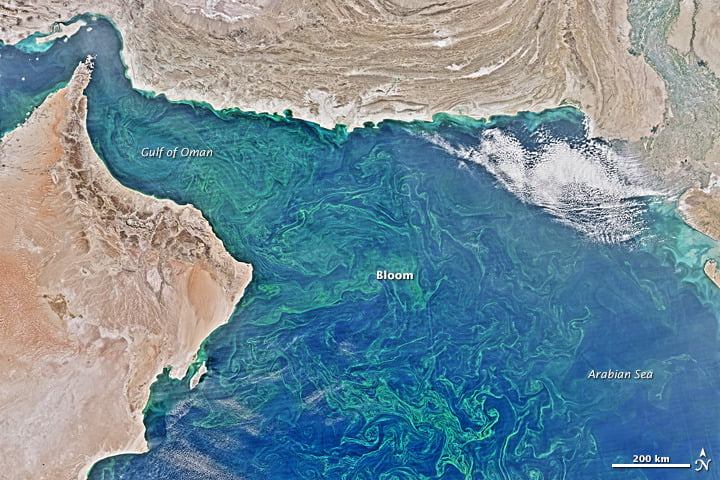
When the right nutrients come together in coastal waters, it can feed a phytoplankton bloom large enough to be visible to satellites. The phytoplankton themselves are microscopic organisms that are easily carried along by oceanic flows. In fluid dynamics terms, they are passive scalars or seed particles–additives that reveal the structure of the flow without altering it. Here the phytoplankton uncover the large-scale turbulent structure of flow in the Arabian Sea. Check the scale in the lower right. Many of the green eddies and swirls in this satellite image are hundreds of kilometers across. Yet, if we could zoom way in, we would still see turbulence acting on scales down to the millimeter length or below. This incredibly large range of length scales–eight or more orders of magnitude here–is a common characteristic of turbulence and part of what makes it such a challenge to understand or model. (Image credit: NASA Earth Observatory)