
For those of us who are Earthbound, it’s easy to think of liquids and gases as being the most common fluids. But plasma–the fourth state of matter–is a fluid as well. Plasmas are essentially ionized gases, which, thanks to their freely flowing electrons, are electrically conductive and sensitive to magnetic fields. Their motions are described by a combination of the Navier-Stokes equations–the usual equations of motion for a fluid–and Maxwell’s equations–the equations governing electricity and magnetism. Studies of plasma motion often fall under the subject of magnetohydrodynamics and can include topics like planetary auroras, sunspots, and solar flares. (Video credit: SciShow)
Tag: physics

Singing Toads
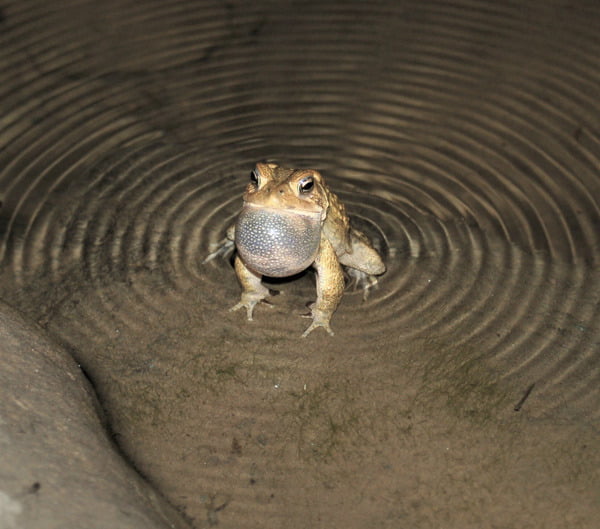
Many male frog and toad species sing during warmer months to attract mates. Some, like the American toad in the photo above, can be heard for an impressive distance. Here’s a video of an American toad in action. To sing, these amphibians close their mouth and nostrils, then force air from their lungs past their larynx and into a vocal sac. As with human sound-making, forcing air past the frog’s larynx vibrates its vocal cords and generates noise. That noise resonates in the vocal sac, amplifying the sound and driving the ripples seen in the photo. (Image credit: D. Kaneski; submitted by romannumeralfive)

Wingtip Vortices


Wingtip vortices are the result of high-pressure air from beneath a wing sneaking around the end of the wing to the low-pressure area on top. They trail for long distances behind aircraft, and are, most of the time, an invisible hazard for other aircraft. If you’ve ever sat in a line of airplanes waiting to take off and wondered why there is so much time between subsequent take-offs, wingtip vortices are the answer. The larger a plane, the stronger its vortices are and the greater their effect on a smaller craft. Much of the time between planes taking off (or landing) is to allow the vortices to dissipate so that subsequent aircraft don’t encounter the wake turbulence of their predecessor. Crossing the wake of another plane can cause an unexpected roll that pilots may not be able to safely correct, a factor that’s contributed to major crashes in the past. (Image credits: flugsnug, source video; submitted by entropy-perturbation)

Reader Question: Submarines

Reader elimik asks:
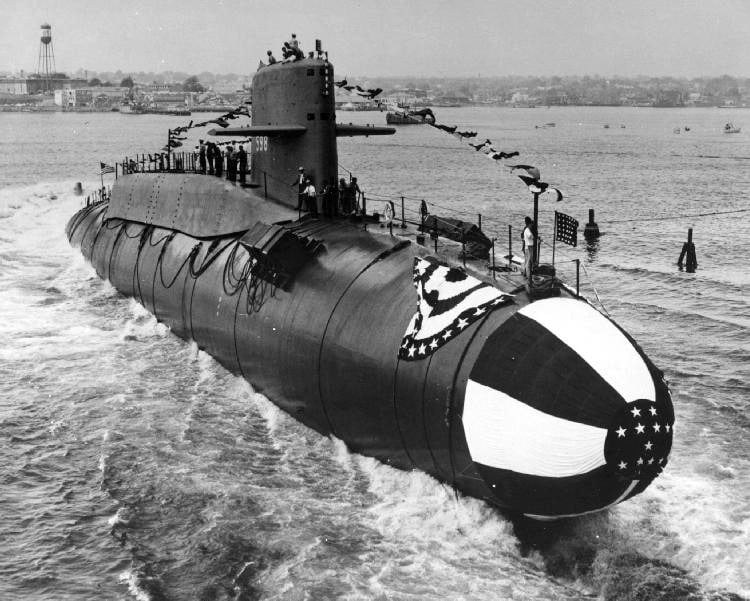
Why do modern submarines have round bows instead of pointy ones, like the early WWII ones?
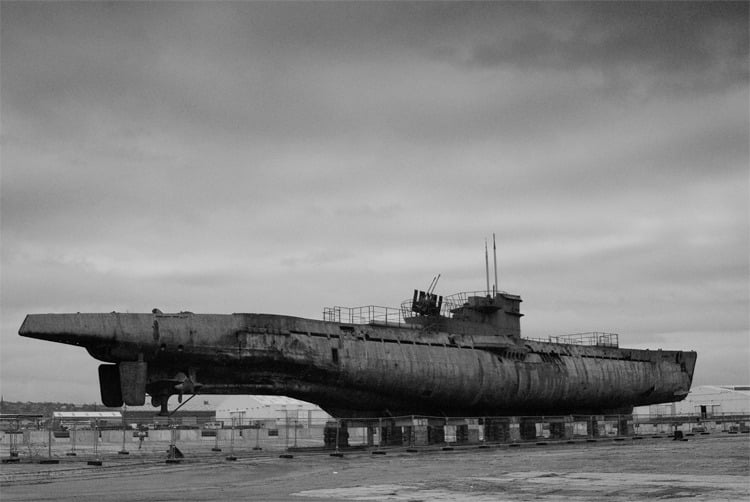
Interestingly, there are more factors that affect this design choice than I originally thought! Perhaps the biggest factor, though, is propulsion. Although early submarines ran through several forms of propulsion from human power to steam, by World War II many subs were driven by diesel-power on the surface and relied on battery power when submerged. Power limitations meant that submarines of that era did most of their travel while at the surface, not underwater. As a result, the ships had better control and decreased drag with a pointed bow similar to that of a surface ship. It wasn’t until the advent of the nuclear-powered submarine that it became practical for submarines to spend most of their time submerged. Once fully-underwater travel was feasible (and, indeed, preferable), many subs transitioned to a blunter, rounded bow that’s more hydrodynamic underwater–and simultaneously more problematic control-wise when moving on the surface.
Another factor separating WW-era submarines and modern subs is the depth to which they submerge. The deeper a submarine dives, the greater the pressure it must withstand. Rounded or cylindrical shapes make much better pressure vessels because they distribute pressure evenly around a surface. Historically, many subs have balanced control and hydrodynamics against pressure requirements by having two hulls, an outer one for cutting through surface waters and an inner cylindrical one that bears the brunt of the hydrostatic pressure. As we developed stronger materials, though, submarines have achieved greater depths. The German Type VII submarine, the most common U-boat of WWII, had a test depth of 230 m, whereas today’s Los-Angeles-class U.S. submarine can operate at 290 m. (Each 10 meters of depth adds about one atmosphere’s worth of pressure.) The combination of nuclear power for subsurface propulsion and stronger materials that allow deeper dives enables many modern submarines to have a single hull–the rounded hydrodynamic and pressure-resistant bow we commonly see. (Image credits: U534 by P. Adams and USS George Washington by U.S. Navy)

Underwater Currents
Like the atmosphere, the ocean is constantly in motion, churned by currents that often go unnoticed by humans watching the surface. Filmmaker Julie Gautier and free diver Guillaume Néry demonstrate the power and speed of some of these underwater currents in the film above. The footage was shot in Tiputa Pass, part of an atoll northeast of Tahiti. In it, Néry serves as a human-shaped seed particle in the flow, illustrating just how swift the current is. (Video credit: J. Gautier; via Colossal; submitted by jshoer)
The Earth in Infrared
The motions of Earth’s atmosphere are often invisible to the human eye, but fortunately, we’ve built tools to reveal them. This timelapse video shows the Earth in infrared light, first from a satellite view centered on the Pacific Ocean and second from a satellite centered on Central America. The water vapor in clouds is an excellent insulator, so clouds appear dark in this video. Warmer areas look brighter. The large-scale motion of the atmosphere and the wind bands that cut east and west across the world are apparent in the first half of the video, largely because they are not being interrupted by any land masses. In the second half of the video, the western coast of South America is intermittently visible. This is because the Andes Mountains disrupt air flow, pushing warm, moist air upward and causing it to condense into the dark-colored clouds that recirculate over the Amazon. Look further south along the coast and you’ll see the Atacama Desert flashing white each day as it heats up. (Video credit: J. Tyrwhitt-Drake/NASA; submitted by entropy-perturbation)

American Football Aerodynamics
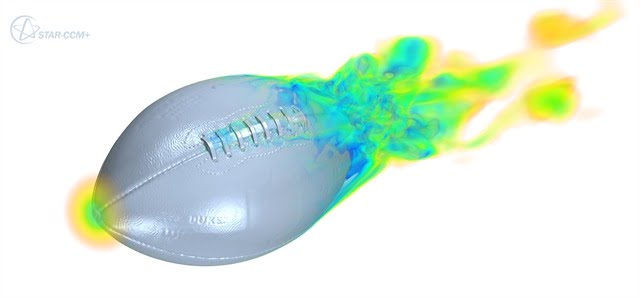
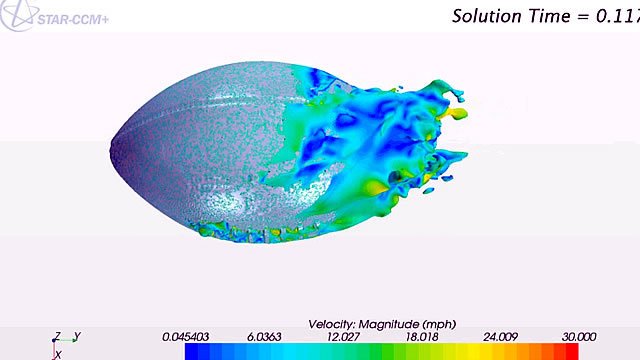

Like many sports balls, the American football’s shape and construction make a big difference in its aerodynamics. Unlike the international football (soccer ball), which undergoes significant redesigns every few years thanks to the World Cup, the American football has been largely unchanged for decades. The images above come from a computational fluid dynamics (CFD) simulation of a spiraling football in flight. Although the surface is lightly dimpled, the largest impact on aerodynamics comes from the laces and the air valve (just visible in the upper right image). Both of these features protrude into the flow and add energy and turbulence to the boundary layer. By doing so, they help keep flow attached along the football longer, which helps it fly farther and more predictably. For more, check out the video of the CFD simulation. (Image credits: CD-adapco; via engineering.com)
Inside a Can of Compressed Air
Many gases are stored in liquid form at high pressures. This video takes a look at tetrafluoroethane, better known as the substance in compressed air cans used for dusting electronics. At atmospheric pressure, tetrafluoroethane boils at about -26 degrees Celsius, but in an air duster, at around 7 atmospheres of pressure, it is a liquid. As demonstrated in the video, releasing the pressure causes the liquid to boil off. Even exposed to atmospheric pressure, though, the liquid doesn’t boil off instantly – the act of boiling requires thermal energy and, without a sufficient source of heat, the liquid consumes its own heat until it drops to a temperature below the boiling point. As it warms up from the surrounding air, it will start boiling again. I don’t recommend trying to open up an air duster can at home, though. High-pressure containers can be dangerous to open up, and tetrafluoroethane is now being phased out in some parts of the world due to its high global warming potential. (Video credit: N. Moore)

Below a Surfer’s Wave
From below a plunging breaking wave–the classic surfer’s wave–looks like a giant vortex tube. Smaller rib vortices, the rings around the main vortex in the photo above, can form where there are variations along the breaking wave. As the wave rolls on, it stretches the vorticity variations along the wave’s span. When stretched, vortices spin up and intensify; this is a result of conservation of angular momentum. Check out more amazing photos of waves in Ray Collins’ portfolio. (Photo credit: R. Collins; via The Inertia)

Melt Fracture in Plastics
Liquid plastics are often extruded–or pressure-driven through a die–during manufacturing. Early on manufacturers discovered that they could only extrude plastic at low flow rates, otherwise the plastic’s surface begins undulating in what became known as melt fracture. These corrugations result from the viscoelasticity of the plastic. Viscoelastic fluids have a response to deformation that is part viscous–like any fluid–and part elastic. At low flow rates, viscous forces dominate in the plastic, but at higher speeds, elasticity increases and the polymers in the plastic get stretched along the direction of flow. In response to this stretching, the polymers exert normal stresses, much like a rubber band that’s being stretched. Because this force acts only along the flow direction, different parts of the fluid are experiencing different forces, and these internal stresses cause the plastic to change shape. (Image credit: D. Bonn et al.)


#mediaviewer/File:USS_George_Washington_(SSBN_589).jpg)