
This numerical simulation shows unsteady supersonic flow (Mach 2) around a circular cylinder. On the right are contours of density, and on the left is entropy viscosity, used for stability in the computations. After the flow starts, the bow shock in front of the cylinder and its reflections off the walls and the shock waves in the cylinder’s wake relax into a steady-state condition. About halfway through the video, you will notice the von Karman vortex street of alternating vortices shed from the cylinder, much like one sees at low speeds. The simulation is inviscid to simplify the equations, which are solved using tools from the FEniCS project. (Video credit: M. Nazarov)
Tag: numerical simulation

Atomizing Jets
The breakup of impinging jets into droplets (also called atomization) and the subsequent dynamics of those droplets are important in applications like jet and rocket engines where the mixing of liquid fuel with oxygen is necessary for efficient combustion. This video showcases recent efforts in high fidelity numerical simulation and modeling of such flows. The complexity of the problem requires clever ways of reducing the computational efforts required. One such method uses adaptotive meshing to concentrate grid points in areas where variables are changing quickly while leaving the grid sparse in areas of less interest. Because the flow is constantly evolving, the mesh must be able to adapt as the simulation steps forward in time. Even so, such calculations typically require supercomputers to complete. (Video credit: X. Chen et al)

Jump Rope Aerodynamics
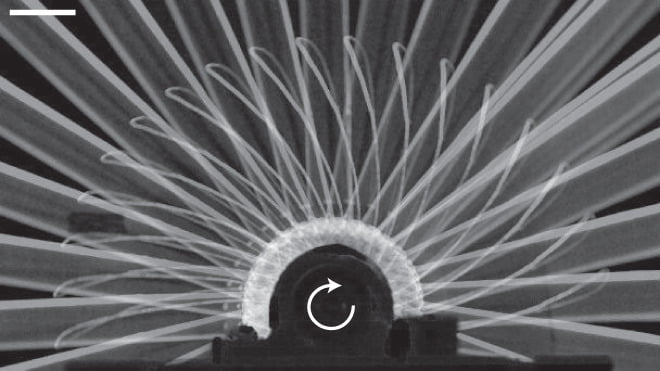
Researchers have used high-speed video and numerical simulation to capture the effects of aerodynamics on jump roping. After videoing an athlete jumping rope and constructing a jump roping robot (shown above imaged multiple times with a strobe light), they found that the U-shaped tip of the jump rope bends away from the direction of motion. When they built a computer model capable of deforming the jump rope based on its drag, they found the same behavior. They concluded that the “best” jump ropes are lightweight, short, and have small diameters to maximize speed and minimize the drag. #
Vortex Street Sim
This numerical simulation shows a von Karman vortex street in the wake of a bluff body. As flow moves over the object, vortices are periodically shed off the object’s upper and lower surfaces at a steady frequency related to the velocity of the flow. The simulation takes place in a channel; note how the thickness of the boundary layers on the walls increases with downstream distance, forcing a slight constriction on the vortex street in the freestream.
2D Convection
This simulation shows 2D Rayleigh-Benard convection in which a fluid of uniform initial temperature is heated from below and cooled from above. This is roughly analogous to the situation of placing a pot of water on a hot stovetop. (In the case of the water on the stove, the upper boundary is the water-air interface, while, in the simulation, the upper boundary is modeled as a no-slip (i.e. solid) interface.) The simulation shows contours of temperature (black = cool, white = hot). In general, the hot fluid rises and the cold fluid sinks due to differences in density, but, as the simulation shows, the actual mixing that occurs is far more complex than that simple axiom indicates.

Underwater Cloaking
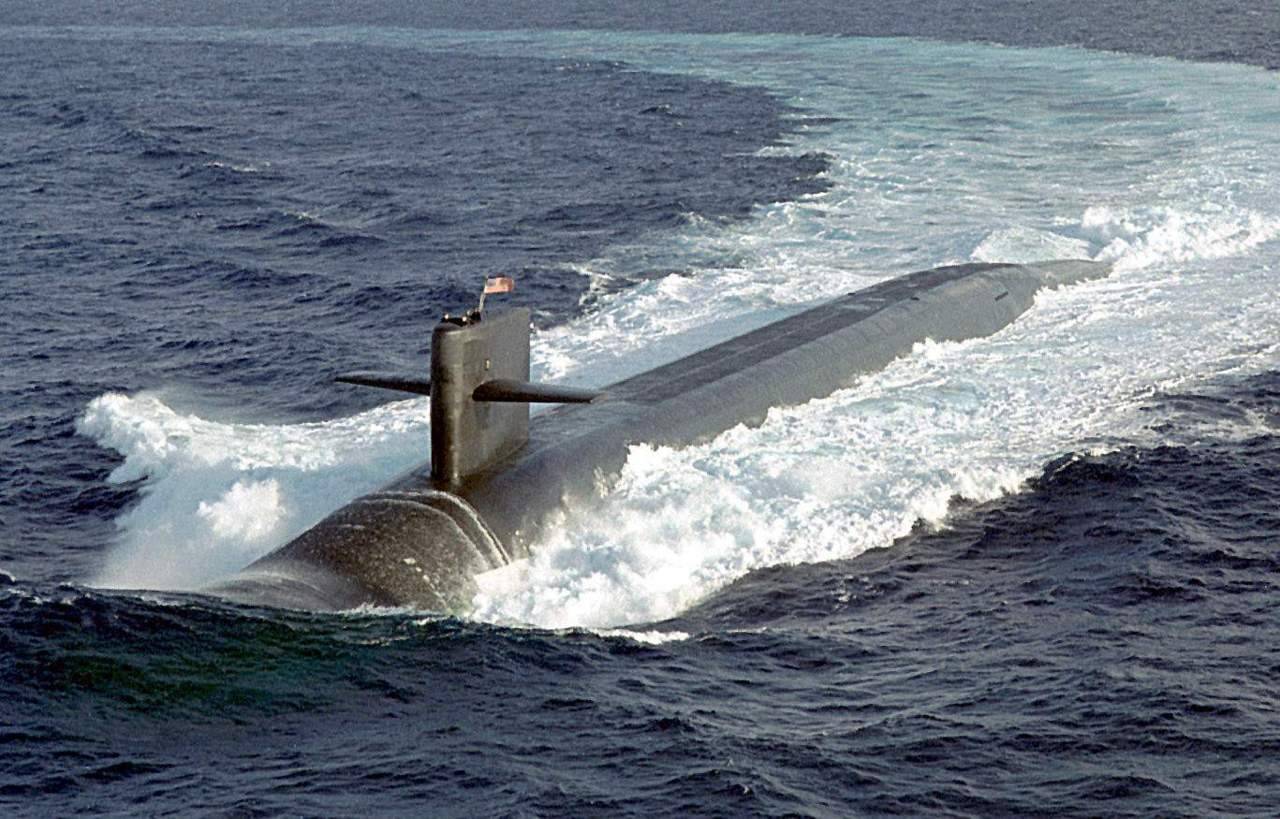
Researchers have suggested that it may be possible to cloak submerged objects as they move through a fluid using layers of mesh and micro-pumps. By redirecting the fluid so that it enters and leaves the mesh surrounding the object in the same speed and direction that it entered, it is theoretically possible to have zero drag and no wake. So far researchers have only simulated this set-up computationally using a sphere with 10 layers of mesh. It’s also unfortunately limited in size and speed: a vehicle 1 cm across could only remain wake-free at speeds below 1 cm/s. (Photo credit: Michael J Rinaldi) #
Computational Shock Compression
[original media no longer available]
Computational modeling can help verify and visualize experimental results, as in this video of supersonic flow. Oak Ridge National Laboratory produced the work as part of a project using shock compression and turbines to capture carbon dioxide gas. Shock waves and velocity profiles are shown throughout the computational field, and velocity isosurfaces paint a telling portrait of the complicated flow pattern. Wired Science features other award-winning simulation videos, many of which also feature fluid dynamics. #
Starting Vortices
Whenever a wing stops or starts in a fluid, it produces a vortex. This 2D numerical simulation shows an airfoil repeatedly starting and stopping, shedding a vortex each time. Note how the line of vortices drifts downward in the wake; this is an indication of downwash. (submitted by jessecaps)
High-Res Rayleigh-Taylor Instability
When a heavy fluid sits atop a lighter fluid, the interface between the two breaks down through the Rayleigh-Taylor instability. This computation of a 2D interface shows the near fractal behavior of this instability as whorls and eddies of all different scales form and mix the fluids. (submitted by @markjstock)
Vortex Shedding from a Hot Cylinder
This numerical simulation shows vortex shedding behind a hot cylinder. The behavior is very similar to what one sees behind an unheated cylinder, until the coefficient of thermal expansion increases and the von Karman vortex street is completely distorted. Describing the particulars of the computation, jessecaps writes (links added):
I wrote an incompressible flow solver to simulate flow past a heated cylinder. The Navier-Stokes equations are discretized on a Cartesian grid and solved explicitly in time. The pressure-Poisson equation is solved implicitly using a bi-conjugate gradient method. The Boussinesq approximation was used (density is constant everywhere except for the gravity term) to account for buoyancy. Reynolds number = 250, Froude number = 1 (gravity is pointing down). The two simulations show the effect of the coefficient of thermal expansion. Each video shows a plot of velocity and temperature.
(submitted by jessecaps)
.jpg)