
This numerical simulation gives a glimpse of flow inside an unsteady rocket nozzle. The nozzle is over-expanded, meaning that the exhaust’s pressure is lower than that of the ambient atmosphere. A slightly over-expanded nozzle causes little more than a decrease in efficiency, but if the nozzle is grossly over-expanded, the boundary layer along the nozzle wall can separate and induce major instabilities, as seen here. In the first segment of the video, turbulent structures along the nozzle wall boundary layer are shown; note how the boundary layer becomes very thick and turbulent after the primary shock wave (shown in gray). This is due to the flow separating near the wall. The second half of the video shows the unsteadiness this can create. The primary shock wave splits into two near the wall, creating a lambda shock wave, named for the shape of the lower case Greek letter. This shock structure is indicative of strong interaction between the boundary layer and shock wave. (Video credit: B. Olson and S. Lele)
Tag: numerical simulation

The Sinking of the Lusitania
In 1915, the early days of submarine warfare, the RMS Lusitania was sunk off the coast of Ireland by a torpedo. Eyewitnesses reported a second, more powerful explosion just after the torpedo strike–possibly a boiler or powder explosion–that contributed to the ship sinking in only 18 minutes, resulting in nearly 1200 lives lost. Researchers at Lawrence Livermore National Laboratory have tackled the historic mystery, combining computational efforts with experimentation and historical research to reconstruct the physics of what happened. The full documentary airs tonight on the National Geographic Channel as “Dark Secrets of the Lusitania”. (submitted by Stephanie N)
Fractal Fluids
Part of the beauty of numerical simulation is its ability to explore the physics of a situation that would difficult or impossible to create experimentally. Here the Rayleigh-Taylor instability–which occurs when a heavier fluid sits atop a lighter fluid–is simulated in two-dimensions. Viscosity and diffusion are set extremely low in the simulation; this is why we see intricate fractal-like structures at many scales rather than the simulation quickly fading into gray. (The low diffusion is also what causes the numerical instabilities in the last couple seconds of video.) The final result is both physics and art. (Video credit: Mark Stock)

Martian Landing Physics

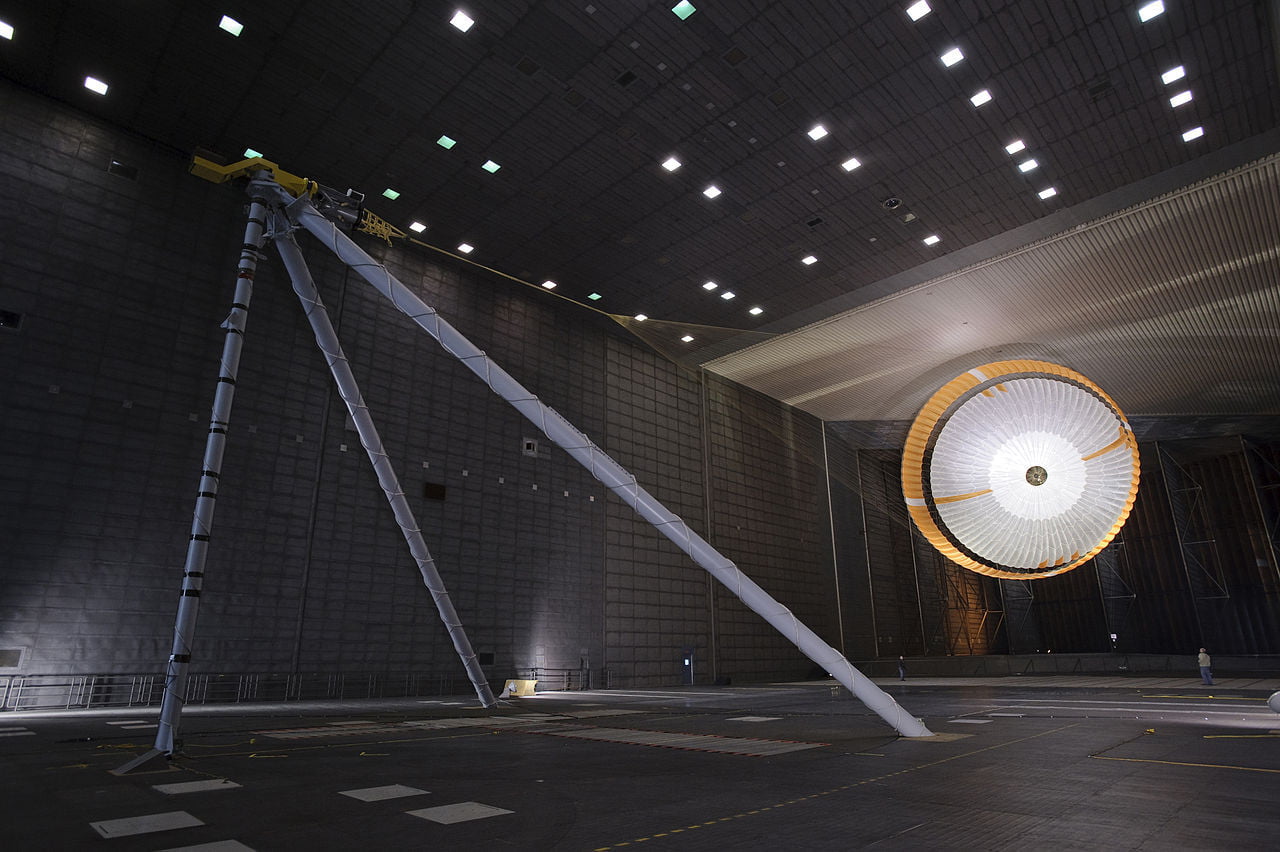
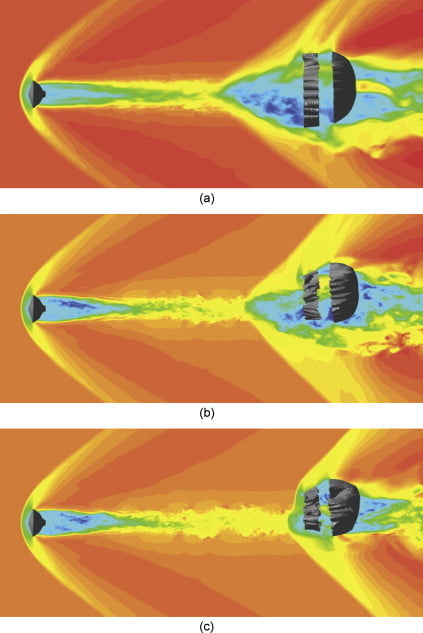
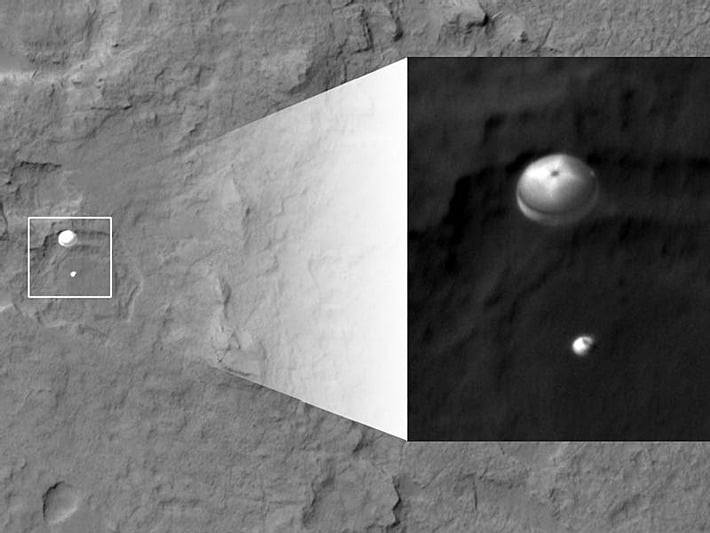
A little over a week ago, NASA’s Curiosity rover landed on Mars, the culmination of years of engineering. The mission’s landing, in particular, was the subject of intense scrutiny as Curiosity’s size necessitated some new techniques in the final segments of the landing sequence. As it hit the Martian atmosphere at 13,000 mph, the compression of the carbon dioxide behind the capsule’s shock wave slowed the descent. At roughly 1,000 mph–speeds still large enough to be supersonic–Curiosity deployed its parachute. Shown above are the parachute in numerical simulation (from Karagiozis et al. 2011), wind tunnel testing at NASA Ames, and during descent thanks to the Mars Reconnaissance Orbiter. The simulation shows contours of streamwise velocity at different configurations; note the bow shock off the capsule and the additional shocks off the parachute. These help generate the drag needed to slow the capsule. For an interesting behind-the-scenes look at the wind tunnel testing for Curiosity’s parachute check out JPL’s four–part video series. Congratulations to all the scientists and engineers who’ve made the rover a success. We look forward to your discoveries! (Photo credits: K. Karagiozis et al., NASA JPL, NASA MRO)
The Olympic Torch
[original media no longer available]
Today marks the beginning of the 2012 Olympic Games in London. In the opening ceremony, the Olympic flame will complete its journey from Olympia to London, having been carried by some 8,000 torch bearers. Modern Olympic torches are expected to withstand wind, rain, snow, and human error to keep the flame alive and are specially designed and tested for these conditions. Each individual torch is fueled by a mixture of propane and butane stored as a pressurized liquid. The liquid fuel travels through a series of evaporation coils around the burner before combustion. Each torch carries sufficient fuel to burn about fourteen minutes. In addition to computer simulation, the 2012 Olympic torch design was tested in BMW’s Environmental Wind Tunnel to ensure a visible, stable flame for orientations within 45 degrees of vertical in conditions ranging from -5 degrees to 40 degrees Celsius, rain, snow, 35 mph winds, and 50 mph wind gusts. For more on the current torch and previous designs, see How Stuff Works, E&T, and the BBC.
FYFD is celebrating the Olympics by featuring the role of fluid dynamics in sports starting Monday. If you have any burning questions, feel free to ask or email!
Sea Surface Temperatures
This video shows sea surface temperature results and their seasonal variation from a numerical simulation modeling circulation in the atmosphere and oceans. Modeling such enormous problems requires the development of reasonable models of the turbulent physics, clever algorithms to quickly progress the solutions, relatively low-fidelity (a single grid node may cover tens of kilometers), and enormous computing power. (Video credit: NOAA; via Gizmodo)

Fractal Fluids
These images from a numerical simulation of a mixing layer between fluids of different density show the development and breakdown to Kelvin-Helmholtz waves. The black fluid is 3 times denser than the white fluid, and, as the two layers shear past one another, billow-like waves form (Fig 1(a)). Inside those billows, secondary and even tertiary billows form (Fig 1(a) and (b)). Fig 1 (c)-(e) show successive closeups on these waves, showing their beautiful fractal-like structure. (Photo credit: J. Fontane et al, 2008 Gallery of Fluid Motion) #
Salinity Near the Amazon
This numerical simulation shows the variation of salinity in the Atlantic Ocean near the mouth of the Amazon River over the course of 36 months. The turbulent mixing of the fresh river water and salty ocean shifts with the ebb and flooding of the river. Salt content causes variations in ocean water density, which can strongly affect mixing and transport properties between different depths in the ocean due to buoyancy. Understanding this kind of flow helps predict climate forecasts, rain predictions, ice melting and much more. (Video credit: Mercator Ocean)
Visualizing Ocean Currents
Researchers used computational models of ocean currents to produce this video visualizing worldwide ocean surface currents from June 2005 through December 2007. Dark patterns under the ocean are representative of ocean depths and have been exaggerated to 40x; land topography is exaggerated to 20x. Notice the wide variety of behaviors exhibited in the simulation: some regions experience strong recirculation and eddy production, while others remain relatively calm and unmoving. Occasionally strong currents sweep long lines across the open waters, carrying with them warmth and nutrients that encourage phytoplankton blooms and other forms of ocean life. (Video credit: NASA; submitted by Jason S)
Mackerel vs. Eel: Who Swam It Better?
Which matters more, form or function? This simulation sets out to answer that question by comparing the swimming motion of eels and mackerels. Eels have longer, more rounded body shapes and swim in an undulatory fashion with their whole body, whereas mackerels have shorter bodies with a more elliptical cross-section and primarily move their tails when swimming. The simulation separates body type from swimming motion by creating virtual races between fishes of the same body type using the two forms of swimming. Eels swim at moderate Reynolds numbers where viscous and inertial effects are reasonably balanced. Under those conditions, eel-like swimming was faster, even with a mackerel’s body type. At the higher Reynolds numbers where mackerels usually swim, inertial forces domination and the racing fish moved faster if they swam like a mackerel, even with the body of an eel. The results suggest that the swimming motion matters more in each Reynolds number range than the shape of the swimmer. This is a neat way that simulation can answer questions we cannot test with an experiment! (Video credit: I. Borazjani and F. Sotiropoulos)
