These golden lines reveal the complexity of turbulent convective flow. They come from a numerical simulation of turbulent Rayleigh-Benard convection, a situation in which fluid trapped between two plates is heated from below and cooled from above. This situation would typically create convection cells similar to those seen in clouds or when cooking. Inside these cells, warm fluid rises to the top, cools, and sinks down along the sides. With large enough temperature differences, instabilities will occur and cause the flow to become turbulent so that the clear structure of convection cells breaks down into something more chaotic. Such is the case in this simulation. This visualization shows skin friction on the bottom (heated) plate in a flow of turbulently convecting liquid mercury. The bright lines are areas with large velocity changes at the wall, an indication of high shear stress and vigorous convective flow. (Image credit: J. Scheel et al.; via Gizmodo)
Tag: numerical simulation

Numerical Rayleigh-Taylor
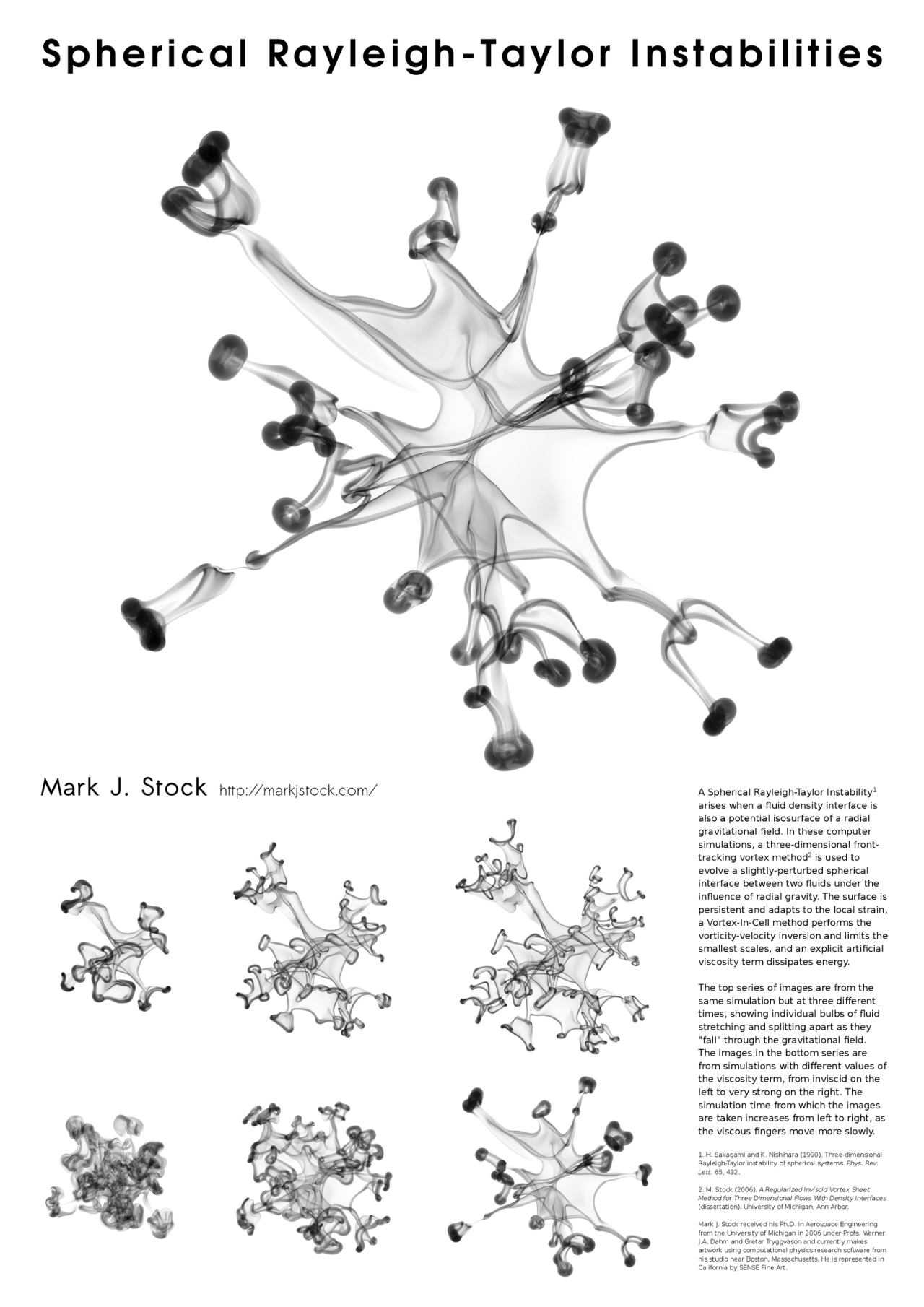
If you’ve ever dripped food coloring or ink into a glass of water, you’ve probably created a cascade of tiny vortex rings similar to the images above. This is the Rayleigh-Taylor instability, in which the heavier ink/food coloring falls under gravity into the less dense water. What’s shown above is a special case–one that no experiment can recreate. It’s a numerical simulation of a spherical Rayleigh-Taylor instability. Imagine a sphere of a dense fluid “falling” outward under the influence of a radial gravitational field. This is one of the interesting aspects of computational fluid dynamics–it can simulate situations that are impossible to create experimentally. That can be both a strength and a weakness, allowing researchers to probe otherwise unavailable physics or fooling the unwary into thinking they have captured something real. (Image credit: M. Stock)

The Kelvin-Helmholtz Instability
The Kelvin-Helmholtz instability is a pattern frequently found in nature. It has a distinctive shape, like a series of breaking ocean waves that curl over on themselves to create a string of vortices. The instability shows up when there is a velocity difference between two fluid layers. The unequal shear between the two layers magnifies any disturbance to their interface, which manifests in the fractal, overturning whorls seen in the numerical simulation above. You can find the Kelvin-Helmholtz instability in the lab, in the sky, in the ocean, on Jupiter and Mars–even on the sun! For more information on the methods used to create the simulation above, check out the full paper. (Video and research credit: K. Schaal et al.)

Cars Helping Cyclists

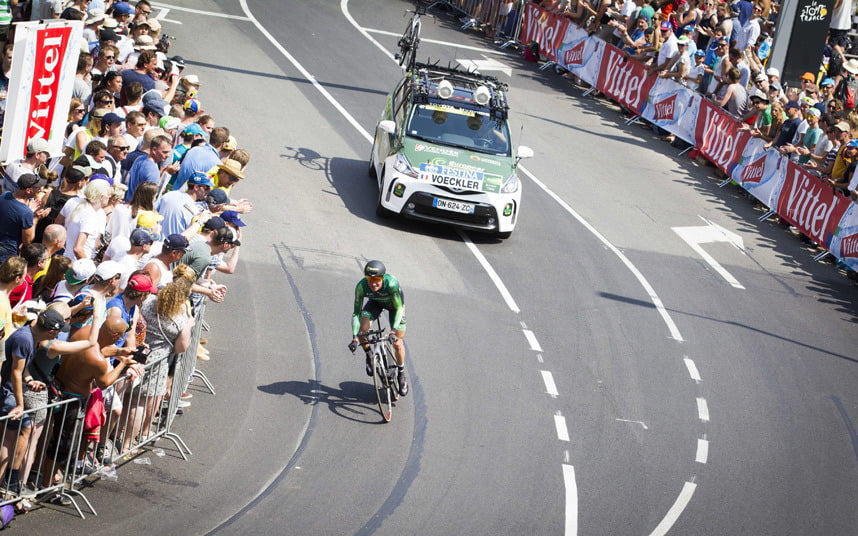
This year’s Tour de France opened with an individual time trial stage in which riders competed solo against the clock. But, according to numerical simulations, some riders may get an unfair aerodynamic advantage in the race if they have a following car. The top image shows the pressure fields around a rider with a car following 5 meters behind versus 10 meters behind. The size of the car means that it displaces air well in advance of its arrival. By following a rider closely, that car’s high pressure region can help fill in a cyclist’s wake, thereby reducing the drag the rider experiences. For a short time trial like the 13.8 km race that kicked off this year’s tour, a rider whose car follows at 5 meter could save 6 seconds over one whose car followed at the regulation 10 meter distance. (As it happens, the stage was decided by a 5 second margin.) Since not all riders get a team follow car, it’s especially important to ensure that those who do aren’t receiving an additional advantage. For more about cycling aerodynamics, check out our previous cycling posts and Tour de France series. (Image credit: TU Eindhoven, EPA/J. Jumelet; via phys.org; submitted by @NathanMechEng)
Inside the Strait of Gibraltar
When a fluid is stratified into layers, it’s possible to have waves generated and transmitted along the interface between layers. Because these waves remain inside the bulk fluid, they are called internal waves. They often occur in the atmosphere or the ocean as fluids with different properties move past changing terrain. The Strait of Gibraltar is an excellent source of internal waves. The tidal exchange of waters between the Mediterranean Sea and Atlantic Ocean takes place through a narrow corridor interrupted by the peak of Camarinal Sill. The internal waves generated by the constriction are large enough that their effect on the surface flow is visible to satellites. The video above visualizations data from a numerical simulation of flow through the Strait, showing the obstacles, flow, and wave structures generated. (Video credit: J.C. Sanchez Garrido et al.)

Supernova Simulation
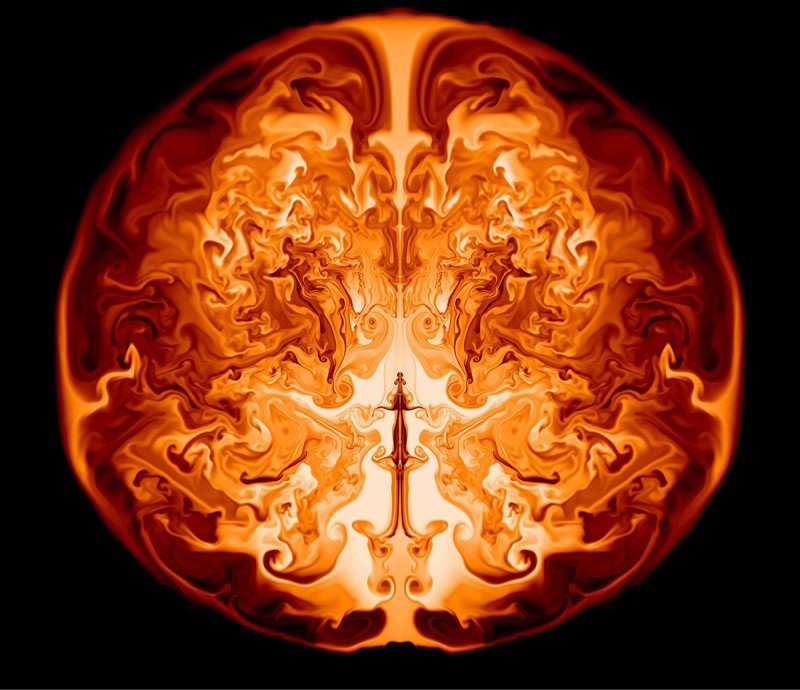
New research shows that supermassive first-generation stars may explode in supernovae without leaving behind remnants like black holes. The work is a result of modeling the life and death of stars 55,000 to 56,000 times more massive than our sun. When such stars reach the end of their lives, they become unstable due to relativistic effects and begin to collapse inward. The collapse reinvigorates fusion inside the star and it begins to rapidly fuse heavier elements like oxygen, magnesium, or even iron from the helium in its core. Eventually, the energy released overcomes the binding energy of the star and it explodes outward as a supernova. The image above is a slice through such a star approximately one day after its collapse is reversed. Hydrodynamic instabilities like the Rayleigh-Taylor instability produce mixing of the heavy elements throughout the expanding interior of the star. The mixing should produce a signature that can be observed in the aftermath as these stars seed their galaxies with the heavy elements needed to form planets. For more, see Science Daily and Chen et al. (Image credit: K. Chen et al., via Science Daily; submitted by mechanicoolest)
City Winds Simulated
Anyone who has spent much time in an urban environment is familiar with the gusty turbulence that can be generated by steady winds interacting with tall buildings. To the atmospheric boundary layer–the first few hundred meters of atmosphere just above the ground–cities, forests, and other terrain changes act like sudden patches of roughness that disturb the flow and generate turbulence. The video above shows a numerical simulation of flow over an urban environment. The incoming flow off the ocean is relatively calm due to the smoothness of the water. But the roughness of an artificial island just off the coast acts like a trip, creating a new and more turbulent boundary layer within the atmospheric boundary layer. It’s this growing internal boundary layer whose turbulence we see visualized in greens and reds. (Video credit: H. Knoop et al.)

Supernova Explosion
Type 1a supernovae occur in binary star systems where a dense white dwarf star accretes matter from its companion star. As the dwarf star gains mass, it approaches the limit where electron degeneracy pressure can no longer oppose the gravitational force of its mass. Carbon fusion in the white dwarf ignites a flame front, creating isolated bubbles of burning fluid inside the star. As these bubbles burn, they rise due to buoyancy and are sheared and deformed by the neighboring matter. The animation above is a visualization of temperature from a simulation of one of these burning buoyant bubbles. After the initial ignition, instabilities form rapidly on the expanding flame front and it quickly becomes turbulent. (Image credit: A. Aspden and J. Bell; GIF credit: fruitsoftheweb, source video; via freshphotons)

Hummingbird Hovering
The hummingbird has long been admired for its ability to hover in flight. The key to this behavior is the bird’s capability to produce lift on both its downstroke and its upstroke. The animation above shows a simulation of hovering hummingbird. The kinematics of the bird’s flapping–the figure-8 motion and the twist of the wings through each cycle–are based on high-speed video of actual hummingbirds. These data were then used to construct a digital model of a hummingbird, about which scientists simulated airflow. About 70% of the lift each cycle is generated by the downstroke, much of it coming from the leading-edge vortex that develops on the wing. The remainder of the lift is creating during the upstroke as the bird pulls its wings back. During this part of the cycle, the flexible hummingbird twists its wings to a very high angle of attack, which is necessary to generate and maintain a leading-edge vortex on the upstroke. The full-scale animation is here. (Image credit: J. Song et al.; via Wired; submitted by averagegrdy)
The Upside-Down Jellyfish
The upside-down jellyfish, Cassiopea, rests its bell against the ocean floor and points its frilly oral arms up toward the sun for the benefit of the symbiotic algae living on it. In return, the algae provide some of the nutrients the jellyfish needs. The rest it obtains by filter feeding for zooplankton. The video above shows how a combination of flow visualization and simplified computational modeling can reveal the jellyfish’s methods for eating. A simple pulsing bell has limited fluid flow in the region of the jellyfish’s mouths, but the addition of a permeable layer (representative of the oral arms) significantly enhances mixing. (Video credit: T. Rodriguez et al.)