Tag: non-Newtonian fluids

  • Featured Video Play Icon

    Non-Newtonian Splashes

    What happens when a stream of liquid falls through a screen? As the above video shows, water creates a beautiful flower-like burst of fluid when it hits a screen. Adding a little polymer to the water makes it non-Newtonian and more viscous. When hitting the screen, this slows it down but doesn’t prevent the fluid from flowing.

    Add enough polymer, though, and the fluid becomes what’s known as a yield-stress fluid. These fluids behave much like a solid–they don’t flow–until you apply a certain amount of stress. Then they’ll flow. If you’ve ever tried to get ketchup out of a glass bottle, then you’re familiar with how these yield-stress fluids act. When dropped onto a screen, the yield-stress fluid just forms a pile–unless the impact speed is high enough to create the necessary force to get the fluid to flow! (Video credit: B. Blackwell et al.)

  • Featured Video Play Icon

    Crushing Oobleck

    Oobleck is probably the Internet’s favorite non-Newtonian fluid. People vibrate it, run across it, shoot it, drop it, and even use it to fix potholes. But how does oobleck hold up to a hydraulic press? Fortunately, that’s been covered, too. Oobleck is a mixture of cornstarch and water, and it’s a bit unusual in that it is a shear-thickening material. That means that the faster you try to deform it, the more it will resist that deformation. Knowing this makes the above video’s results make more sense. When they try to crush the balloon full of oobleck, the deformation happens pretty slowly, so the fluid just flows away.

    The same thing happens initially with the pot full of oobleck; it overflows much like any other liquid. But as the press pushes deeper, the oobleck gets confined by the pot’s walls and things change. Research has shown that the shear-thickening of oobleck comes from cornstarch particles jamming up in the fluid. By confining the oobleck, the pot and hydraulic press magnify this jamming effect, causing a spurt of semi-solid cornstarch fingers and leaving the press tool thoroughly trapped by the jammed particles. (Video credit: Hydraulic Press Channel)

  • Climbing Up the Walls

    Climbing Up the Walls

    You may have noticed when baking that fluids don’t always behave as expected when you agitate them. If you put a spinning rod into a fluid, we’d expect the rod to fling fluid away, creating a little vortex that stirs everything around. And for a typical (Newtonian) fluid, this is what we see. The fluid’s viscosity tries to resist deforming the fluid, but the momentum imparted by the rod wins out. With a viscoelastic fluid, on the other hand, the story is much different. As before, the spinning of the rod deforms the fluid. But the viscoelastic fluid contains long chains of polymers. As those polymers get stretched by the deformation, they generate their own forces, including forces parallel to the rod. Instead of being flung outward, the viscoelastic fluid starts climbing up the rod, with the stretchy elasticity of the polymers helping pull more fluid up and up.  (Image credit: Ewoldt Research Group, source)

  • Striking Oobleck

    Striking Oobleck

    Mixing cornstarch and water creates a fluid called oobleck that has some pretty bizarre properties. Oobleck is a shear-thickening, non-Newtonian fluid, which means its viscosity increases when you try to deform it with a shearing, or sliding, force. But as the Backyard Scientist demonstrates above, striking oobleck with a solid object produces some spectacular and very non-fluid-like results. The golf ball’s impact blows the oobleck into pieces that look more like solid chunks than liquid droplets. This solid-like behavior occurs because the impact jams the suspended cornstarch particles together, creating a solidification front that travels ahead of the golf ball. Imagine how a snow plow pushes a denser region of snow ahead of it as it drives; the cornstarch behaves similarly but only in a region near the impact. Once that impact force dissipates, the particles unjam and the mixture responds fluidly again. (Image credit: The Backyard Scientist, source; research credit: S. Waitukaitis and H. Jaeger, pdf)

  • Rotating Jet

    Rotating Jet

    This photo, one of the winners of the Engineering and Physical Sciences Research Council’s (EPSRC) annual photography contest, shows a rotating viscoelastic jet. Rotating liquid jets are common to many manufacturing processes, and their sometimes-wild appearance comes from a balance of gravitational forces and centrifugal force against surface tension. But because this fluid contains a small amount of polymer additive, surface tension has the additional aid of some elasticity to help hold the jet together and keep the globules and ligaments you see from flying off. As centrifugal forces fling the fluid outward, it stretches the polymer chains within the fluid, and they pull back against that tension like a stretched rubber band. To see some of the other contest winners–including other fluids entries!–check out the Guardian’s run-down. (Image credit and submission: O. Matar et al., ICL press release)

  • Featured Video Play Icon

    Watching a Sneeze

    What does a sneeze look like? You might imagine it as a violent burst of air and a cloud of tiny droplets. But this high-speed video shows, that’s only part of the story. The liquid leaving a sneezer’s mouth and nose is a mixture of saliva and mucus, and in the few hundred milliseconds it takes to expel this air/mucosaliva mixture, there’s not enough time for the liquid to break into droplets. Instead, liquid leaves the mouth as a fluid sheet that breaks into long ligaments.

    Because mucosaliva is viscoelastic and non-Newtonian, it does not break down into droplets as quickly as water. Instead, when stretched, the proteins inside the fluid tend to pull back, causing large droplets to form with skinny strands between them – the beads-on-a-string instability. The end result when the ligaments do finally break is more large droplets than one would expect from a fluid like water. Understanding this break-up process and the final distribution of droplet sizes is vital for better understanding the spread of diseases and pathogens.  (Video credit: Bourouiba Research Group; research paper: B. Scharfman et al., PDF)

  • Featured Video Play Icon

    Fluids Round-up

    Here’s to another fluids round-up, our look at some of the interesting fluids-related stories around the web:

    – Above is a music video by Roman Hill that relies on mixing and merging different fluids and perturbing ferrofluids for its visuals as it re-imagines the genesis of life.

    – GoPro takes viewers inside a Category 5 typhoon with 112 mph (180 kph; 50 m/s) winds.

    – Astronaut Scott Kelly demonstrates playing ping pong with a ball of water in space. (via Gizmodo)

    – See fluid dynamics on a global scale with Glittering Blue. (via The Atlantic)

    – To make a taller siphon, you have to find a way to avoid cavitation.

    – Speaking of siphons, Randall Munroe tackles the question of siphoning water from Europa over at What If? (submitted by jshoer)

    – The Mythbusters make a giant tanker implode using air pressure.

    – Sixty Symbols explores how tiny things swim.

    – What happens when you bathe in 500 pounds of putty? Let’s just say that bathing in an extremely viscous non-Newtonian fluid is not recommended. (via Gizmodo)

    (Video credit and submission: R. Hill et al.)

    Don’t forget to check out our Patreon page. Please help support FYFD by becoming a patron. 

  • Paint Flying

    Paint Flying

    Paint getting flung from a spinning drill bit can create some incredible art. Here the Slow Mo Guys recreate the effect in high-speed video. What we’re seeing is tug of war between centrifugal force, which tries to fling the paint outward, and internal forces in the paint, which struggle to hold the the fluid together. Primarily, it’s surface tension keeping the fluid together, but, depending on what sort of non-Newtonian fluid the paint may be, there could be other internal forces helping keep the paint intact. In this case, centrifugal force is clearly winning out, though the paint stretches pretty far before it thins enough to break. It would be interesting to see how the balance plays out with the drill bit spinning at a lower RPM. (Image credit: Slow Mo Guys, source)

  • Chocolate Fountain

    Chocolate Fountain

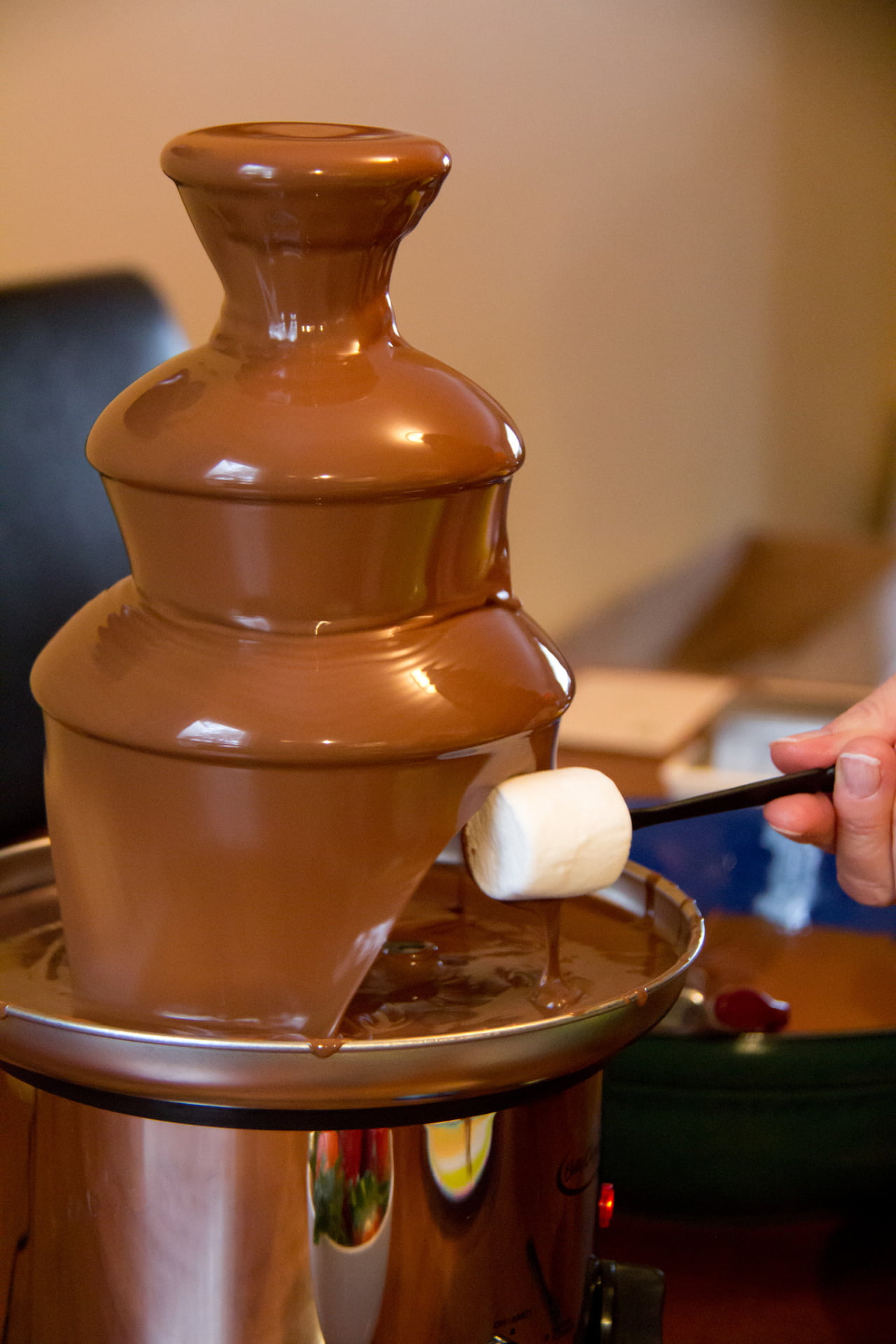
    Amidst your holiday celebrations, you may have encountered a chocolate fountain. In a recent paper, applied mathematicians have laid out the physics behind these delicious decorations, and it turns out they are an excellent introduction to many fluids concepts. Molten chocolate is a mildly shear-thinning, non-Newtonian fluid, meaning that it becomes less viscous when deformed. This adds a wrinkle to the mathematics describing the flow, but only a little one. The researchers divide the flow into three regimes: pipe flow driving the chocolate up the inside of the fountain, thin-film flow over the fountain’s domes, and, finally, the curtain of falling chocolate where foodstuffs are dipped. The final regime is the most mathematically challenging and may be the most fascinating. The authors found that the free-falling curtain of liquid pulls inward as it falls due to surface tension. Their paper is quite approachable, and I recommend those of you with mathematical inclinations check it out.  (Image credit: P. Gorbould; research credit: A. Townsend and H. Wilson)

  • Featured Video Play Icon

    Extinguishing Flames

    Putting out fires can be a difficult, water-intensive task. In this video, scientists demonstrate how using a non-Newtonian fluid can make it easier to extinguish and suppress flames. Where water tends to splatter and scatter against an object, a yield-stress fluid can cling and coat to smother the flame. The fluid used here is water with a 0.1% polymer additive, which is enough to significantly change the fluid’s rheological properties. Pre-treating flammable objects with the fluid is also effective at suppressing combustion, raising additional possibilities for using such techniques in fighting the spread of wildfires. (Video credit: B. Blackwell et al.)