Hydrophobic surfaces are great for creating some wild behaviors with water droplets, but they make neat effects with other liquids, too. The viscous honey in the first segment of this Chemical Bouillon video is a great example. Because the honey doesn’t adhere to the hydrophobic surface, the viscoelastic fluid does not maintain the form it had when drizzled on the surface. Instead, the honey contracts, with surface tension driving Plateau-Rayleigh-like instabilities that break the contracting ligaments apart to form nearly spherical droplets of honey on the surface. (Video credit: Chemical Bouillon)
Tag: non-Newtonian fluids

Paint on Speakers


Paint seems to dance and leap when vibrated on a speaker. Propelled upward, the liquid stretches into thin sheets and thicker ligaments until surface tension can no longer hold the the fluid together and droplets erupt from the fountain. Often paints are shear-thinning, non-Newtonian fluids, meaning that their ability to resist deformation decreases as they are deformed. This behavior allows them to flow freely off a brush but then remain without running after application. In the context of vibration, though, shear-thinning properties cause the paint to jump and leap more readily. For more images, see photographer Linden Gledhill’s website. (Photo credit: L. Gledhill; submitted by pinfire)

4th Birthday: The Kaye Effect
Today’s post continues my retrospective on mind-boggling fluid dynamics in honor of FYFD’s birthday. This video on the Kaye effect was one of the earliest submissions I ever received–if you’re reading this, thanks, Belisle!–and it completely amazed me. Judging from the frequency with which it appears in my inbox, it’s delighted a lot of you guys as well. The Kaye effect is observed in shear-thinning, non-Newtonian fluids, like shampoo or dish soap, where viscosity decreases as the fluid is deformed. Like many viscous liquids, a falling stream of these fluids creates a heap. But, when a dimple forms on the heap, a drop in the local viscosity can cause the incoming fluid jet to slip off the heap and rebound upward. As demonstrated in the video, it’s even possible to create a stable Kaye effect cascade down an incline. (Video credit: D. Lohse et al.)
Stirring Up
When a viscoelastic non-Newtonian fluid is stirred, it climbs up the stirring rod. This behavior is known as the Weissenberg effect and results from the polymers in the fluid getting tangled and bunched due to the stirring. You may have noticed this effect in the kitchen when beating egg whites. In this video, researchers explore the effect using rodless stirring. The first example in the video shows a viscous Newtonian fluid being stirred. The stirring action creates a concave shape in the glycerin-air interface, and dye injection shows a toroidal vortex formed over the stirrer. Fluid near the center of the vortex is pulled downward and circulates out to the sides. In contrast, the viscoelastic fluid bulges outward when stirred. Dye visualization reveals fluid being pulled up the center into the bulge. It then travels outward, forming a mushroom-cap-like shape before sinking down the outside. This is also a toroidal vortex, but it rotates opposite the direction of the Newtonian one. Exactly how the polymers create this change in flow behavior is a matter of active research. (Video credit: E. Soto et al.)
Why Ketchup is Hard to Pour
Oobleck gets a lot of attention for its non-intuitive viscous behaviors, but there are actually many non-Newtonian fluids we experience on a daily basis. Ketchup is an excellent example. Unlike oobleck, ketchup is a shear-thinning fluid, meaning that its viscosity decreases once it’s deformed. This is why it pours everywhere when you finally get it moving. Check out this great TED-Ed video for why exactly that’s the case. In the end, like many non-Newtonian fluids, the oddness of ketchup’s behavior comes down to the fact that it is a colloidal fluid, meaning that it consists of microscopic bits of a substance dispersed throughout another substance. This is also how blood, egg whites, and other non-Newtonian fluids get their properties. (Video credit: G. Zaidan/TED-Ed; via io9)
“High Ball Stepper”
The recently released music video for Jack White’s “High Ball Stepper” is a fantastic marriage of science and art. The audio is paired with visuals based around vibration effects using both granular materials and fluids. There are many examples of Faraday waves, the rippling patterns formed when a fluid interface becomes unstable under vibration. There are also cymatic patterns and even finger-like protrusions formed by when shear-thickening non-Newtonian fluids get agitated. (Video credit: J. White, B. Swank and J. Cathcart; submitted by Mike and Marius)
The Kaye Effect
The Kaye effect is particular to shear-thinning non-Newtonian fluids – that is, fluids with a viscosity that decreases under deformation. The video above includes high-speed footage of the phenomenon using shampoo. When drizzled, the viscous liquid forms a heap. The incoming jet causes a dimple in the heap, and the local viscosity in this dimple drops due to the shear caused by the incoming jet. Instead of merging with the heap, the jet slips off, creating a streamer that redirects the fluid. This streamer can rise as the dimple deepens, but, in this configuration, it is unstable. Eventually, it will strike the incoming jet and collapse. It’s possible to create a stable version of the Kaye effect by directing the streamer down an incline. (Video credit: S. Lee)

Fluids Round-up – 11 January 2014
It’s a big fluids round-up today, so let’s get right to it.
- Over at txchnologist, there’s a great article on controlling combustion instabilities in rocket engines with sound.
- Quanta Magazine asks if knot theory can help unravel turbulence. (submitted by iamaponyrocket)
- SciAm takes a look at how FIFA finally got their aerodynamics right so that their video game football (soccer) balls fly correctly.
- The Smithsonian considers an important question: can you fry foods in space?
- The Navy unveiled a fantastic new facility for simulating ocean waves (via J. Ouellette)
- At SciAm, there’s a nice explanation of the polar vortex and its effects on recent freezing weather. For additional background, check out this excerpt from a presentation by meteorology professor Jennifer Francis. (via Nicholas Travers)
- Cold weather also brings a host of new viral videos; NatGeo explains some of the science behind instant snow, ice fog, and frozen bubbles. See also: our own explanation of the instant snow phenomenon.
- io9 looks at the physics of knuckleballs.
- Over at Wired, Rhett Allain questions whether dwarves should stand in floating barrels. Also on the subject of The Hobbit, here’s an analysis of fire-breathing in dragons.
- At SciAm, Kyle Hill explains how inertia lets one pour a drink toward the sky.
- SciAm reports on a manufacturing process for superhydrophobic paper.
- I don’t know what banking has to do with a pool of non-Newtonian fluids, but this Malaysian ad sure makes it look fun. (via physicsphysics and jmlinhart)
- Wired has a great write-up on the mantis shrimp, which kills its prey with cavitation.
- io9 tackles explaining one of the most vexing brain teasers in fluid dynamics, the Feynman sprinkler.
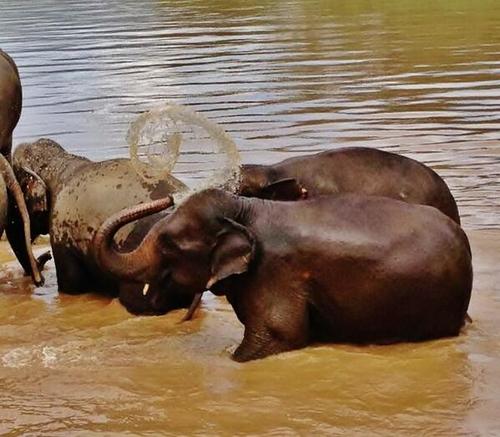
- Finally, today’s lead image comes from our friends at Think Elephants, who study elephant intelligence over in Thailand and occasionally capture the animals’ mastery of fluid dynamics. Be sure to check them out and follow them on Twitter and Facebook.
(Photo credit: Think Elephants International/R. Shoer)
Vibrating Paint
Paint is probably the Internet’s second favorite non-Newtonian fluid to vibrate on a speaker–after oobleck, of course. And the Slow Mo Guys’ take on it does not disappoint: it’s bursting (literally?) with great fluid dynamics. It all starts at 1:53 when the less dense green paint starts dimpling due to the Faraday instability. Notice how the dimples and jets of fluid are all roughly equally spaced. When the vibration surpasses the green paint’s critical amplitude, jets sprout all over, ejecting droplets as they bounce. At 3:15, watch as a tiny yellow jet collapses into a cavity before the cavity’s collapse and the vibration combine to propel a jet much further outward. The macro shots are brilliant as well; watch for ligaments of paint breaking into droplets due to the surface-tension-driven Plateau-Rayleigh instability. (Video credit: The Slow Mo Guys)

Fluids Round-up – 7 December 2013
Fluids round-up time! I missed out last weekend because of the holidays, so this is a long list of links. There’s a lot of really great stuff here, including some neat fluidsy geophysics and astronomy.
- xkcd’s Randall Munroe explains why you can’t boil your tea by stirring it.
- LATimes describes a flying jellyfish robot.
- Wired takes a detailed look at archerfish physics, including some of the fluid dynamics we’ve discussed previously. (via iamaponyrocket)
- Several readers have also pointed out this ASCII CFD simulator, seen in action in this video.
- New models suggest that Europa’s chaotic terrain features may be due to turbulence in its lower latitudes.
- In a similar vein, nearby Jupiter’s Great Red Spot may owe its longevity to existing in three-dimensions.
- NASA revealed new movies and images of Saturn’s polar hexagon this week. For more, see some of the earlier photos and laboratory recreations of the hexagon and this summary from io9. (submitted by @AndrisPiebalgs)
- Continuing with the astronomical bent, check out Anders Sandberg’s musings on what a habitable planet twice the size of Earth would be like.
- Back here on Earth, NASA released some impressive images of global weather patterns as computed by their high-resolution models.
- PhysicsBuzz takes a look at the fluid dynamics of flying fish.
- I’ve seen plenty of videos of people doing crazy things with non-Newtonian fluids, but Hard Science adds an interesting new one: attempting to ride a bike across a pool of oobleck.
- PopSci reported from CES 2013 about a non-Newtonian fluid for protecting tech gadgets from impacts.
- Drummer Ali Siadat shows how to blow the perfect smoke rings using a bass drum. (via Jennifer Ouellette)
- Finally, this week’s lead image comes from the Grand Canyon where a strong temperature inversion created spectacular fog-filled vistas.
(Photo credit: E. Whittaker)