Putting out fires can be a difficult, water-intensive task. In this video, scientists demonstrate how using a non-Newtonian fluid can make it easier to extinguish and suppress flames. Where water tends to splatter and scatter against an object, a yield-stress fluid can cling and coat to smother the flame. The fluid used here is water with a 0.1% polymer additive, which is enough to significantly change the fluid’s rheological properties. Pre-treating flammable objects with the fluid is also effective at suppressing combustion, raising additional possibilities for using such techniques in fighting the spread of wildfires. (Video credit: B. Blackwell et al.)
Tag: non-Newtonian fluids

Self-Pouring Fluids
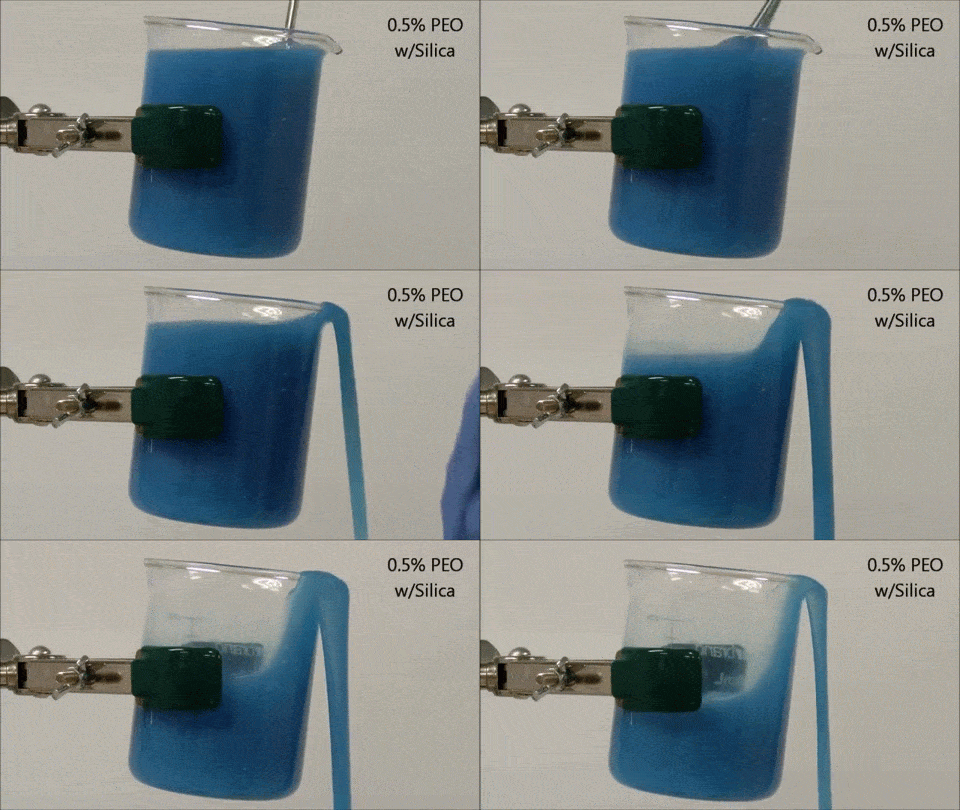
Non-Newtonian fluids are capable of all kinds of counter-intuitive behaviors. The animations above demonstrate one of them: the tubeless or open siphon. Once the effect is triggered by removing some of the liquid, the fluid quickly pours itself out of the beaker. This is possible thanks to the polymers in the liquid. The falling liquid pulls on the fluid left behind in the beaker, which stretches the polymers in the fluid. When stretched, the polymers provide internal tension that opposes the extensional force being applied. This keeps the fluid in the beaker from simply detaching from the falling liquid. Instead, it flows up and over the side against the force of gravity, behaving rather more like a chain than a fluid! (Image credit: Ewoldt Research Group, source)

Sea Foam

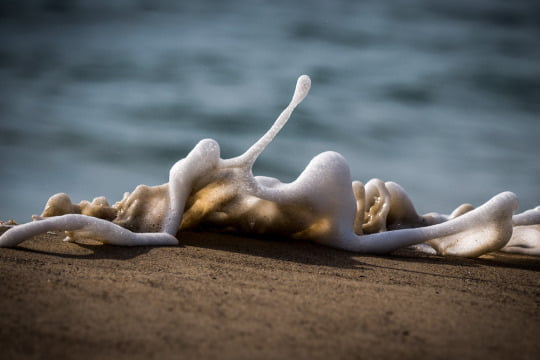

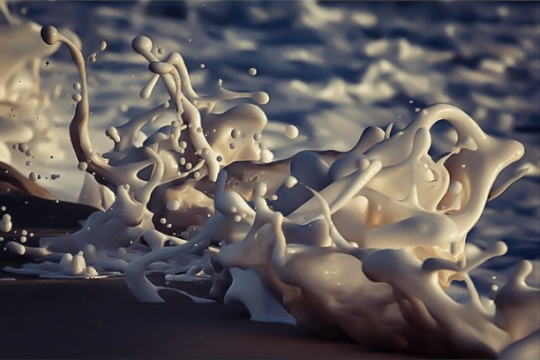
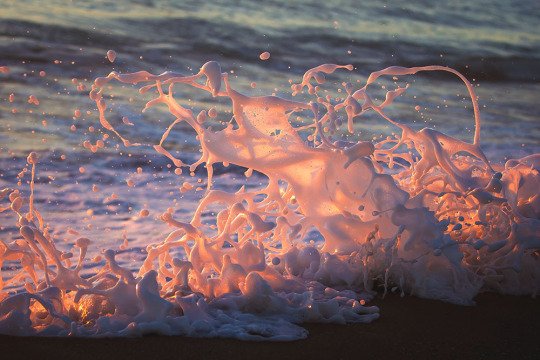
Photographer Lloyd Meudell captures surrealistic images of breaking sea foam.
Interestingly, the sea foam is essentially a three-phase fluid made up of air, water, and sand. Yet despite the surrealism of its forms, the foam bears strong resemblance to other flows. The shapes the foam forms are reminiscent of vibrated non-Newtonian fluids like paint or oobleck. Momentum deforms the foam into sheets and ligaments smoothed and held together by surface tension until droplets snap free. You can find more of Meudell’s work at his site. (Image credits: L. Meudell; via freakingmindblowing; submitted by molecular-freedom)

Newtonian and Non-Newtonian Vortices

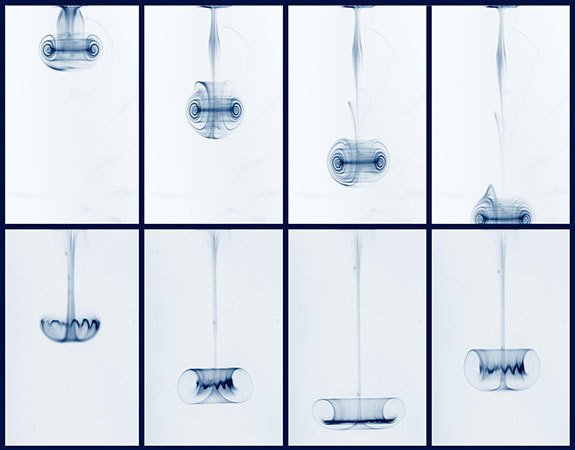
Not all vortex rings are created equal. Despite identical generation mechanisms and Reynolds numbers, the two vortex rings shown above behave very differently. The donut-shaped one, on the top left in green and in the middle row in blue, was formed in a Newtonian fluid, where viscous stress is linearly proportional to deformation. As one would expect, the vortex travels downward and diffuses some as time passes. The mushroom-like vortex ring, on the other hand, is in a viscoelastic fluid, which reacts nonlinearly to deformation. This vortex ring first furls and expands as it travels downward, then stops, contracts, and travels backward! (Image credit: J. Albagnac et al.; via Gallery of Fluid Motion)

Magnetic Putty
Sometimes fluids are slow-moving enough that it takes timelapse techniques to reveal the flow. Fog is one example, and, as seen above, magnetic silly putty is another. The putty is an unusual fluid in a couple of ways. First, having been impregnated with ferromagnetic nanoparticles, it is sensitive to magnetic fields, making it a sort of ferrofluid. And secondly, being silly putty, it’s a non-Newtonian fluid, meaning that it has a nonlinear response to deformation – a fact that will be familiar to anyone who has tried to knead putty versus striking it. With a strong enough magnet, the putty makes for an impressively tenacious creeping flow. (Video credit: I. Parks; via io9; submitted by Chad W.)
Stepping on Lava
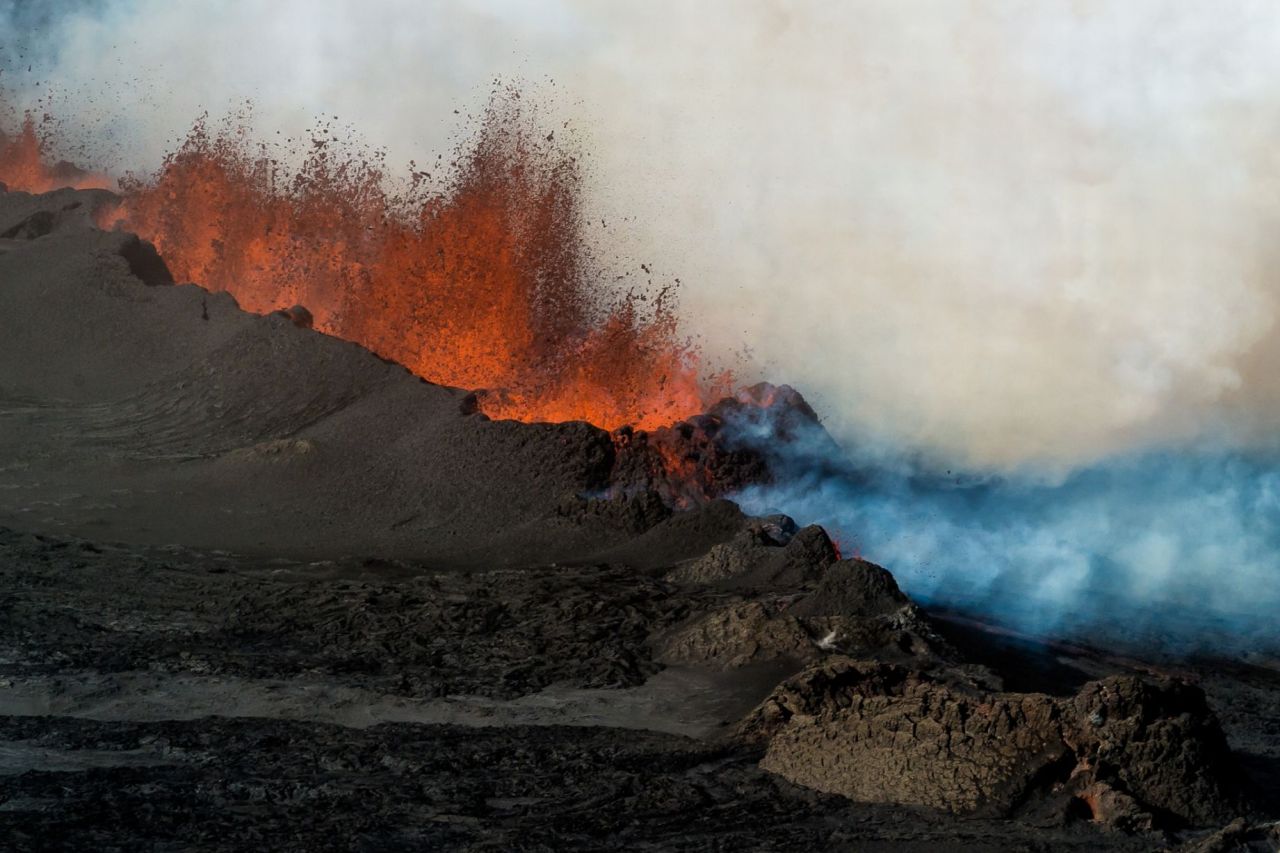
What happens when you step on lava? (First off, don’t try this yourself.) Lava is both very dense and very viscous, so, as illustrated in the animation above, it does not give all that much under pressure. If you were to fall on it, you’d land, sink a little bit, and then get burned. It’s also interesting to note that the lava springs back after being indented. Basaltic lava like that found in Hawaii, where this clip originates, does have viscoelastic properties, which might explain the elasticity of the deformed fluid. (Image credit: A. Rivest, source video; via Gizmodo)

Jet Impact

Viscoelasticity can generate some bizarre fluid behaviors. Viscoelastic fluids are special class of non-Newtonian fluid in which the response to deformation is both viscous, like a fluid, and elastic, like rubber. Above, a jet of viscoelastic fluid impacts a plate as viewed from the side (top image) and beneath (bottom image). When the jet impacts the plate, elastic stresses in the fluid destabilize the cylindrical symmetry of the jet. The jet instead becomes webbed, with an odd, asymmetric number of webs. The number of webs depends on the viscoelastic properties of the fluid as well as the jet’s speed and distance from the plate. (Image credit: B. Néel et al.)

The Kaye Effect
Those who have poured viscous liquids like syrup or honey are familiar with how they stack up in a rope-like coil, as shown in the top row of images above. What is less familiar, thanks to the high speed at which it occurs, is the Kaye effect, which happens in fluids like shampoo when drizzled. Shampoo is a shear-thinning liquid, meaning that it becomes less viscous when deformed. Like a normal Newtonian fluid, shampoo first forms a heap (bottom row, far left). But instead of coiling neatly, the heap ejects a secondary outgoing jet. This occurs when a dimple forms in the heap due to the impact of the inbound jet. The deformation causes the local viscosity to drop at the point of impact and the jet slips off the heap. The formation is unstable, causing the heap and jet to collapse in just a few hundred milliseconds, at which point the process begins again. (Image credit: L. Courbin et al.)

Beading Fluids
Adding just a few polymers to a liquid can substantially change its behavior. The presence of polymers turns otherwise Newtonian fluids like water into viscoelastic fluids. When deformed, viscoelastic fluids have a response that is part viscous–like other fluids–and part elastic–like a rubber band that regains its initial shape. The collage above shows what happens to a thinning column of a viscoelastic fluid. Instead of breaking into a stream of droplets, the liquid forms drop connected with a thin filament, like beads on a string. In a Newtonian fluid, surface tension would tend to break off the drops at their narrowest point, but stretching the polymers in the viscoelastic fluid provides just enough normal stress to keep the filament intact. If the effect looks familiar, it may be because you’ve seen it in the mirror. Human saliva is a viscoelastic liquid! (Image credit: A. Wagner et al.)

Lava Physics
Lava is rather fascinating as a fluid. Lava flow regimes range from extremely viscous creeping flows all the way to moderately turbulent channel flow. Lava itself also has a widely varying rheology, with its bulk properties like viscosity and its response to deformation changing strongly with temperature and composition. As lava cools, instabilities form in the fluid, causing the folding, coiling, branching, swirling, and fracturing associated with different types and classes of lava. (Image credit: E. Guddman, via Mirror)