The Saffman-Taylor instability occurs when a less viscous fluid is injected into a more viscous one, usually in a Hele-Shaw cell. Here oil paint and mineral spirits were painted onto flat surfaces that were pressed together before being pulled apart. The result is viscous fingering of the fluids. #
Tag: instability

Ferrofluid Self-Organization
The behavior of a ferrofluid subject to magnetic fields can be fascinating. Here a ferrofluid is subjected to a permanent magnet and thinner is added to the ferrofluid. As it spreads outward, the thinner carries ferrofluid with it. The thinner evaporates, increasing the concentration of ferrofluid in the outer ring and eventually forming peaks of ferrofluid that move inward toward the main body due to the attraction of the magnet. Near the main body, the peaks are repelled by the ferrofluid because they have the same magnetic orientation.
Rayleigh-Taylor Art
The Rayleigh-Taylor instability occurs when a denser fluid lies atop a lighter fluid (relative to the gravitational field). The interface between the fluids deforms and the two fluids form finger-like protrusions that turn into mushroom caps and mix the dissimilar fluids together. This video, though based on a 2D Rayleigh-Taylor instability numerical simulation, was actually part of an art exhibit. (submitted by Mark S)
Personally, I recommend putting together a playlist of your favorite late 60s/early 70s rock (Pink Floyd, late Beatles, Jimi Hendrix, etc.) and sticking it on in the background while you watch the video in HD. It’s totally worth the 15 minutes. Especially in the later stages of each segment, the mixing between fluid layers really brings to mind cloud patterns on Jupiter or Saturn.

Jet Breakup
A non-cylindrical stream falling through a slit nozzle exhibits the Plateau-Rayleigh instability, which drives a falling jet of fluid to break into droplets due to surface tension. The fingers formed off the falling stream may be a form of Rayleigh-Taylor instability. #

Upside-Down Umbrellas
When a heavier fluid is suspended over a lighter fluid (as with ink or food coloring in water), the interface between fluids is subject to the Rayleigh-Taylor instability. As the heavier fluid starts to sink, it forms “fingers”, which develop into mushroom-cap shapes as the fluid continues falling. Sometimes the shear stress between the heavier fluid and lighter fluid causes secondary Kelvin-Helmholtz instabilities as well. (Photo by Leonardo Aguiar)
Liquids Lens Breakup
A decane liquid lens floating on water (think drops of fat in chicken soup) displays different breakup and pinch-off than seen in three-dimensional droplet breakup. The pinch-off process in two dimensions relies on line tension rather than surface tension, and the quasi-2D liquid lens system is somewhere between these. The video above is a magnification of the filament connecting one liquid lens as it is broken into two smaller liquid lenses (the dark areas on the left and right of the screen). # (via scienceisbeauty)
Leapfrogging Vortices
This numerical simulation shows two pairs of vortices interacting in a leap-frogging motion. Another version shows the same situation but with a small perturbation in the rotational alignment that causes even more interesting interactions. Both simulations are of potential flow–an idealized flow without viscosity where velocity can be described as the gradient of a scalar function. The mathematics governing potential flow are notably easier than the full Navier-Stokes equations that govern fluid mechanics. (submitted by jessecaps)
Jets from Waves
When vibrated, fluid surfaces can exhibit standing waves known as Faraday waves. In this experiment, increased forcing of these standing waves causes the formation of a jet. Under the right conditions, as the standing wave collapses, a singularity forms on the fluid surface when velocity and surface curvature diverge. The narrow jet column forms as a result of the fluid’s kinetic energy getting focused by the collapse. For more, see this letter to Nature. #

Laminar Flow Control
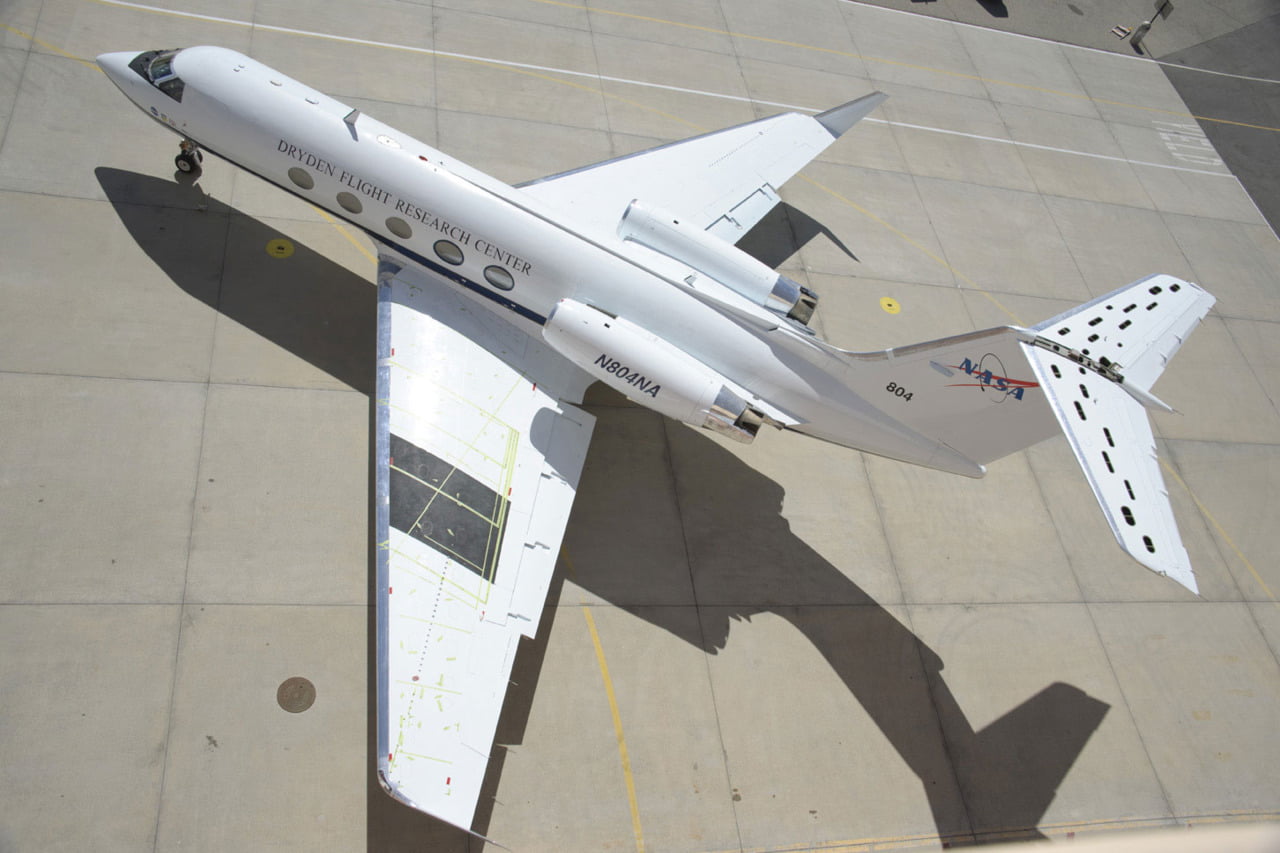
On Wednesday, March 30, 2011 at 3:00 EDT NASA engineers are holding an online chat about a current project to achieve laminar flow control on business jet-class airplanes. Keeping flow over an airplane’s wings laminar could decrease the total drag on an airplane by as much as 15%. In particular, this project involves placing tiny hockey-puck-shaped discrete roughness elements (DREs) along the front of the wing. These DREs are positioned such that they perturb the mean-flow over the wing at a higher frequency than the naturally most unstable frequency; as a result, flow actually remains laminar over a greater extent of the wing than would normally be the case. For more on the technical ideas, see this NASA blog post or feel free to ask questions in the comments. #
Full disclosure: This project is being conducted in joint with professors with whom I work, and the subject matter is related to my own research.
Shock Waves
Flow visualization really can be considered a form of art. Though we fluid mechanicians are looking for physics, we’re quite aware of the beauty of what we study. The clips in this video mostly show transient shockwave behavior, including lots of shock reflection and even a few instabilities. It’s unclear what the speeds are, aside from faster than sound; the medium is air.