Atomization–breaking a flowing liquid into a fine spray–is important for fuel injection in a variety of engines, including automobiles, jet engines, ramjets, scramjets, and rockets. The more effectively a liquid fuel can be dispersed as a spray in an engine, the more efficient and stable the combustion will be. The apparatus in this high-speed video injects an annular water sheet with concentric jets of air on either side of the water. The video series shows the effects of increasing the outer and inner air velocities relative to the water on the breakup of the liquid. What to the naked eye looks like a deluge, high-speed video reveals as a complex undulating structure.
Tag: instability

Jet Breakup
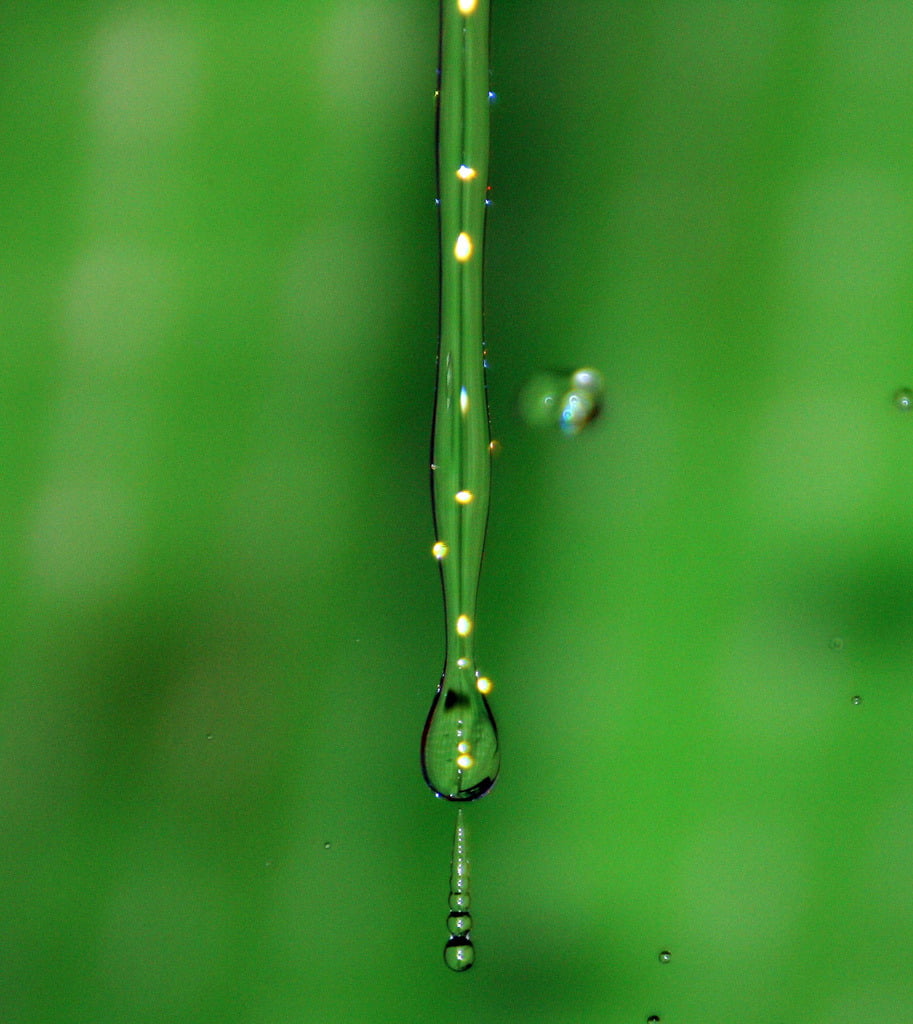
As a laminar column of water falls, slight perturbations cause waviness in the stream. Whenever the radius of the stream decreases, the pressure due to surface tension increases, causing fluid to flow away from the area of smaller radius. This outflow decreases the radius further and drives the stream to break into droplets. The mechanism is called the Plateau-Rayleigh instability. (Photo credit: Mahmoudreza Shirinsokhan)

Toroidal Vortex
When instabilities exist in laminar flow, they do not always lead immediately to turbulence. In this video, a viscous fluid fills the space between two concentric cylinders. As the inner cylinder rotates, a linear velocity profile (as viewed from above) forms; this is known as Taylor-Couette flow. If any tiny perturbations are added to that linear profile–say there is a nick in the surface of one of the cylinders–the flow will develop an instability. In this type of flow, an exchange of stabilities will occur. Rather than transitioning to turbulence, the fluid develops a stable secondary flow–the toroidal vortex highlighted by the dye in the video. If the rotation rate is increased further other instabilities will develop.
The Dance of Jets and Droplets
Placing a prism upside down in a bath of silicone oil creates a trapped bubble of air inside the prism. When oscillated above a critical amplitude, the corners of the prism, the oil, and the air perform an intricate dance of bubbles, singularities, jets, and droplets. Read more in the research paper. #

Spiky Ferrofluid
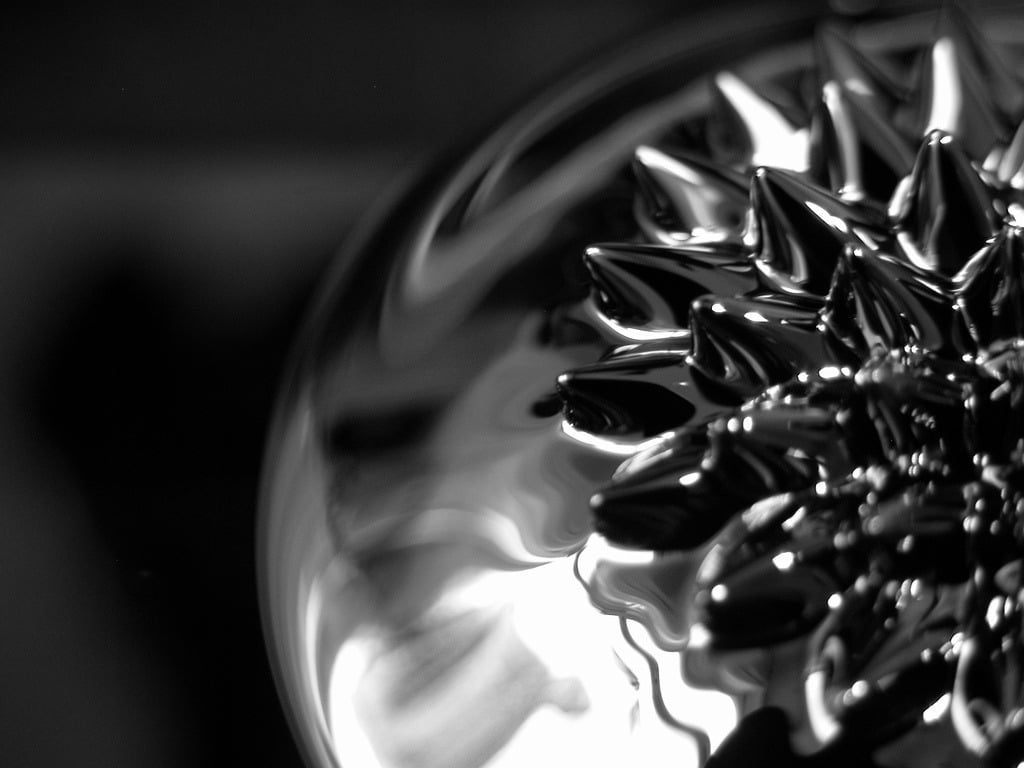
Ferrofluids consist of ferromagnetic nanoparticles suspended in a fluid. When subjected to strong magnetic fields, they develop a distinctive peak-and-valley formation due to the normal-field instability. The shape is a result of minimizing the magnetic energy of the fluid. Both gravity and surface tension resist the formation of these peaks. Ferrofluids, in addition to appearing in art exhibits, can be used as liquid seals, MRI contrast agents, and loudspeaker cooling fluids. (Photo credit: Maurizio Mucciola)
The Tibetan Singing Bowl
The vibration caused by rubbing a Tibetan singing bowl excites standing waves in a Faraday instability on the surface of water in the bowl. As the amplitude of excitation increases, jets roil across the surface, creating a spray of droplets, some of which actually bounce on the surface as it vibrates. For more see the BBC and SciAm articles.
High-Res Rayleigh-Taylor Instability
When a heavy fluid sits atop a lighter fluid, the interface between the two breaks down through the Rayleigh-Taylor instability. This computation of a 2D interface shows the near fractal behavior of this instability as whorls and eddies of all different scales form and mix the fluids. (submitted by @markjstock)

Whipping Instability
A droplet of glycerol coalescing in silicone oil while subjected to strong electric fields exhibits a whip-like instability reminiscent of fireworks. Check out videos of the phenomenon or see the paper for more information. Happy Independence Day to our American readers!
For more fun, holiday-themed high-speed video, check out PopSci’s fireworks videos.
Liquid Rope Coiling
Some liquids, when falling in a stream into a pool, tend to coil into a liquid rope. This video shows honey, but the effect can also be observed in syrups and silicone oil. The rate of coiling is dependent on the height from which the liquid falls. Other factors governing coiling include viscosity, density, and flow rate.
Coronal Waves
NASA’s Solar Dynamics Observatory has found evidence of Kelvin-Helmholtz waves in the sun’s corona. These waves, which occur between two fluids of different densities or moving at different speeds, are similar to the iconic waves surfers ride. Researchers suspect that this turbulent motion may help explain why the corona is 1,000 times hotter than the surface of the sun. #