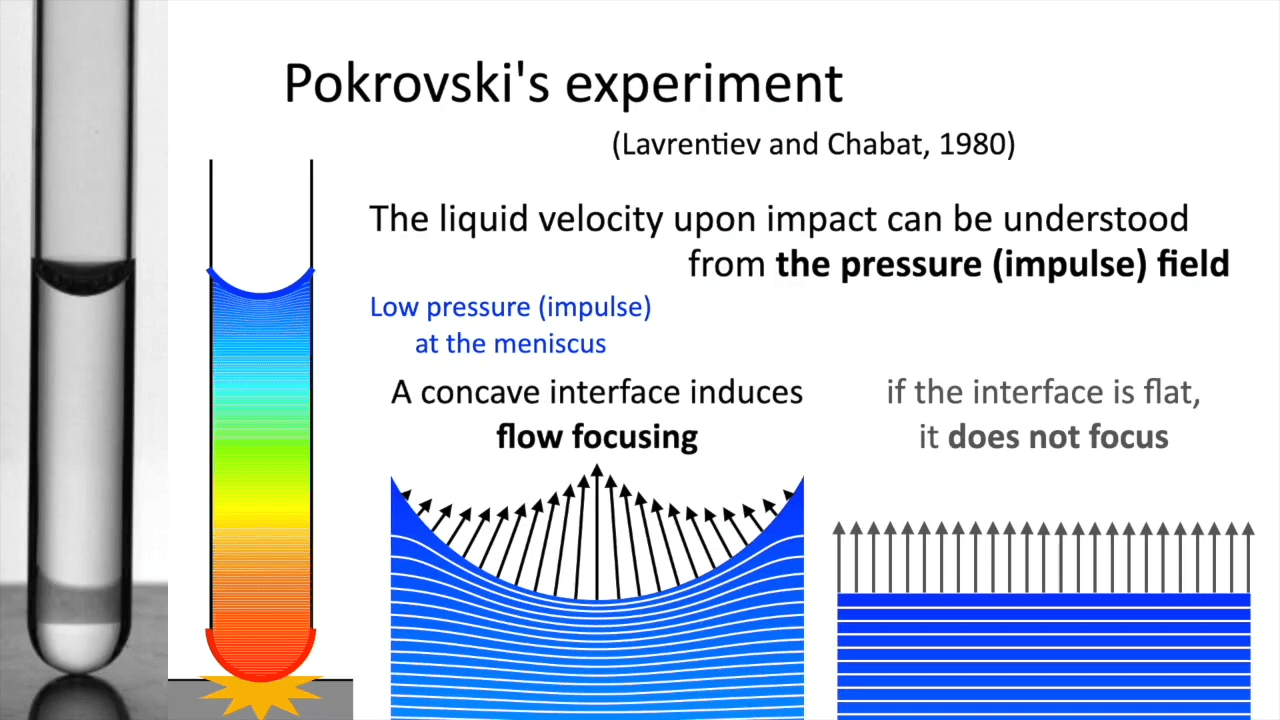
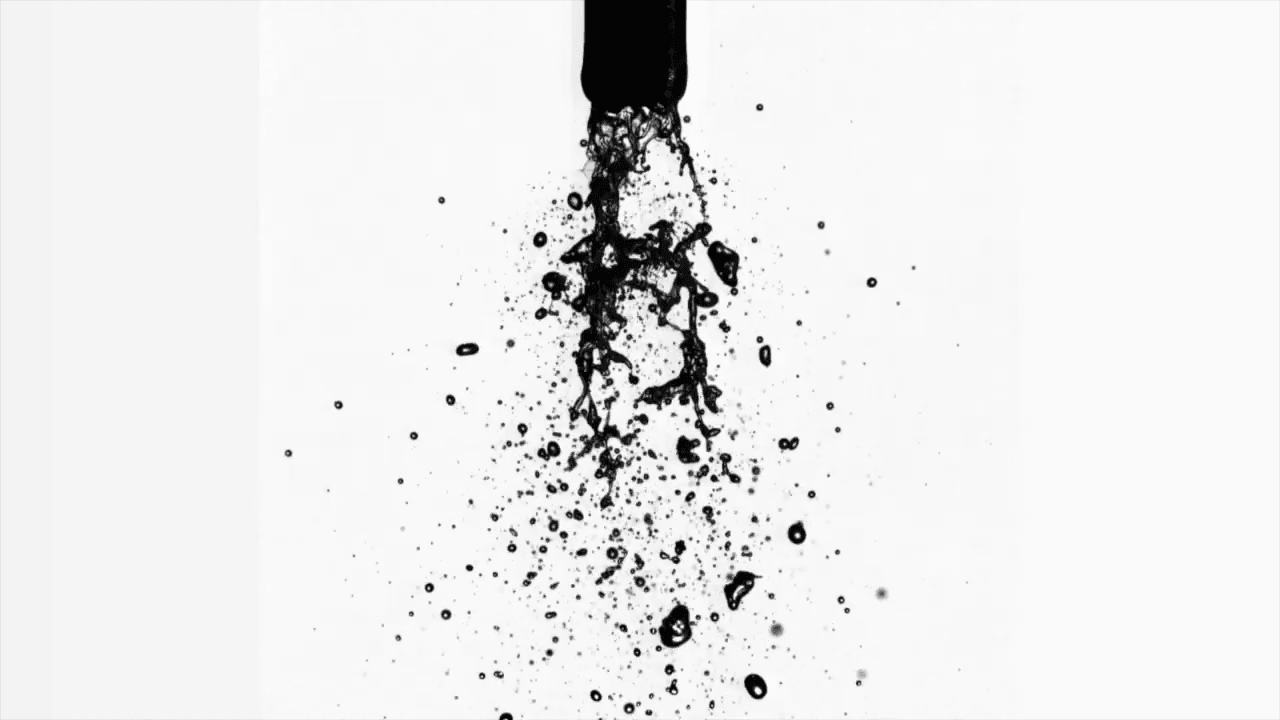
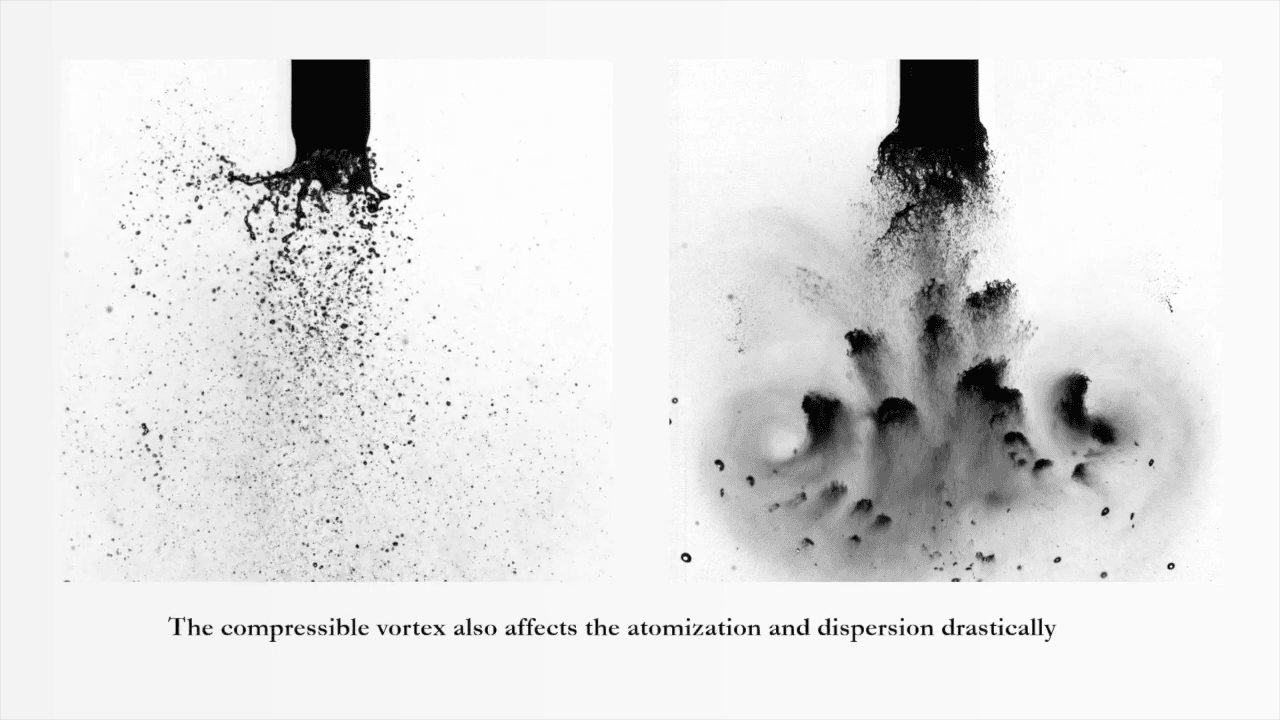
Many industrial processes break a fluid jet into droplets, like spray painting and ink-jet printing. Here, researchers examine an effervescent fluid jet made up of both liquid and gas. Like a fluid-only jet, this fizzy jet forms sheets, bags, ligaments, and droplets. As it breaks down, it creates a range of droplet sizes–both large and small. But when a shock wave passes, the jet and its droplets get atomized into even tinier droplets. (Video and image credit: S. Rao et al.)
Search results for: “liquid jet”

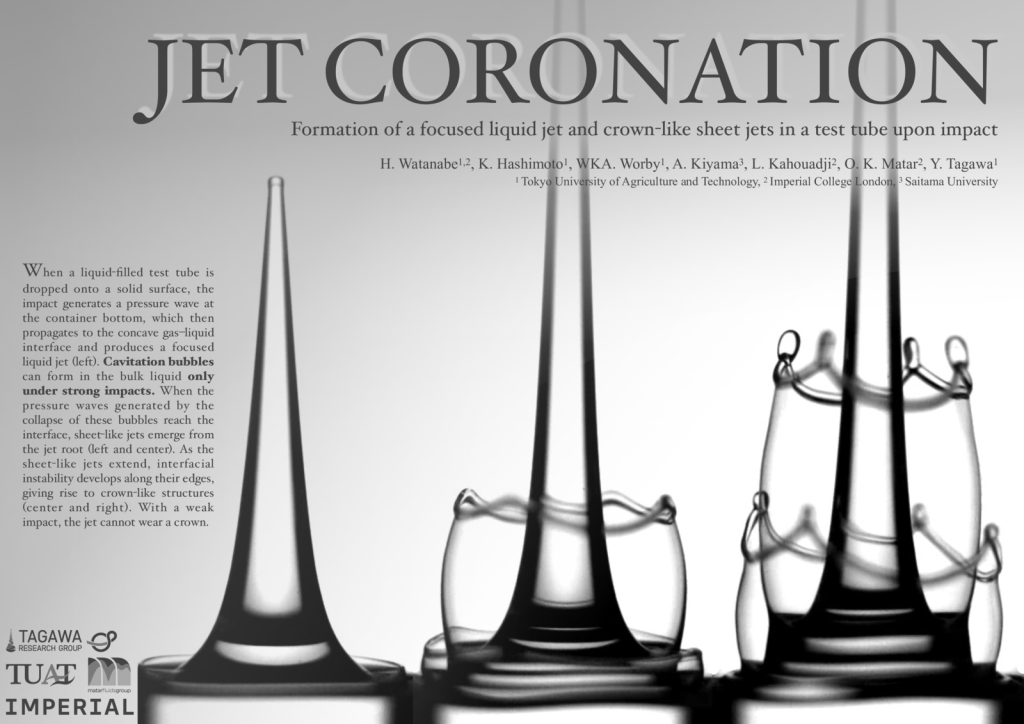
Crowned Jets
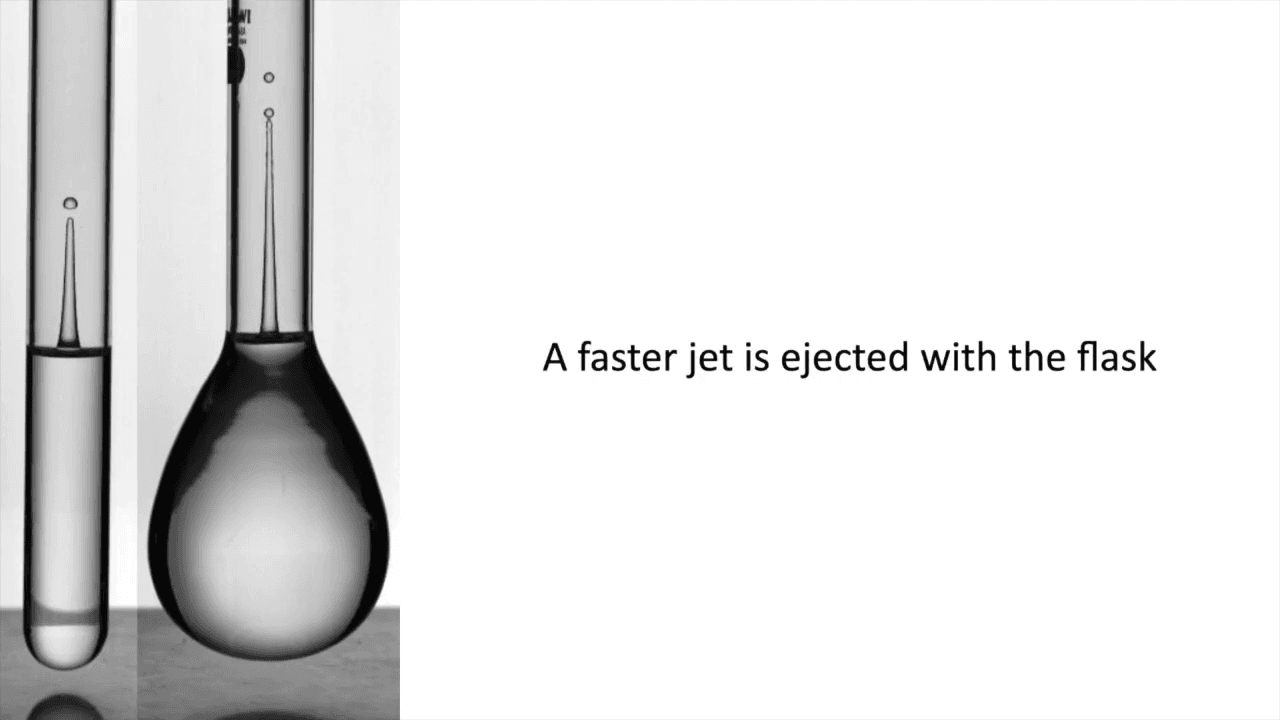
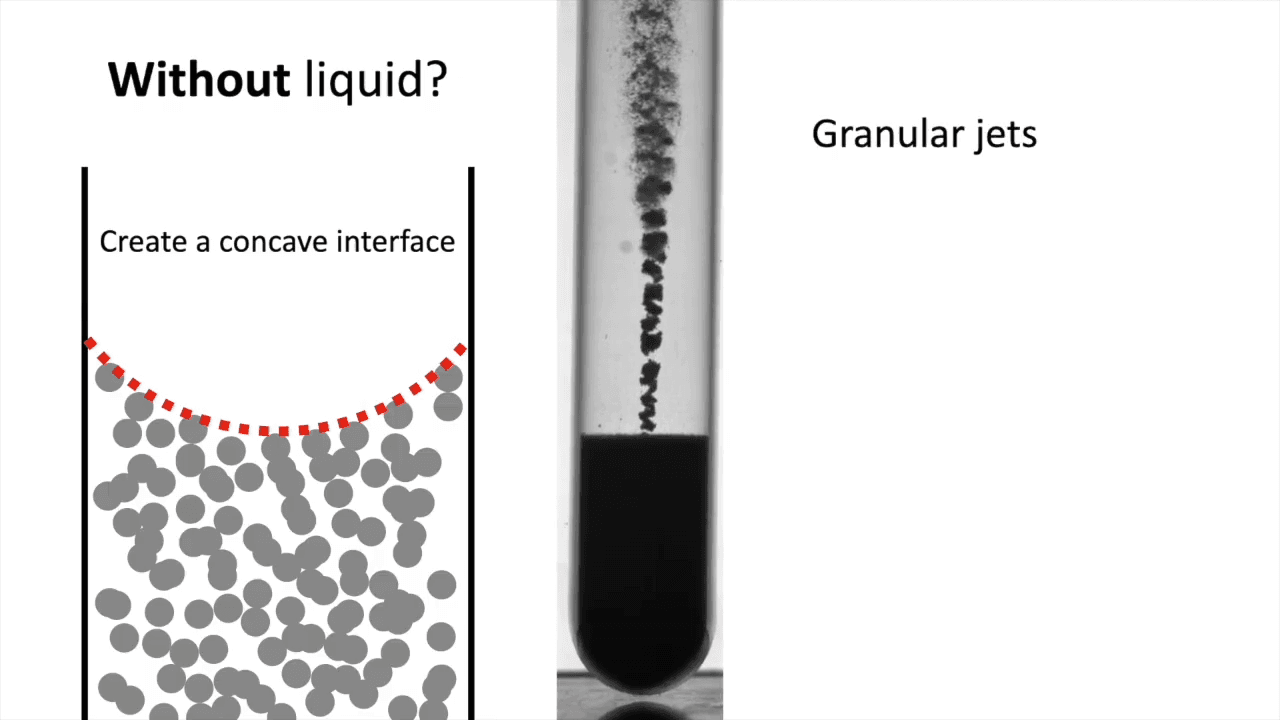
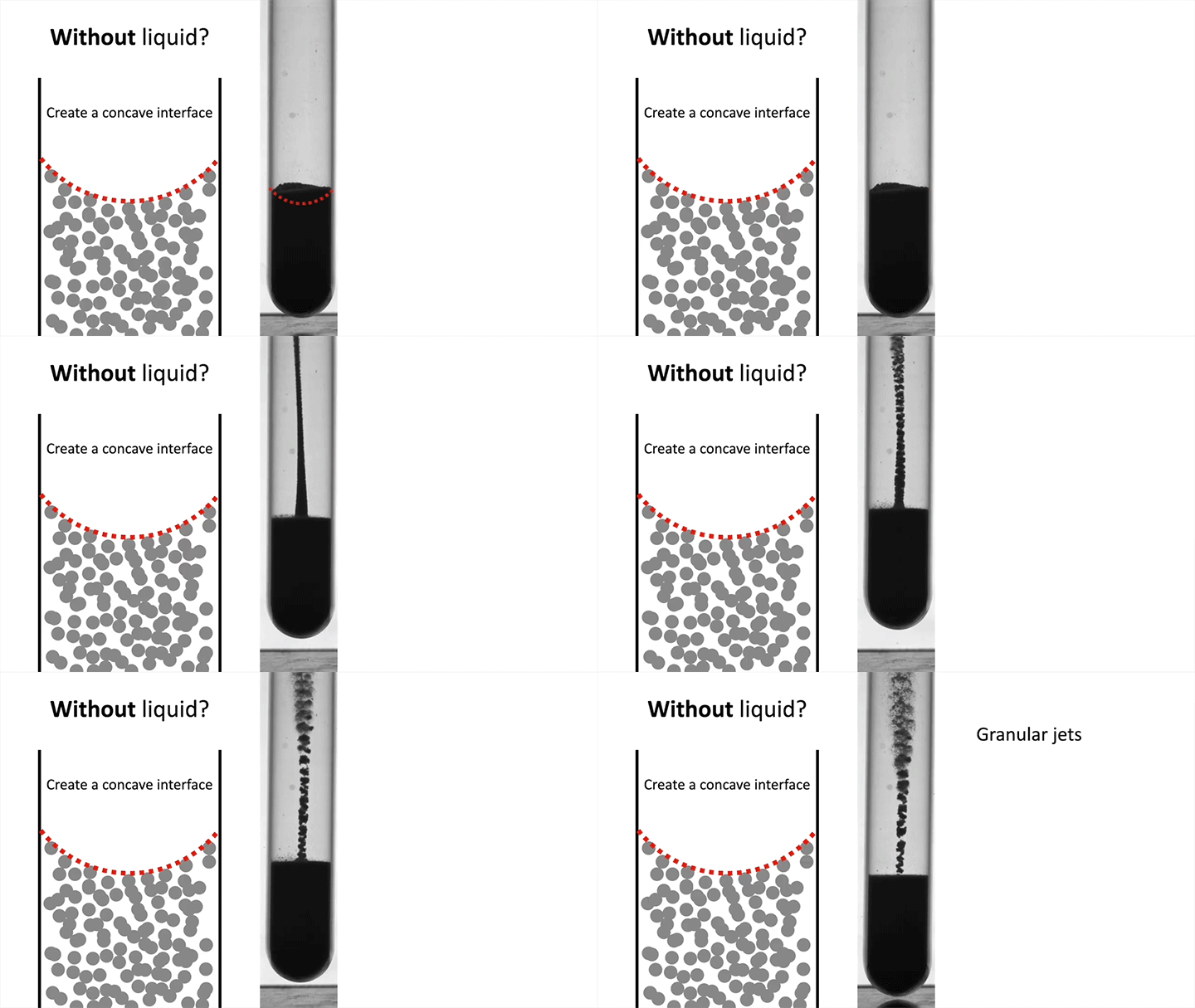
If you fill a test tube with water and drop it, the impact causes a pressure wave that travels up from the bottom and creates a focused jet (left). If the impact is strong enough, cavitation bubbles form at the bottom and generate a sheet-like jet around the central one, like a crown (center and right). (Image credit: H. Watanabe et al.)


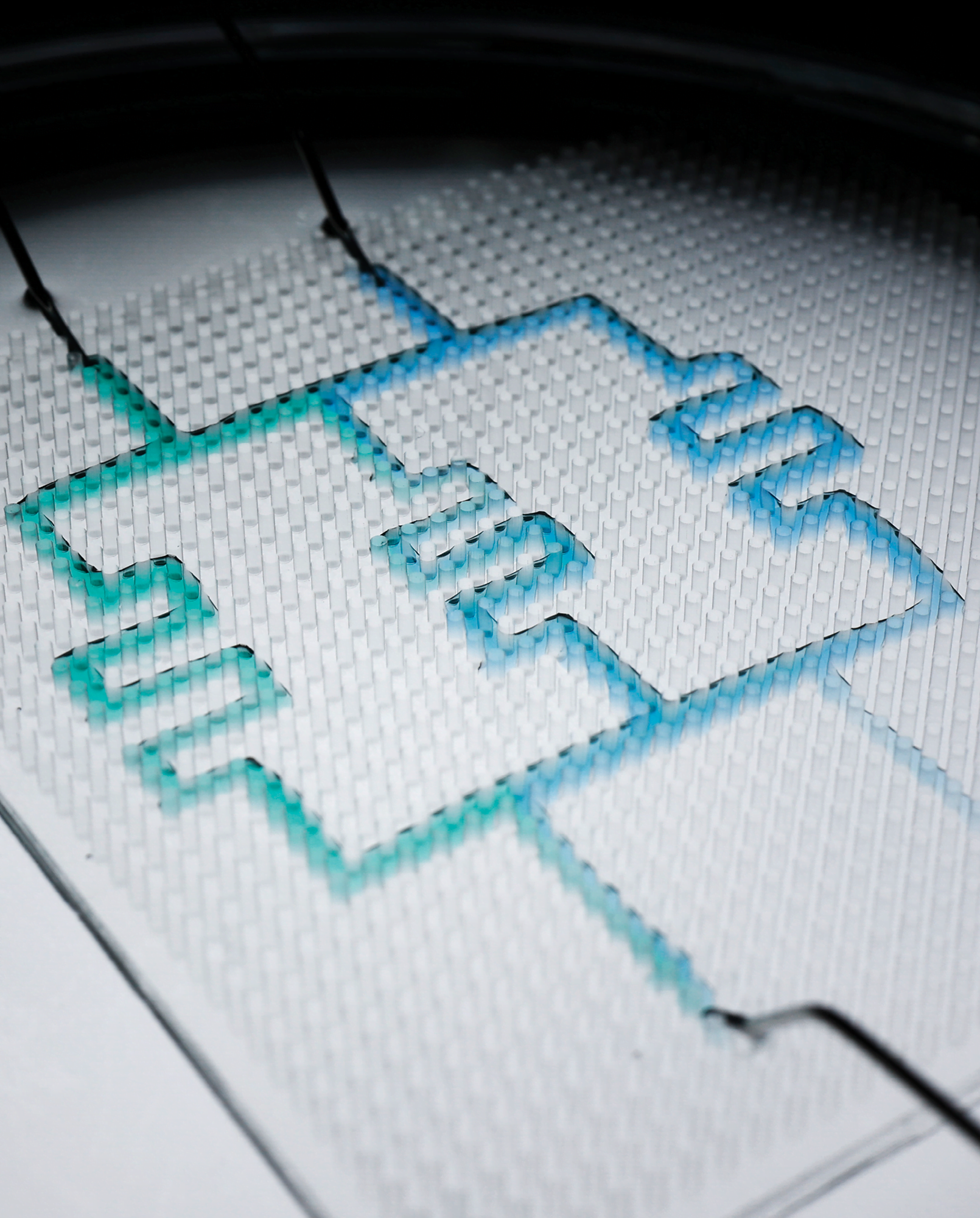
Making Reconfigurable Liquid Circuits
Microfluidic circuits are key to “labs on a chip” used in medical diagnostics, inkjet printing, and basic research. Typically, channels in these circuits are printed or etched onto solid surfaces, making it difficult to reconfigure them. A group in China developed an alternative design, inspired by reconfigurable toys like Lego blocks. Their set-up, shown above, uses a pillared surface immersed in oil. To create the channels, they pipette water — one droplet at a time — into the space between pillars. The combination of oil and pillars traps the drop. With multiple drops linked together, they get channels, like the ones above that mix two fluids. When the time comes to reconfigure the channels, they just pipette the water out and cut the channel with a sheet of coated paper. (Image and research credit: Y. Zeng et al.; via Physics Today)

Laser-Induced Jet Break-Up
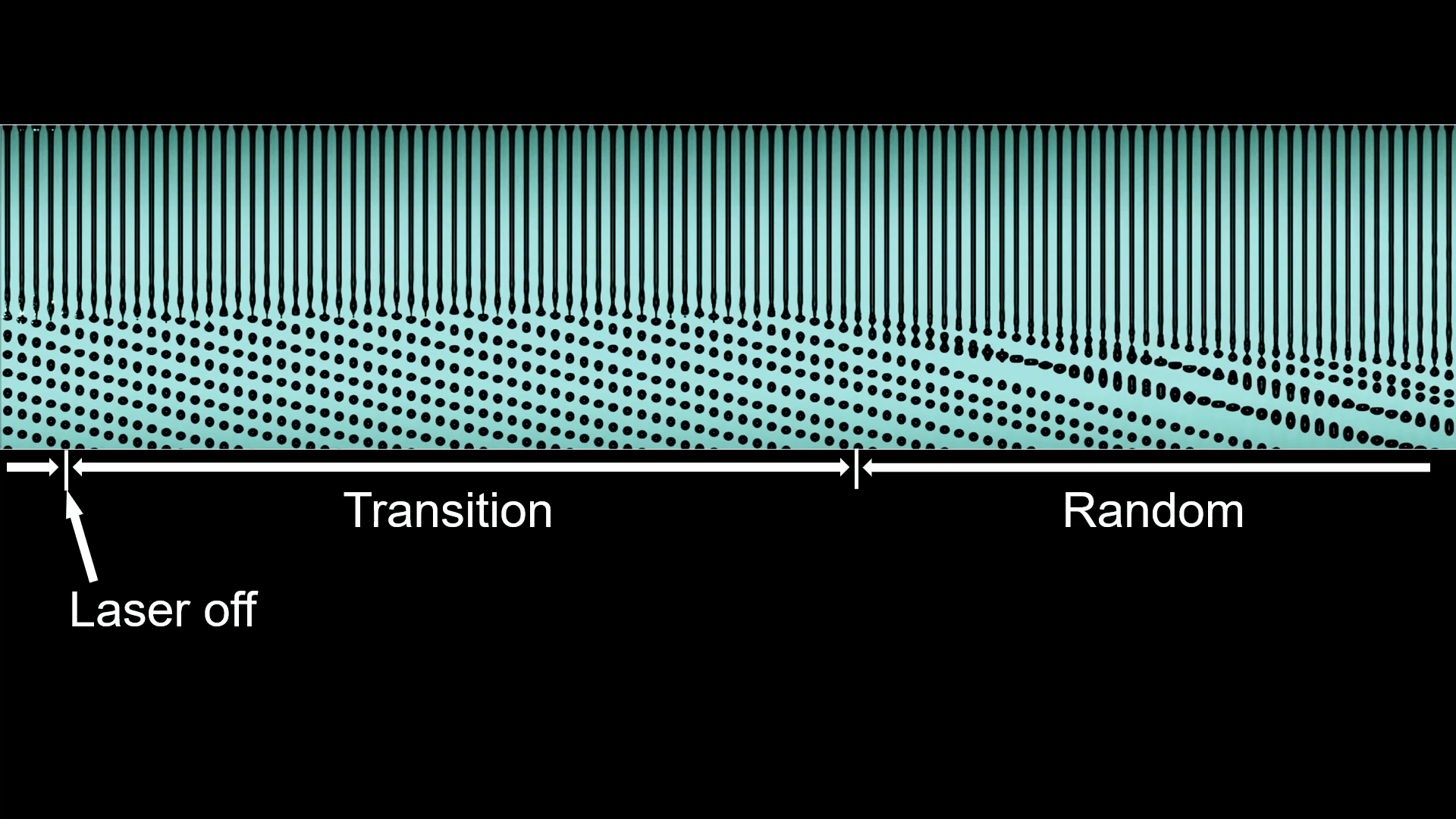
A falling stream of water will naturally break up into droplets via the Plateau-Rayleigh instability. Those droplets are random, unless something like vibration of the nozzle sets their size. In this study, though, researchers found that shining a laser beam on the stream can trigger an orderly break-up with droplets that are consistent in size and spacing.
The optofluidic phenomenon depends on a few different effects. The changing curvature of the liquid stream reflects the laser light, some of which undergoes total internal reflection and travels up the jet as if it were a fiber optic cable. Look closely in the right side of the second image, and you’ll see a periodic flicker of green light at the mouth of the nozzle. Those flashes of green reveal that the liquid jet is guiding the light upstream in bursts, each of which exerts an optical pressure that triggers the Plateau-Rayleigh instability.
When the laser first turns on, there’s a transition period before the orderly break-up begins, and, likewise, turning the laser off triggers a transition from orderly to random (top image). (Image and research credit: H. Liu et al.; via APS Physics; submitted by Kam-Yung Soh)

Cavitation-Induced Microjets
In cavitation, tiny bubbles of vapor form and collapse in a liquid, often sending shock waves ricocheting. In most occurrences beyond the lab, cavitation bubbles aren’t a solo act; many bubbles can form and interact. This video takes a look at some of the effects of those interactions. When close together, two cavitation bubbles can act to focus the flow during collapse, generating a microjet strong enough to penetrate into nearby surfaces. Researchers hope this technique may one day be used for needle-free injections. (Image, video, and submission credit: A. Mishra et al.)

Liquid Umbrellas
Two well-timed and properly aligned droplets combine to create these umbrella-like fluid sculptures. The initial drop creates a jet that shoots upward. When the second drop hits that jet, it forms an expanding sheet of liquid like a miniature parasol. The higher the viscosity of the drops, the less lacy and unstable the sheet’s rim will be.
Although set-ups for these sorts of pictures can be finicky, they’re very doable, even for amateur photographers. In fact, the techniques used here have been around for about a century! (Image and research credit: A. Kiyama et al.)

Decelerating Jets
For more than a century, scientists have been fascinated by the jet that forms after a drop impacts a liquid. In this study, researchers tracked fluorescent particles in the fluid to understand the velocity and acceleration of flow inside the jet. They found that, within the first 10ms after the jet appears, it decelerates at up to 20 times the gravitational acceleration. That’s much too fast for gravity to cause, pointing instead to the critical importance of surface tension in dictating the behavior of these fast-moving jets. (Image and research credit: C. van Rijn et al.; via APS Physics; submitted by Kam-Yung Soh)

Jets from Lasers
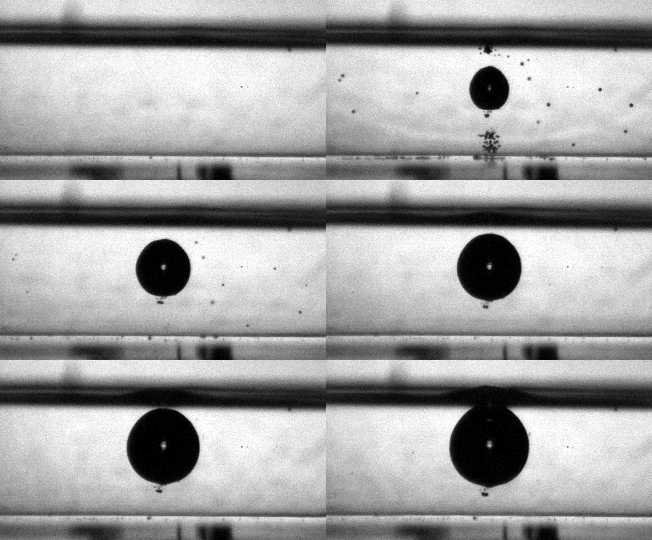
Laser-induced forward transfer (LIFT) is an industrial printing technique where a laser pulse aimed at a thin layer of ink creates a tiny jet that deposits the ink on a surface. In practice, the technique is plagued with reproducibility issues, in part because it’s difficult to produce only a single cavitation bubble when aiming a laser at the liquid layer. This is what we see above.
The laser pulse creates its initial bubble just above the middle of the liquid layer. Shock waves expand from that first bubble and quickly reflect off the liquid surface (top) and wall (bottom). When reflected, the shock waves become rarefaction waves, which reduce the pressure rather than increasing it. This helps trigger the clouds of tiny bubbles we see above and below the main bubble.
The effect is worst along the path of the laser pulse because that part of the liquid has been weakened by pre-heating, but impurities and dissolved gases in the liquid layer are also prone to bubble formation, as seen far from the bubble. The trouble with all these unintended bubbles is that they can easily rise to the surface, burst, and cause additional jets of ink that splatter where users don’t intend. (Image and research credit: M. Jalaal et al.; submitted by Maziyar J.)
Using Air to Break Up Jets
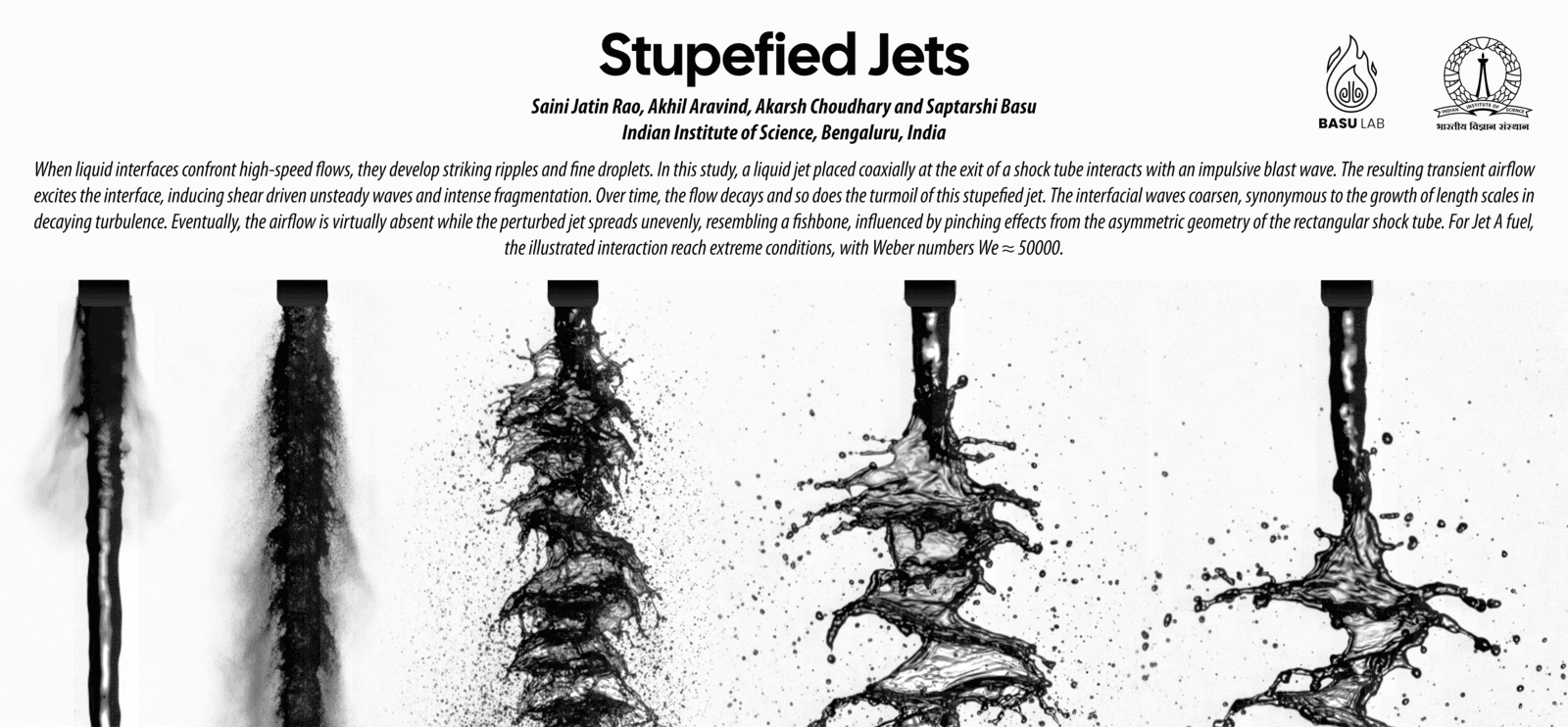
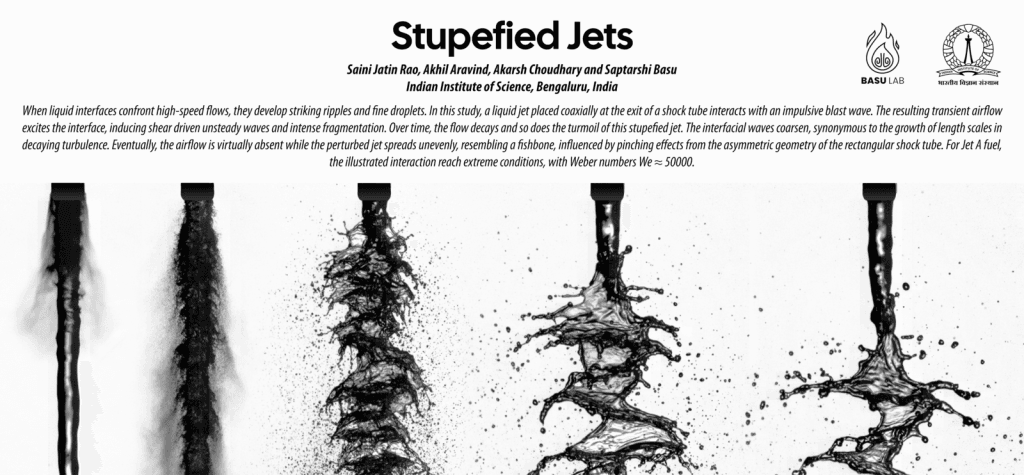
One method of breaking a liquid into droplets, or atomizing it, uses a slow liquid jet surrounded by an annulus of fast-moving gas. The gas along the outside of the liquid shears it, creating waves that the wind blowing past can amplify. This draws the liquid into thin ligaments that then break into droplets. This is a popular technique in rocket engines, where cryogenic liquid fuels often need to be atomized for efficient combustion. When things aren’t working exactly right, however, the liquid jet may start flapping instead of breaking up. In this case, the jet will swing back and forth, but only part of it will atomize. For a rocket engine, this would mean slower and less efficient combustion – never desirable outcomes! (Image credit: A. Delon et al.)

Liquid Sculptures
With patience and timing, one can create remarkable sculptures with fluids. To capture this shot, Moussi Ouissem used two droplets, perfectly timed. The first fell through the soap bubble (which stayed intact thanks to its powers of self-healing) and hit the pool of water. The impact caused a cavity, which then inverted into a Worthington jet. The second drop was timed to impact the column of the jet, creating the saddle-shaped splash seen here. Ripples in the bubble are still visible from the passage of the second drop, and several satellite droplets are signs of the violence of the impacts. (Image credit: M. Ouissem)