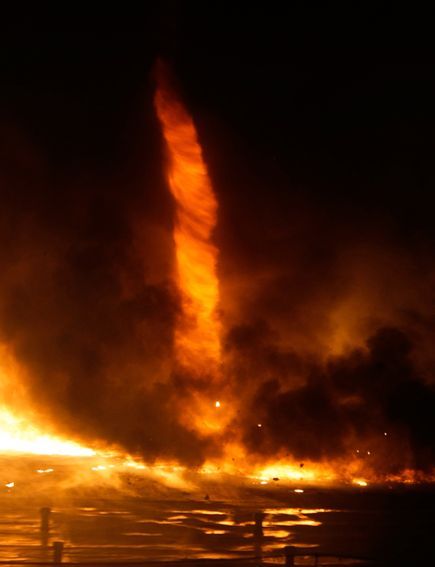
This fire tornado formed over a burning plastic-processing plant in Hungary a week ago. Fire tornadoes aren’t rare, but footage of them is because they typically occur amidst wild conflagrations. Take a look at our explanation of how they form. #
Tag: fluid dynamics

High-Speed Cooking
I suspect demonstrating fluid mechanics was not what this cookbook had in mind when they filmed creamer poured into coffee at 2000 fps, but there’s some awesome droplet breakup, crowning, roiling turbulent mixing, and even some deformed Worthington jets here. It’s a reminder that, even though we may not notice it, fluid dynamics are all around.

Wright Brothers’ Wind Tunnel
A large part of the Wright Brothers’ ultimate success in creating the first powered heavier-than-air craft came as a result of work done in their homemade wind tunnel, shown above. In the aftermath of the failure of their 1901 Glider, the brothers decided that the lift and drag data they had used from Otto Lilienthal must be inaccurate. They built this wind tunnel and its force balances to measure lift and drag on two hundred different airfoils themselves and were rewarded with far more successful flights with their 1902 Glider, which led directly to the Wright Flyer in the following year. #
Pouring Paint
In this artwork by Holton Rower, paint (typically a non-Newtonian fluid) is poured down a rectangular prism; the result is a neat demonstration of shearing in laminar flows. Paint is usually shear-thinning, meaning that its viscosity decreases under shear; this is why the color stripes on the vertical panels expand more than those on the horizontal surfaces do. # (submitted by Stephan)

Hotwire Anemometry
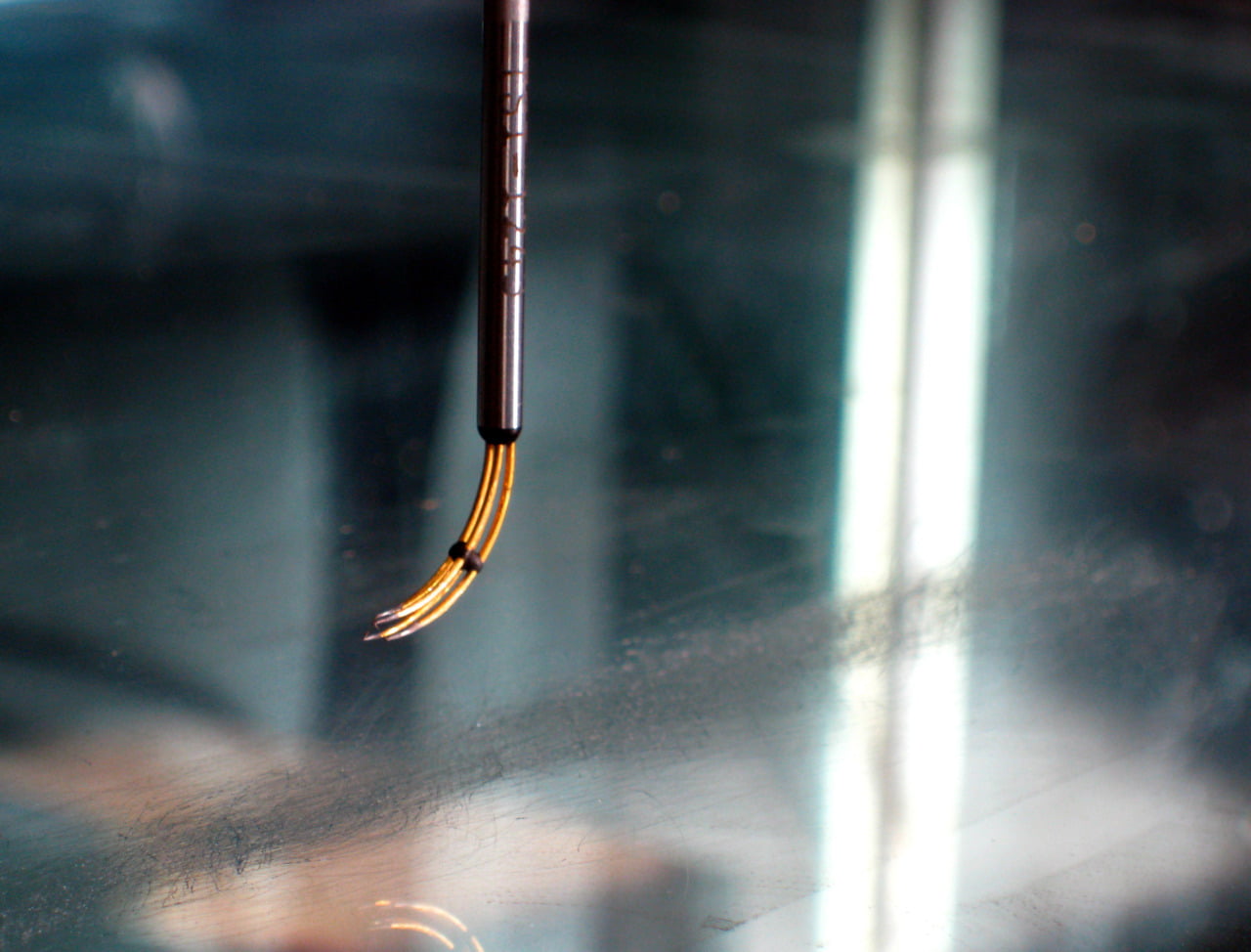
Hotwire anemometry is used in experimental fluid dynamics to measure velocities with high temporal resolution. The boundary layer crosswire probe shown here was used for turbulence research. Between the prongs, which are about the thickness of a sewing needle, are tiny wires about 3 microns in diameter. A human hair is about 80 microns in diameter. Hotwires actually measure voltage; when part of an electrical circuit, the hotwire’s temperature rises above ambient. As air flows over the wire, it cools, which causes the wire’s resistance to drop. By tracking this change in resistance, it is possible to determine the speed of the air moving over the wire.
Cornstarch Monsters
The patterns formed when vibrating a liquid on a speaker cone are standing waves known as Faraday waves. With a large enough amplitude, this produces some very cool effects with a shear-thickening non-Newtonian fluid like oobleck. (It would actually be interesting to see what happens when you vibrate a shear-thinning liquid like shampoo…) This video also details how you can set up this demonstration yourself at home.

Neutron Superfluids in Stars?
This image shows a composite X-ray (red, green, and blue) and optical (gold) view of the supernova remnant Cassiopeia A, located about 11,000 light years away. At the heart of this supernova remnant is a neutron star. After ten years of observations, astronomers have found a 4% decline in the temperature of this neutron star, which cannot be accounted for in current theory. Two research teams have independently found that this cooling could be due to the star converting the neutrons in its core into a superfluid. As the neutron superfluid is formed, neutrinos are emitted; this decreases the energy in the star and causes more rapid cooling. See Wired for more. #
Godspeed, Discovery!
The space shuttle, despite three decades of service, remains a triumph of engineering. Although it is nominally a space vehicle, fluid dynamics are vital throughout its operation. From the combustion in the engine to the overexpansion of the exhaust gases; from the turbulent plume of the shuttle’s wake to the life support and waste management systems on orbit, fluid mechanics cannot be escaped. Countless simulations and experiments have helped determine the forces, temperatures, and flight profiles for the vehicle during ascent and re-entry. Experiments have flown as payloads and hundreds of astronauts have “performed experiments in fluid mechanics” in microgravity. Since STS-114, flow transition experiments have even been mounted on the orbiter wing. The effort and love put into making these machines fly is staggering, but all things end. Godspeed to Discovery and her crew on this, her final mission!

Swimming Sandfish Lizards
Sandfish lizards can “swim” through granular flows like sand using an undulating, sinusoidal motion. Having studied this motion, engineers have built a robot that swims similarly through large glass beads and have now created a numerical simulation of the physics that matches the measured forces on the swimmer to within 8%. This type of flow is, in some respects, tougher than actual fluids because individual particles have to followed, while in most of fluid mechanics, we can use the continuum assumption to treat a liquid or gas as a continuous medium. #
Dancing Droplets
When a droplet falls onto a larger pool of the same liquid, it briefly sits on a layer of air that prevents coalescence. When that air drains away, the coalescence cascade–in which the droplet breaks into progressively smaller droplets until fully absorbed–begins. But if you vibrate the pool of liquid, the droplet bounces, effectively injecting more air between it and the pool. This prevents coalescence. What’s really neat here is that the researchers demonstrate this effect with arrays of droplets dancing in formation.