The pistol shrimp (or pistol crab) is a finger-sized crustacean with a fluid dynamical superpower. When it snaps its claw, a jet of water shoots out so quickly (62 mph) that a low-pressure bubble forms in its wake. When the bubble collapses, it emits a bang and a flash of light in a process known as sonoluminescence. The whole event takes less than 300 microseconds. The light emitted suggests that temperatures inside the bubble reach 5,000 degrees Kelvin, around the temperature of the surface of the sun. #
Tag: fluid dynamics

Instability in a Jet
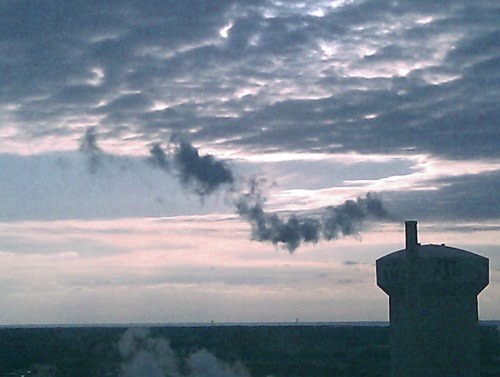
This photo shows the development of a flow instability in an axisymmetric jet. On the left, the jet is smooth and fully laminar, but, by the center of the photo, disturbances in the jet have grown large enough to distort the laminar profile. The jet is then in transition; by the right side of the frame, it has reached a turbulent state, as evidenced by the increased mixing (which causes the smoke to disperse more quickly) and intermittency of the flow. #
Dr. Seussian Mystery Fluid Could Have Saved Top Kill
Dr. Seussian Mystery Fluid Could Have Saved Top Kill
Wired article about using non-Newtonian fluids to plug leaking oil wells as we featured previously.

Reader Question: National Committee for Fluid Mechanics Films
lazenby asks: Have you seen these guys? http://web.mit.edu/hml/ncfmf.html
Yes, absolutely! Those videos, which date from the 1960s, are so useful that they’re still shown to undergraduates today. (Or at least they showed several of them to us when I was junior!) They can seem a bit slow by current standards, but the films are full of great demonstrations of basic fluid mechanics. If the links on that page don’t work (or, if like me, you can’t stream RealPlayer), a lot of the videos can also be found on YouTube by searching for individual titles. The Low Reynolds Number Flow video is one of my favorites because it’s hosted by G. I. Taylor, one of the the most prolific and influential fluid mechanicians of the 20th century.
Flow Visualization
[original media no longer available]
This video gives a neat introduction to some common and uncommon techniques used to visualize fluid flows.

Smokestack Plumes
On a cold and windy day, the plume from a smokestack sometimes sinks downstream of the stack instead of immediately rising (Figure 1). This isn’t an effect of temperature–after all, the exhaust should be warm compared to the ambient, which would make it rise. It’s actually caused by vorticity.

Figure 2: Simple geometry (side view) In Figure 2, we see a simplified geometry. The wind is blowing from right to left, and its velocity varies with height due to the atmospheric boundary layer. Mathematically, vorticity is the curl of the velocity vector, and because we have a velocity gradient, there is positive (counterclockwise) vorticity generated.

Figure 3: Vortex lines (top view) According to Helmholtz, we can imagine this vorticity as a bunch of infinite vortex lines convecting toward the smokestack, shown in Figure 3. Those vortex lines pile up against the windward side of the smokestack–Helmholtz says that vortex lines can’t end in a fluid–and get stretched out in the wake of the stack. If we could stand upstream of the smokestack and look at the caught vortex line, we would see a downward velocity immediately behind the smokestack and an upward velocity to either side of the stack. It’s this downward velocity that pulls the smokestack’s plume downward.

Figure 4: Vortex wrapped around stack Now Helmholtz’s theories actually apply to inviscid flows and the real world has viscosity in it–slight though its effects might be–and that’s why this effect will fade. The vortex lines can’t sit against the smokestack forever; viscosity dissipates them.

Airfoil-shaped Ice
I discovered this interesting bit of icing a couple years ago near the foot of a waterfall in Ithaca, NY. The predominant wind was always heading toward the falls (left to right in these pictures), while the falls were always throwing spray up into the wind. The result was that ice airfoils (center) formed in the wake of each tree branch throughout most of the gorge (top).
Thixotropic and Rheopectic Fluids
There’s more to non-Newtonian fluids than shear-thickening and shear-thinning. The viscosity of some fluids can also change with time under constant shear. A fluid that becomes progressively less viscous when shaken or agitated is called thixotropic. The opposite (and less common) behavior is a fluid that becomes more viscous under constant agitation; this is known as a rheopectic fluid. This video demonstrates both types of fluids using a rotating rod as the agitator. The rheopectic fluid actually appears to climb the rod–similar to the Weissenberg effect–while the thixotropic fluid moves away from the rod.
Liquid Settling
Despite the strange shapes of the arms on this container, the fluid inside will always settle to a common height. This is because each interconnected section is open to the outside air. The fluid’s surface has to reach a static equilibrium with the atmosphere–i.e. the surface of the fluid must be at atmospheric pressure–and the pressure at the lowest level in each section must match because the arms are connected. When fluid is added, the height of the columns oscillates some because the momentum of the added fluid carries the column past its equilibrium position, much like a perturbed mass hanging from a spring will oscillate before settling.
Ants as a Fluid
The collective behavior of ants can mirror the flow of a viscous fluid. It would be interesting to see if any such parallels carry over to the flocking of birds or schooling of fish. The latter two behaviors are thought to increase aero- and hydrodynamic efficiency for the group. #