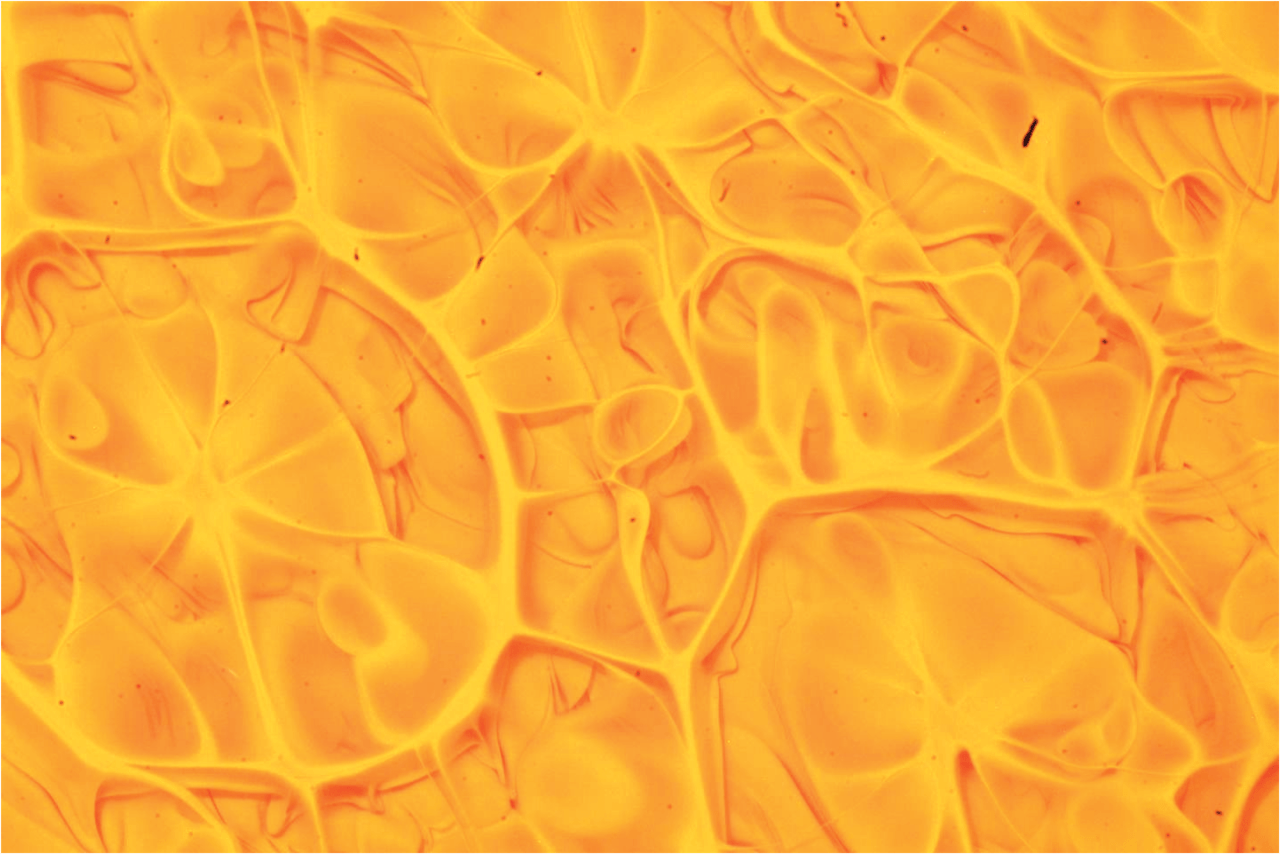
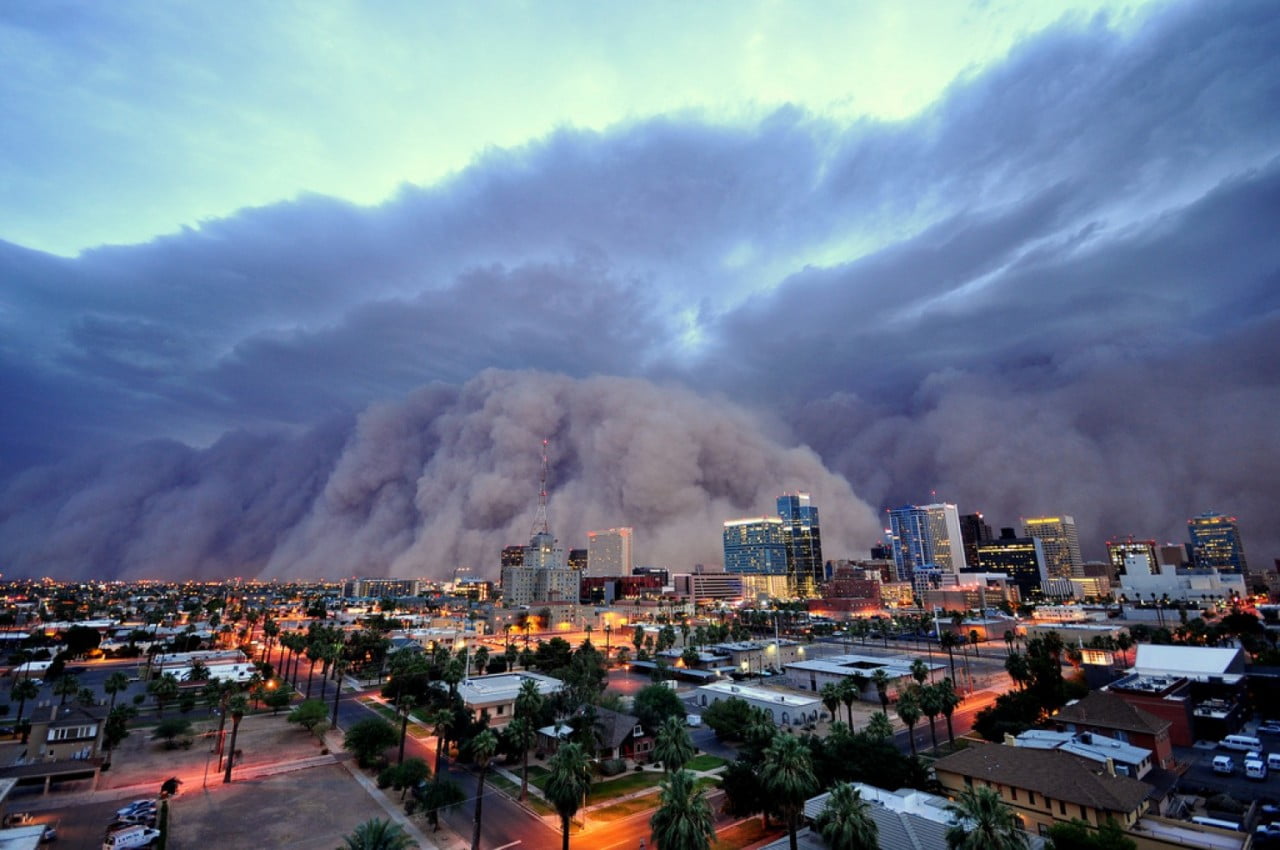
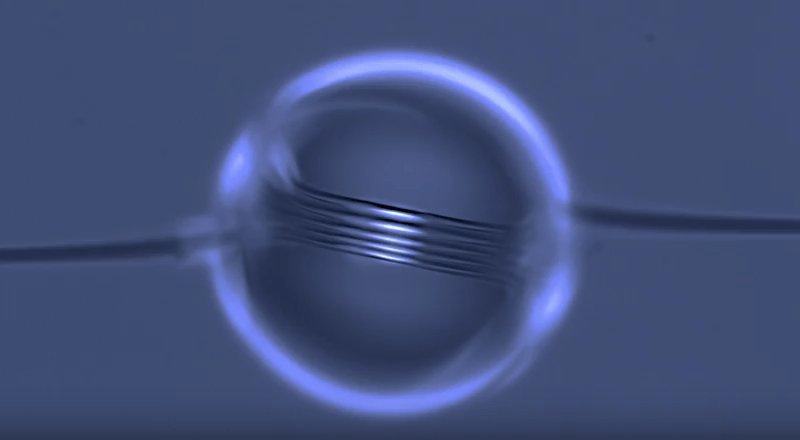
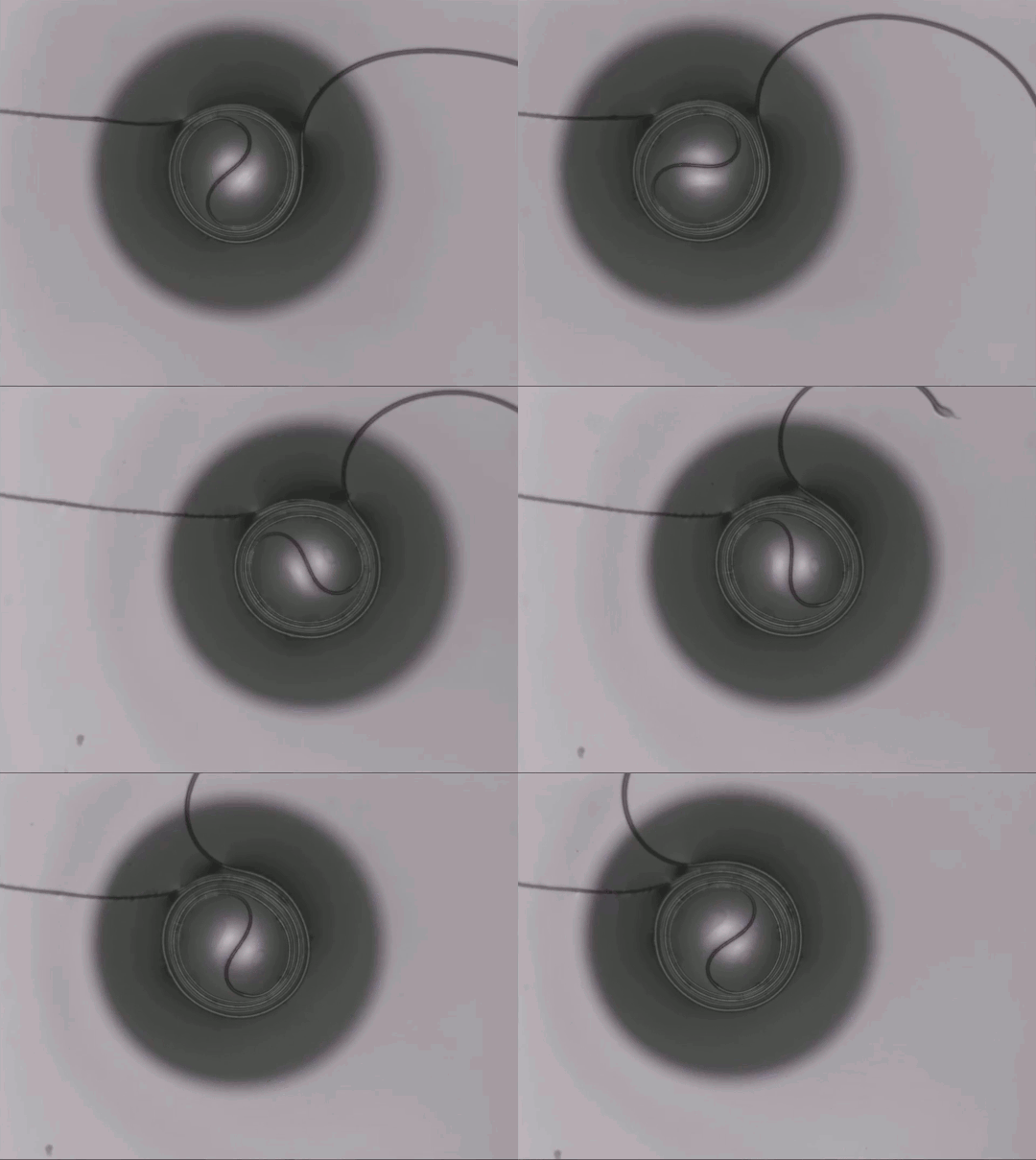
Peering into a vortex feels like staring into an abyss in the Julia Set Collective’s “Gargantua”. Like their previously featured works, this video uses a macro perspective on fluid phenomenon to create an alternate sense of scale. Instead of a whirlpool, we could be observing a wormhole. Part of this is a matter of fooling our brains with perspective, but it also works because, on some level, we recognize that these same fluid patterns occur at very different lengthscales and so it is believable that what we see is much bigger than in reality. (Video credit and submission: S. Bocci/Julia Set Collective)
Tag: fluid dynamics

A Molecular View of Boiling

All matter is made up of molecules. But most of the time we treat fluids as materials with given properties – like density, viscosity, and surface tension – without worrying about the individual molecules responsible for those material characteristics. Now that we have much more powerful computers, though, we can begin to simulate fluid behavior in terms of molecules.
The animations above show some examples of this. In the top animation, we see a gas condensing into a liquid. As the temperature decreases, molecules start clumping together, and eventually settle into a droplet on the solid surface. The lower animation shows the opposite situation – boiling – in which bubbles of vapor nucleate next to the solid surface and grow as more liquid changes phase. To see more examples, including droplets pinching off, check out the full video. (Image credit: E. Smith et al., source; submitted by O. Matar)

Hairy Surfaces Keep Skin Dry
Big animals like whales and sea lions stay warm in cold waters by having thick layers of insulating blubber. But smaller mammals, like beavers and sea otters, have a different mechanism for staying warm – their thick fur traps air near their skin, keeping the cold water at bay. Researchers used flexible, 3D-printed “hairy” surfaces to see how hair density, diving speed, and fluid viscosity affected the amount of air trapped between hairs. This enabled them to build a mathematical model describing the physics, which can now be used to predict, for example, the characteristics needed for a hairy wetsuit that could keep surfers warm in and out of the water. For more on this research check out MIT News’ video, and for a closer look at sea otter fur – not to mention a healthy overdose of pure adorable – check out the video below. (Photo credit: F. Frankel; video credit: Deep Look; research credit: A. Nasto et al.)

Vortex Wake in Quebec
These satellite images show Rupert Bay in northern Quebec. Sediment and tannins have stained the bay’s waters various shades of brown, which helps show the dynamic flows of the area. Rivers empty into the bay, but the tide appears to be coming in from the northwest as well. The flow is just right to create a wake of alternating vortices off a tiny island near the center of the bay. This pattern is known as a von Karman vortex street and often appears in the wake of spheres, cylinders, and, yes, islands. (Image credit: NASA Earth Observatory; submitted by Adam V.)

Crushing Oobleck
Oobleck is probably the Internet’s favorite non-Newtonian fluid. People vibrate it, run across it, shoot it, drop it, and even use it to fix potholes. But how does oobleck hold up to a hydraulic press? Fortunately, that’s been covered, too. Oobleck is a mixture of cornstarch and water, and it’s a bit unusual in that it is a shear-thickening material. That means that the faster you try to deform it, the more it will resist that deformation. Knowing this makes the above video’s results make more sense. When they try to crush the balloon full of oobleck, the deformation happens pretty slowly, so the fluid just flows away.
The same thing happens initially with the pot full of oobleck; it overflows much like any other liquid. But as the press pushes deeper, the oobleck gets confined by the pot’s walls and things change. Research has shown that the shear-thickening of oobleck comes from cornstarch particles jamming up in the fluid. By confining the oobleck, the pot and hydraulic press magnify this jamming effect, causing a spurt of semi-solid cornstarch fingers and leaving the press tool thoroughly trapped by the jammed particles. (Video credit: Hydraulic Press Channel)

Inside a Supernova
During a supernova, shock waves moving outward push denser material into less dense plasma and gas. This causes what is known as a Richtmyer–Meshkov instability, where the interface between the two fluids first becomes wavy and then develops finger-like intrusions. Those too break down, as seen in the simulation above, causing large-scale mixing between the different fluids.
Here on Earth this instability shows up in the process of inertial confinement fusion. In that case, the outer shell material is denser than the fuel core and the instability is triggered during the implosion process. As the fusion material is suddenly compressed, waviness and mixing occurs along the interface between the shell and the fuel. That’s undesirable because it reduces the efficiency of the fusion reaction. (Image credit: E. Evangelista et al.)

Ionic Sound
So, as we learned previously, sound can actually travel through space. But the recordings our spacecraft send us from other planets or from the edge of the Solar System aren’t really that kind of sound. Acoustic waves require a medium; they travel when particles bump into one another, which, given the sparseness of space, means that only very low frequency sounds can travel. But space has a lot of ions and plasmas – charged particles like electrons and protons – and those particles can interact without physically contacting one another. Instead their motion causes a changing magnetic field that affects nearby particles, which in turn affect more particles (and so on). This transmits what’s called ionic sound. Check out the video above to hear some awesome examples of the ionic sounds of our solar system! (Video credit: The Point Studios)

Inside a Cello
At first glance, Adrian Borda’s photograph seems to show an old room. In reality, this is the interior of a cello with light shining through the f-holes. Dust particles in the air trace out pathlines that reveal the turbulent movements of air inside the instrument. Both the camera’s perspective and the visible flow try to trick our minds into seeing something larger than reality. It’s a reminder that the patterns and forms of fluid flow repeat across an enormous range of scales, from millimeters to light-years. (Image credit: A. Borda; via Joseph S./CU Boulder Flow Viz)

Lava Flowing
Lava flows like these Hawaii’an ones are endlessly mesmerizing. This type of flow is gravity-driven; rather than being pushed by explosive pressure, the lava flows under its own weight and that of the lava upstream. In fact, fluid dynamicists refer to this kind of flow as a gravity current, a term also applied to avalanches, turbidity currents, and cold drafts that sneak under your door in the wintertime. How quickly these viscous flows spread depends on factors like the density and viscosity of the lava and on the volume of lava being released at the vent. As the lava cools, its viscosity increases rapidly, and an outer crust can solidify while molten lava continues to flow beneath. Be sure to check out the full video below for even more gorgeous views of lava. (Image/video credit: J. Tarsen, source; via J. Hertzberg)

Fish, Feathers, and Phlegm
Inside Science has a new documentary all about fluid dynamics! It features interviews with five researchers about current work ranging from the physics of surfing to the spreading of diseases. Penguins, sharks, archer fish, 3D printing, and influenza all make an appearance (seriously, fluid dynamics has everything, guys). If you’d like to learn more about some of these topics, I’ve touched on several of them before, including icing, penguin physics, shark skin, archer fish, and disease transmission via droplets. (Video credit: Inside Science/AIP)