Tag: fluid dynamics

  • Fluid Fingers

    Fluid Fingers

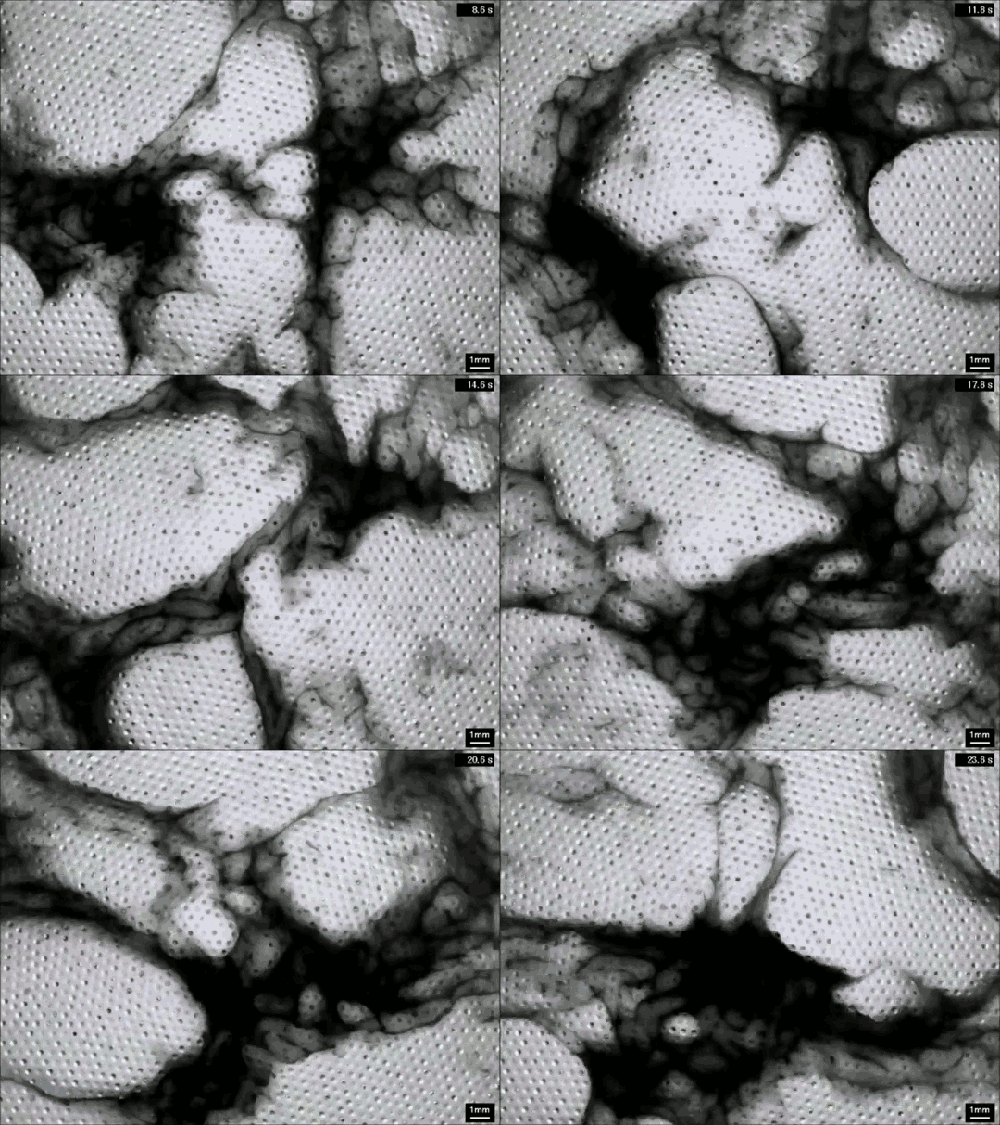
    Fluid phenomena can show up in unexpected places. The collage above shows patterns formed when an aluminum block is lifted during wet sanding, a polishing technique. The dendritic fingers are formed from oil and the slurry of sanded particles being polished away. They are an example of the Saffman-Taylor instability, which forms when less viscous fluids (oil) protrude into a more viscous one (the slurry). Each image contains a different concentration of oil, resulting in very different fingering patterns. (Image credit: D. Lopez)

  • Plesiosaur Swimming

    Plesiosaur Swimming

    Plesiosaurs are marine reptiles that thrived during the Jurassic period and went extinct some 66 million years ago. Since the first discoveries of plesiosaur fossils centuries ago, scientists have debated how the four-limbed creature would have swam. One approach to answering this question is to examine the efficiency of different strokes. Researchers have done this computationally by building a digital plesiosaur with biologically realistic joint motions. They then couple the model plesiosaur’s body motions with the movement of fluid around the body. With this computational model, they then simulate many different methods for moving the plesiosaur’s limbs and search for the most efficient one.

    What they found is that the plesiosaur’s propulsion is dominated by its forelimbs, which likely moved with a flight stroke similar to that of a penguin or sea turtle. Despite their size, the hindlimbs were able to produce very little thrust, suggesting that they were primarily used for stability and maneuverability. (Image credits: S. Liu et al., GIF source)

  • Dripping, Frozen

    Dripping, Frozen

    The simple drip of a faucet is more complicated when frozen in time. Any elongated strand of water tends to break up into droplets due to surface tension and the Plateau-Rayleigh instability. Whenever the radius of the water column shrinks, surface tension tends to drive water away from the narrow region and toward a wider point. This exaggerates the profile, making narrow regions skinnier and wider regions fatter. Eventually, the neck connecting the droplets becomes so thin that it pinches off completely, leaving a string of falling droplets.  (Image credit: N. Sharp)

  • Featured Video Play Icon

    Clogging, In Hourglasses and Crowds

    Hourglasses are pretty common, but you’ve probably never given much thought to the way they flow. An hourglass designer has to carefully select the sizing of the neck and the grains. Choosing a neck that’s too small relative to the grain size will result in frequent clogs but choosing too large a neck will make setting the timing difficult. Interestingly, it doesn’t matter whether the hourglass is filled with air or with water–the same principle holds.

    Where this knowledge becomes especially useful, though, is when dealing with crowds. We’ve all experienced the frustration of being in a large crowd trying to fit through a small exit. Paradoxically, the fastest way to get a large number of particles (or sheep or people) through a narrow opening is to slow each individual down. This can either be done by instructing everyone to slow down or by forcing that same result by placing an obstacle immediately before the exit. The reduction in speed reduces clogging, which means everyone gets through faster! (Video credit: A. Marin et al.)

  • Frost Spreading

    Frost Spreading

    Frost typically forms when supercooled droplets of water scattered across a surface freeze together. The freezing spreads via tiny ice bridges that link droplets together into a frozen network. The animation above shows this process in action. Freezing starts in a droplet off-screen on the right and quickly spreads. Watch carefully, and you can see the ice bridges growing toward the unfrozen droplets. This is because the ice bridges are fed by water vapor evaporating from the droplets. If one can spread the droplets far enough from one another, it’s possible for a droplet to evaporate completely before the ice bridge reaches it, thereby disrupting the spread of frost.  (Video credit: J. Boreyko et al.; research paper)

  • Featured Video Play Icon

    Researching Wind Turbines

    Two of the most awesome things (in my admittedly biased opinion) about fluid dynamics are the amazing facilities we build for experiments and the tests they allow us to do. In this video, you get a behind-the-scenes look at one such facility, used for wind turbine research at Princeton.

    One challenge of wind turbine research is accurately capturing the aerodynamic effects of full-scale wind turbines in the controlled-environment of a laboratory. At Princeton, they match conditions between their model turbines and the real ones by drastically raising the density in their wind tunnel. This means that running the tunnel requires a series of compressors and storage tanks full of compressed air, and it also means that the wind tunnel itself has to be quite hefty to handle the pressure difference inside and out. Definitely check out the full video for more on their wind tunnel and what it can help them learn about wind turbines. (Video credit: M. Miller and J. Keifer; submitted by M. Miller)

  • Spore Squirting

    Spore Squirting

    The fungus Pilobolus spreads its spores with a squirt cannon. Each spore sits on the end of a round fluid-filled pod. Like many plants, the fungus uses a process called osmosis to pump water into the pod. Through osmosis, the fungus increases the concentration of certain molecules inside the pod, which draws water into the pod and increases its pressure. Eventually, the pod ruptures, sending the spore aloft on a jet of fluid that accelerates it at 20,000+g! (Image credit: BBC Earth Unplugged, source; research credit: L. Yafetto et al.)

  • Featured Video Play Icon

    Underwater Explosions in Slow Mo

    The Slow Mo Guys bring their high-speed skills to underwater explosions in this new video. The physics of such explosions is very neat (but also incredibly destructive). When the fuse ignites, a blast wave travels outward in a sphere, creating a bubble filled with gas. Eventually, the pressure of the surrounding water is too great for the bubble to expand against. When its expansion slows, that much larger pressure from the surrounding water starts to crush the bubble back down. Decreasing the volume of the bubble raises its pressure and its temperature again, and this often reignites any leftover fuel and oxidizer left in the bubble. The secondary shock bubble will re-expand, kicking off another round of expansion and collapse. (Video credit: The Slow Mo Guys; submitted by potato-with-a-moustache)

  • Hummingbird Drinking

    Hummingbird Drinking

    Hummingbirds are master acrobats, able to hover and drink simultaneously before flitting off to the next flower. At first glance, you might expect that their tongues are simply tiny straws that use surface tension and capillary action to draw up nectar. But it turns out that process is just too slow for the fast-paced birds.

    Instead, hummingbirds use a forked tongue with a long groove on either half. When the hummingbird extends its tongue, its beak compresses the grooves and squeezes them together. Once the tongue reaches nectar, the grooves expand, which draws nectar up along the full length of the tongue grooves. This allows the bird to fill its tongue much faster than it could otherwise, enabling the hummingbird to lick up nectar more than 10 times a second.

    There’s a neat excerpt from a documentary including this research over here (Tumblr won’t allow the embedded version); the full documentary premieres today on PBS. (Image credits: A. Rico-Guevara et al., sources 1,2; submitted by mypronounsareherrchancellor)

  • Floating on a Granular Raft

    Floating on a Granular Raft

    A thin layer of hydrophobic particles dispersed at an oil-water interface is strong enough to prevent a water droplet from coalescing. The researchers refer to this set-up as their granular raft. As the red-dyed water droplet gets larger (top row), it deforms the raft more and more, but the grains continue to keep the drop separate from the fluid beneath (middle row). When water is removed from the droplet, wrinkles form on the raft as the drop’s volume shrinks. This is because the contact line – where the droplet, grains, and air meet – is pinned. The grains already touching the drop are held there by adhesion. But since the drop is shrinking, the area on the raft has to shrink, too – thus wrinkles! (Photo credits: E. Jambon-Puillet and S. Protiere, original)