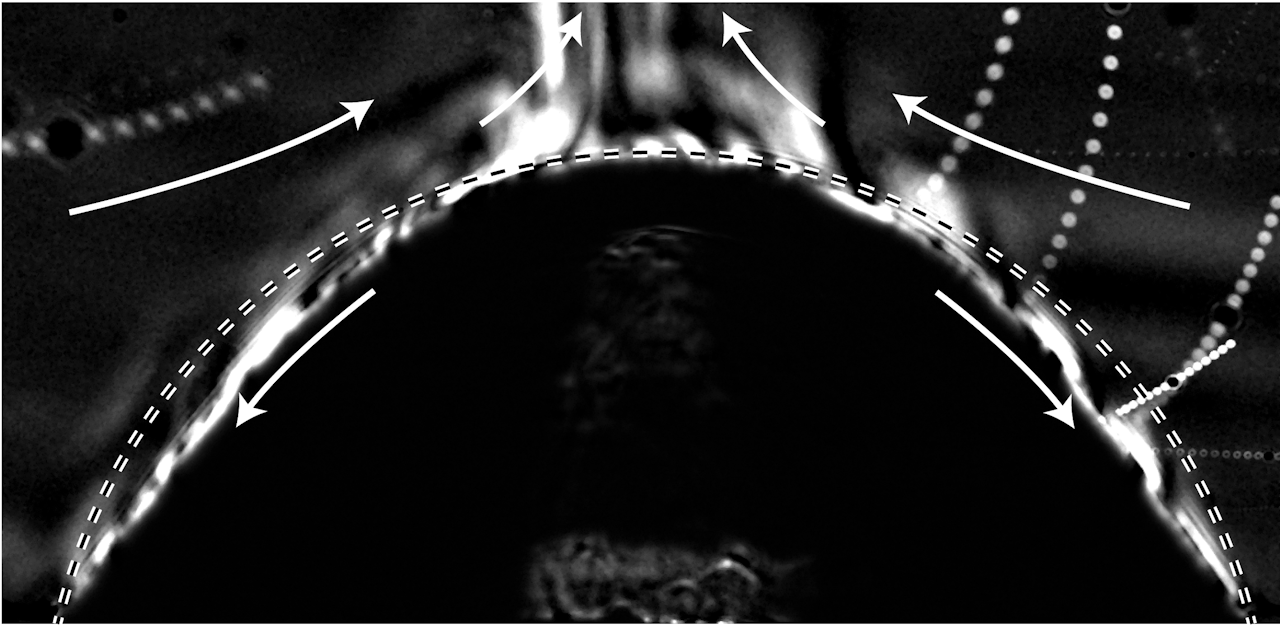
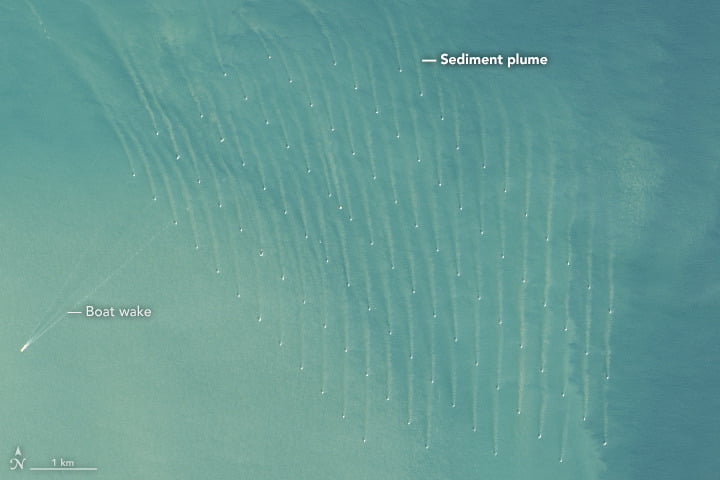
Playing with a vortex cannon is a ton of fun, and they are remarkably easy to make. You can knock over cups or card houses, create art, or just try your best Big Bad Wolf impression. Or you can supersize things like one group in the Czech Republic did and build a 3m vortex cannon capable of firing 100m! (Seriously, watch it in action here.) And if you’d like to learn more about how vortex rings form and why they’re useful in nature and engineering, check out my vortex ring video. (Image credit: Laborky Cz, source; via Gizmodo)
Tag: fluid dynamics

Making Droplets
If you’ve ever wondered how fluid dynamicists create those tiny perpetually bouncing droplets they study, wonder no further. A typical method, shown here, is to use a simple toothpick. First, you take a shallow container of silicone oil and vibrate it vertically. Then you dip the tip of the toothpick into the oil and pull it out, stretching the oil into a long filament. When it detaches from the toothpick, a droplet will start to form at the tip of the filament as it falls back toward the pool. But the bouncing of the surface is enough to keep the new drop from coalescing back into the pool, leaving the little drop to bounce along on its liquid trampoline. (Image credit: S. Lapointe)

The Law of Urination
Tonight is the 26th Ig Nobel Prize ceremony. As I’ve covered previously, the subject of fluid dynamics has been quite successful at winning these awards designed to “make people LAUGH, then THINK,” and last year’s ceremony was no exception. Georgia Tech researchers won the Physics Prize last year for explaining why mammals of very different sizes all urinate for roughly 21 seconds.
Urination is a gravity-driven process, and larger animals have longer urethras, which means that gravity will have more time to accelerate fluid flowing from the the bladder to, well, the exit. Thus, larger animals will have higher flow rates. This allows them to empty their bigger bladders in essentially the same amount of time as a smaller animal. Recognizing this pattern can be helpful to both veterinarians diagnosing problems in animals and to engineers designing systems to move fluids efficiently.
There’s no way to know whether fluid dynamics will win another Ig Nobel Prize tonight, but I can guarantee that subject will come up. I’ll be giving a 24/7 lecture on Fluid Dynamics during tonight’s Ig Nobel Prize ceremony. You can see me – and find out this year’s winners – by watching the ceremony webcast here starting at 5:40pm EDT. (Video credit: DNews; research credit: P. Yang et al.)

Jovian Poles
We’re used to viewing Jupiter from its equator, where bands of light and dark clouds dominate the picture. From its poles, Jupiter looks very different, as these recent images from Juno show. Jupiter’s north pole is shown on the left and its south pole on the right. Both are awash in vortices. There’s another great black-and-white image of the south pole here, where the vortices really stand out. Jupiter’s atmosphere contains both cyclones, which rotate counterclockwise in the northern hemisphere and clockwise in the southern hemisphere, and anticyclones, which behave in the reverse. Unlike in Earth’s atmosphere, anticyclones dominate on Jupiter, especially among storms more than 2000 km across. (Image credit: NASA/JPL/Juno Mission; via APOD)
P.S. – Tomorrow night is the Ig Nobel Prize Ceremony, and I’ll be giving one of their 24/7 lectures. If you’d like to tune in and hear me describe fluid dynamics in 24 seconds + 7 words, there will be a webcast here.

Soap Film Turbulence
The brilliant colors of a soap film reveal the fluid’s thickness, thanks to a process known as thin film interference. The twisting flow of the film depends on many influences: gravity pulls down on the liquid and tends to make it drain away; evaporation steals fluid from the film; local air currents can push or pull the film; and the variation in the concentration of molecules – specifically the surfactants that stabilize the film – will change the local surface tension, causing flow via the Marangoni effect. Together these and other effects create the dancing turbulence captured above. (Video credit: A. Filipowicz)

Inside a Humidifier
After this, you may never look at a humidifier the same way again. Ultrasonic humidifiers generate tiny droplets using piezoelectric transducers. When the humidifier is on, the ultrasonic vibrations of the piezoelectric transducer create a pressure wave that forces the water above into a hill with a string of liquid droplets extending upward. For a sense of the scale, the gray bars shown in each image above represent 1mm. The super-fine droplets the humidifier produces come from cavitation of these larger drops, as shown in image c). Image d) shows snapshots of the formation of the droplet string over a matter of milliseconds. (Image credit: S. J. Kim et al., original poster)

Shark Tooth Instability
Imagine that you partially fill a horizontal cylinder with a viscous fluid, like corn syrup or honey. If that cylinder is still, the fluid will simply pool along the bottom. On the opposite extreme, if you spin it very fast, that cylinder will become coated in an even layer of fluid that rotates along with the cylinder thanks to centrifugal force. Between those two extremes in rotational velocity, some interesting fluid behaviors occur. Start spinning the cylinder and some of the pooled fluid will be pulled up the sides, eventually forming a thicker film with a straight front along the bottom of the cylinder. Spin faster and that straight front starts to break down, forming sharper cusp-like waves known as shark teeth. (Image credit: S. Morris et al., source; research credit: S. Thoroddsen and L. Mahadevan)

Fog Over Marin
Fog rolls over the hills of Marin County in this long-exposure photograph by Lorenzo Montezemolo. One of the most beautiful aspects of fluid dynamics is the way the same patterns and forms show up across situations. The slow flow of fog over hills in moonlight can echo the blurring speed of rivers pouring over a rocky streambed. Despite the differences in speed, lengthscale, and fluid, the physics remain the same. (Photo credit: L. Montezemolo; via Colossal)

Shear Across the Water
This photo series shows the development of a Kelvin-Helmholtz instability. It’s formed when two layers of fluid move past one another at different speeds. In this case, the two fluids meet off the back of a flat plate (seen at the left of the top image) when fast-moving flow from the top of the plate encounters slower fluid beneath. Friction and shear between the fluid layers causes billows to rise up and form waves very similar to those on the ocean (wind across the water works the same way!). Those waves turn over into vortex-like spirals and keep mixing until they break down into turbulence. This pattern crops up pretty frequently, especially in clouds. (Image credit: G. Lawrence)

Droplet Bounce
Water droplets don’t always immediately disappear into a pool they’re dropped onto. If the droplet is small and doesn’t have much momentum, it will join the pool gradually through a process known as the coalescence cascade, seen here in high speed video. The droplet bounces off the surface, then settles. A thin layer of air is caught between it and the pool. Slowly the weight of the drop pushes that air out until there is contact between the drop and pool. Before the drop can merge completely, though, surface tension pinches it off, creating a smaller daughter droplet. Ripples caused by the merger help bounce the little droplet, which repeats the same process until the tiniest droplet merges completely. (Video credit: B. ter Huume)