Tag: fluid dynamics

  • Droplets on Inclined Walls

    Droplets on Inclined Walls

    When a droplet impacts an inclined surface, it spreads asymmetrically. The splash shape is largely elliptical, as researchers found when modeling such impacts over a range of inclination angles. Understanding such splash patterns is important not only for industrial applications like printing but in areas like forensic science. (Image and research credit: P. García-Geijo et al.)

  • Featured Video Play Icon

    A Primer on Blood Pressure

    Some of the most important fluid dynamics goes on every moment inside our bodies. After only a few weeks of gestation, the human heart begins its lifelong task of pumping blood throughout tens of thousands of kilometers’ worth of blood vessels. One of our simplest methods for tracking the health of this critical system is a person’s blood pressure, which measures the forces exerted on our blood vessels as our hearts pump. This video gives a brief primer on blood pressure as well as some of the problems that arise when extended bouts of high blood pressure damage our blood vessels. (Image and video credit: TED-Ed)

  • Freezing Splats

    Freezing Splats

    When a drop hits a surface colder than its freezing point, there’s a competition between retraction and solidification that determines the final shape of the splat. For many materials, like wax or soldering metals, the contact angle between their liquid and solid phase is zero, so there’s no major shape change once solidification begins. But water — as is so often the case — is an exception.

    Water and ice have a non-zero contact angle, which means that retraction can continue even after the drop begins freezing. As a result, the final shape of the splat varies depending on how cold the surface is. For a surface only a little colder than the freezing point, the final splat forms a spherical cap (Image 1). But once the surface is colder, freezing happens before the water can fully retract and the final splat forms a ring (Image 2). (Image and research credit: V. Thiévenaz et al.)

  • Coffee, Magnified

    Coffee, Magnified

    Sometimes it’s nice to see a new perspective on something familiar. These images show oils from coffee beans suspended in hot water, as seen under 40x magnification. The crystals you see are caffeine and the variety of shapes in the oil blobs is due to being sandwiched between two layers of glass. You can check out an image of the set-up these students used here. (Image credits: M. Armstrong and B. Pullutasig)

    Coffee oils suspended in hot water.
  • A Colorful Portrait of Flow

    A Colorful Portrait of Flow

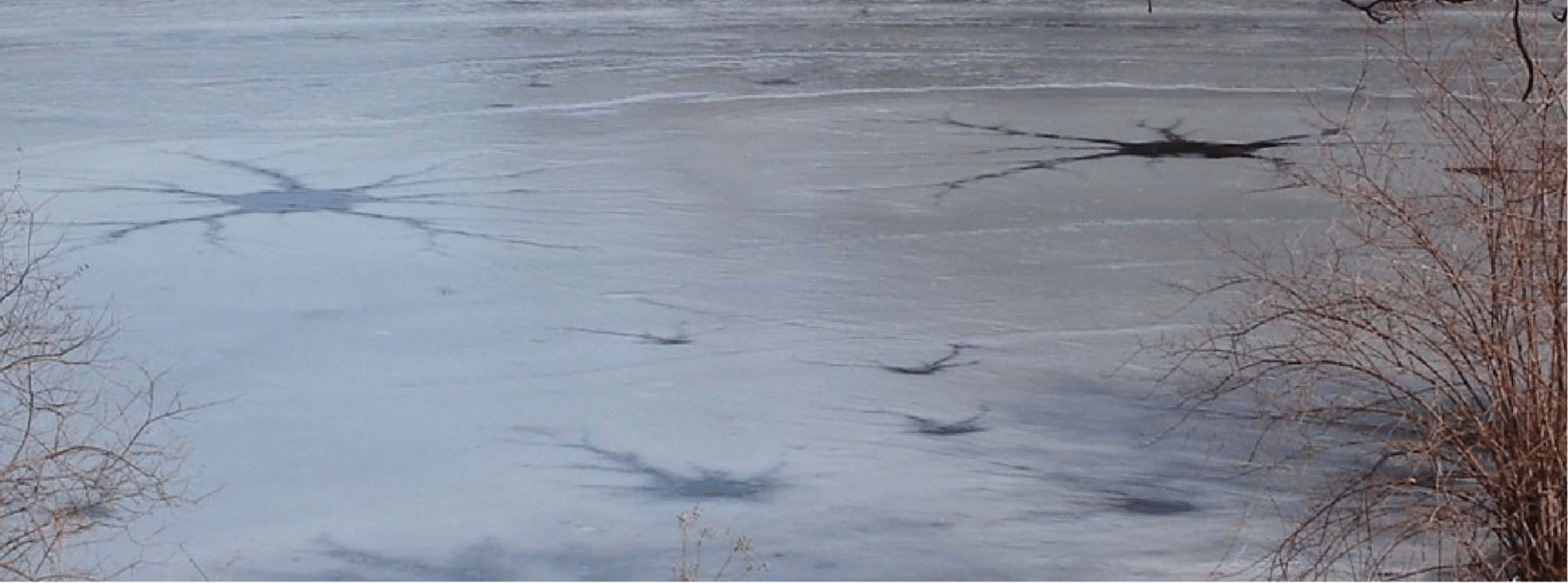
    This gorgeous, natural-color image shows Lake Balkhash in southeastern Kazakhstan. In early March, the ice on the lake was beginning to break up, revealing glimpses of swirling sediment below the water’s surface. In contrast, the smaller lakes and ponds of the surrounding area remained frozen amidst the wintery browns of the nearby desert and wetlands. (Image credit: J. Stevens/USGS; via NASA Earth Observatory)

  • Vortex Rings on V-Shaped Walls

    Vortex Rings on V-Shaped Walls

    Vortex ring impacts are eternally fascinating. Here, researchers explore what happens when a vortex ring encounters a V-shaped wall. Because the outer portions of the vortex ring hit the wall sooner than the inner ones, distortions begin there first.

    The vortex’s approach creates a pressure gradient that causes flow near the wall to separate, generating that first little hook in each arm of the vortex. Next, secondary vortices develop on either side and quickly get pulled into the original vortex. The whole process repeats a second time to generate tertiary vortices that continue the inward spiral. The impact appears even more complicated when viewed from the side of the valley (Image 2). Check out Image 3 for a point-by-point breakdown of the impact process. (Image and research credit: T. New et al.)

  • Featured Video Play Icon

    Self-Started Siphoning

    Here’s a fun activity you can do while you #StayHome: build a self-starting siphon. Michael from VSauce explains how in this video. Moving fluids from one location to another is almost always about pressure, and a siphon is no different. To get the water to flow, there must be unequal pressures driving the liquid to move from high pressure to lower pressure. This is the basic physics behind any siphon; the fun of a self-starting siphon comes from generating enough pressure imbalance to start flow without applying suction. (Video credit: D!NG/M. Stevens)

  • Lava Barriers

    Lava Barriers

    Inspired by protecting people and property from lava flows, researchers investigated how viscous fluids flow downhill past large obstacles. As seen above, when the obstacle is tall enough that the flow does not overtop it, there’s substantial deflection of the fluid both up- and downstream. Upstream of the barrier, the flow gets deeper, and downstream there’s a dry region left behind.

    The researchers modeled these flows numerically, leading to equations designers can use to predict the necessary height, strength, and shape of barrier necessary to protect areas from encroaching lava. (Image and research credit: E. Hinton et al.)

  • Featured Video Play Icon

    The Great Haboob Chase

    Few sights look as apocalyptic as the leading edge of an incoming dust storm. Known as a haboob, these storms form when a downdraft spreads along the ground, picking up loose dust as the storm front advances. Winds inside the haboob can be severe; when one swept through Denver last year, my first clue was the trees outside my window whipping back and forth wildly, followed by the sky going dark and brownish. Photographer Mike Olbinksi’s short film offers a far better vantage, letting viewers appreciate the towering cloud as it bears down. (Video and image credit: M. Olbinski)

  • Stratospheric Effects of Wildfires

    Stratospheric Effects of Wildfires

    Australia’s bushfires from earlier this year are offering new insights into how pyrocumulonimbus clouds can affect our stratosphere. A massive, uncontrolled blaze between December 29th and January 4th generated a towering, turbulent cloud of smoke like the one shown above.

    Using meteorological data, a new study shows this enormous cloud initially rose to 16 km in altitude, then began a months-long trek that circled the globe. The smoke plume ultimately stretched to over 1,000 km wide and reached a record altitude of over 31 km. Inside the plume, concentrations of water vapor and carbon monoxide were several hundred percent higher than normal stratospheric air.

    Researchers found the plume extremely slow to dissipate, possibly due to strong rotational winds surrounding it. This is the first time scientists have observed these shielding winds, and work is still underway to determine how and why they formed. (Image credit: M. Macleod/Wikimedia Commons; research credit: G. Kablick III et al.; via Science News; submitted by Kam-Yung Soh)